
Explore Torricelli’s Theorem in fluid dynamics, its applications, limitations, and modern adaptations in engineering and environmental science.
Torricelli’s Theorem: Understanding Fluid Exit Speed and Dynamics
Evangelista Torricelli, an Italian physicist and mathematician, is renowned for his 1643 discovery of the principle now known as Torricelli’s Theorem. This theorem plays a crucial role in the field of fluid dynamics, providing insights into the behavior of fluids under the influence of gravity.
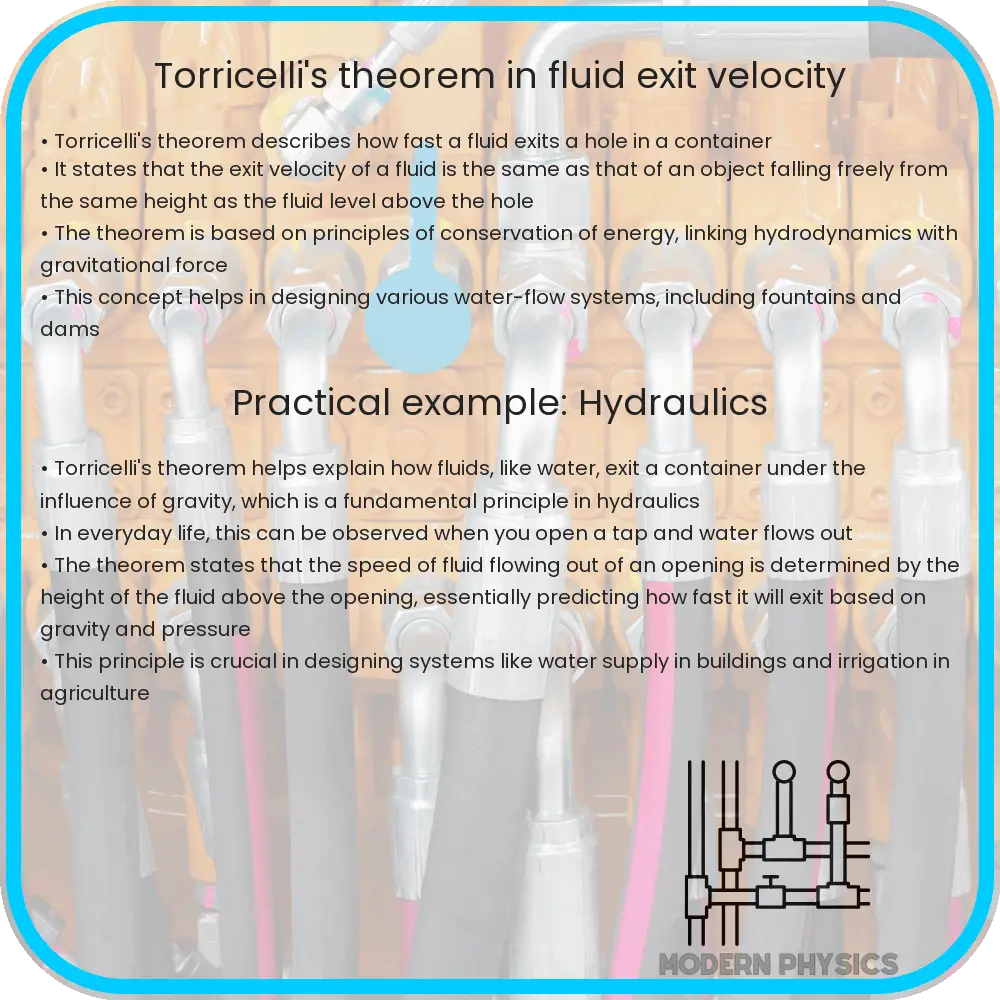
At its core, Torricelli’s Theorem states that the speed (v) of a fluid flowing out of an orifice under the force of gravity is equivalent to that which a freely falling body would achieve after descending from a height equal to the fluid’s surface above the opening. Mathematically, it is expressed as:
v = √(2gh)
Where v is the exit speed of the fluid, g is the acceleration due to gravity (approximately 9.81 m/s2 on Earth), and h is the height of the fluid column above the orifice.
Applications in Various Fields
The applications of Torricelli’s Theorem are vast and diverse. In engineering, it is used to design spillways for dams, ensuring safe and controlled release of water. In the field of hydrology, it assists in calculating the discharge from water bodies, aiding in flood prediction and water resource management. Additionally, this theorem finds its use in everyday objects like garden hoses and fire extinguishers, where understanding the exit speed of fluids is essential for optimal design and functionality.
Laws Governing Fluid Exit Speed
Torricelli’s discovery is intrinsically linked with the principles of fluid dynamics, particularly Bernoulli’s principle, which states that an increase in the speed of a fluid occurs simultaneously with a decrease in pressure or a decrease in the fluid’s potential energy. This relationship is pivotal in understanding the dynamics of fluid flow, especially in systems where fluids move through varying cross-sectional areas.
Moreover, the theorem is an application of the conservation of energy principle. It considers that the potential energy of the fluid at height h is converted into kinetic energy as it exits the orifice. This conversion underpins the theorem’s ability to predict the exit speed of the fluid.
Deeper Insights into Torricelli’s Theorem
The practicality of Torricelli’s Theorem extends beyond its basic formula. In real-world scenarios, factors such as fluid viscosity, orifice shape, and air resistance can influence the actual exit speed. For instance, in viscous fluids, internal friction can reduce the speed of outflow, deviating from the idealized predictions of the theorem. Similarly, the shape of the orifice can create varying flow patterns, affecting the exit speed and direction of the fluid.
Another aspect to consider is the impact of atmospheric pressure. In Torricelli’s original experiments, he noted that atmospheric pressure plays a role in sustaining the column of fluid, an observation that led to the development of the barometer. This correlation between fluid dynamics and atmospheric science underscores the multifaceted implications of the theorem.
Limitations and Modern Adaptations
While Torricelli’s Theorem provides a fundamental understanding of fluid exit speeds, it has its limitations. It assumes an ideal fluid (non-viscous, incompressible, and lacking turbulence) and neglects factors like air resistance and orifice edge effects. In complex systems, such as high-speed jets or turbulent flows, additional considerations and modifications to the theorem are necessary for accurate predictions.
Modern fluid dynamics often uses computational fluid dynamics (CFD) simulations, which can model the complexities of real fluid flows more accurately. These simulations take into account the various factors that Torricelli’s Theorem simplifies or omits, offering a more comprehensive understanding of fluid behavior in diverse applications.
Conclusion
Torricelli’s Theorem, despite its simplicity, offers a profound insight into the behavior of fluids under gravity. Its applications span across multiple fields, from engineering to environmental science. While its assumptions limit its accuracy in complex scenarios, the theorem remains a cornerstone in the study of fluid dynamics. It not only serves as a fundamental teaching tool in physics and engineering but also continues to inspire modern advancements in fluid mechanics. As we delve deeper into understanding fluid behavior, Torricelli’s principle remains a testament to the timeless relevance of classical physics in our ever-evolving scientific landscape.