
Explore the origins, effects, and detection methods of topological defects in astrophysics, and understand their significance in the cosmos.
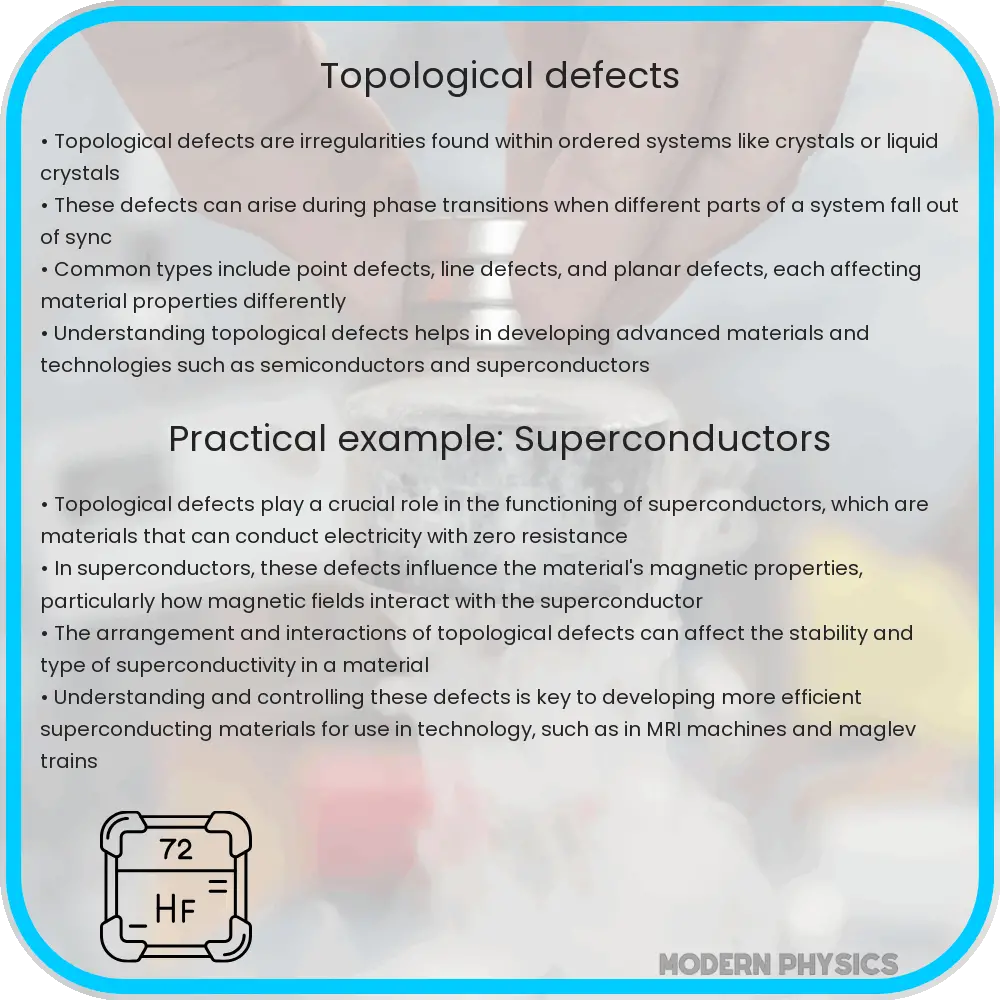
Introduction to Topological Defects in Astrophysics
Topological defects play a critical role in the field of astrophysics, providing insights into the early universe’s conditions and the fundamental structures of matter. These defects arise from phase transitions in the early universe, leading to the formation of stable, non-trivial structures in the cosmic fabric. Understanding these defects not only sheds light on the universe’s formation and evolution but also helps in exploring the unification of fundamental forces and the nature of dark matter.
Origins of Topological Defects
The origins of topological defects lie in the concept of symmetry breaking in quantum field theory, akin to the way crystals form in a cooling liquid. During the universe’s early stages, it underwent several phase transitions, similar to water turning into ice. These transitions, occurring under different temperature and energy conditions, led to the breaking of symmetrical states and the creation of defects at the points of instability. The types of defects formed depend on the nature of the symmetry broken and include monopoles, cosmic strings, and domain walls.
Effects of Topological Defects
Topological defects have profound implications in cosmology and astrophysics. Cosmic strings, for example, can act as seeds for the formation of galaxies and influence the Cosmic Microwave Background (CMB) radiation. The gravitational effects of these strings could bend light and create observable patterns in the CMB, providing a unique window into the early universe. Similarly, the existence of monopoles and domain walls can offer critical tests for theories of grand unification and the fundamental forces of nature.
Detection of Topological Defects
Detecting topological defects involves a range of astronomical observations and experiments. Cosmic strings, being one-dimensional defects, could be identified through gravitational lensing effects or imprints on the CMB. The search for magnetic monopoles, although more elusive, continues through particle physics experiments and cosmic ray observations. Advanced detection techniques and increased sensitivity of astronomical instruments are paving the way for the potential discovery of these enigmatic features.
Challenges in Studying Topological Defects
Despite their significant implications, studying topological defects presents considerable challenges. The primary difficulty lies in the sheer scale and energy levels at which these defects operate, often far beyond current experimental reach. Additionally, the indirect nature of potential evidence requires careful interpretation and validation, making definitive conclusions elusive. Advances in technology and methodology, however, are gradually overcoming these obstacles, enabling more precise measurements and simulations.
Future Prospects in the Detection and Study of Topological Defects
The future of topological defects in astrophysics is promising, driven by rapid advancements in observational techniques and theoretical models. Upcoming space missions and ground-based telescopes are expected to provide higher resolution data, potentially uncovering signatures of topological defects. Furthermore, interdisciplinary approaches, combining particle physics, cosmology, and astrophysics, are enhancing our understanding of the universe’s fundamental properties and its early stages of development.
Conclusion
Topological defects offer a unique perspective on the universe’s history, structure, and fundamental physical laws. While challenges remain in their detection and interpretation, the potential rewards are significant, offering insights into the early universe, the nature of matter, and the forces that shape our cosmos. As observational techniques improve and theoretical frameworks evolve, the study of topological defects stands at the forefront of unraveling the mysteries of the universe, promising new discoveries and deeper understanding in the years to come.