
Explore the fusion of science and art in time-space visualization, focusing on clarity, precision, and relativity in understanding the universe.
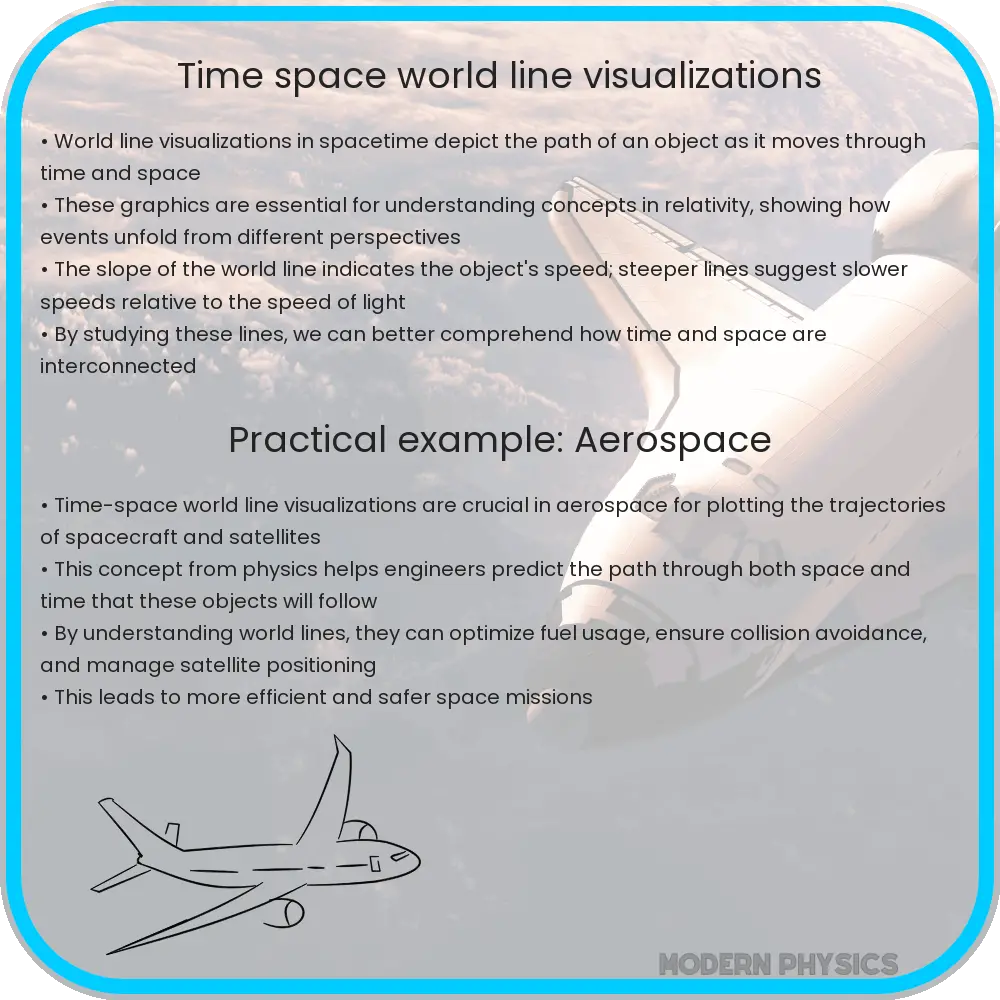
Understanding Time-Space Visualizations: Clarity, Precision, and Relativity
The concept of time-space visualization is an intriguing and complex field that intertwines various aspects of physics, mathematics, and visual arts. This multidisciplinary approach allows for a deeper understanding of how we perceive and interact with the dimensions of time and space. In this article, we delve into the principles of clarity, precision, and relativity in time-space visualizations, exploring how they contribute to our comprehension of the universe and its intricate workings.
Clarity in Time-Space Visualizations
Clarity in time-space visualization refers to the ability to represent complex scientific concepts in an understandable and accessible manner. This is particularly crucial when dealing with abstract notions such as the fourth dimension or the curvature of space-time. A clear visualization helps bridge the gap between advanced theoretical physics and public understanding. Tools like 3D models, animations, and interactive simulations play a vital role in achieving this clarity.
Precision in Representing Time and Space
Precision is paramount when visualizing time and space. The accuracy of these visualizations impacts not only educational and scientific communication but also practical applications in fields like astrophysics and engineering. For instance, precise models of gravitational waves or the expansion of the universe provide invaluable insights into cosmological phenomena. The mathematical rigor behind these visualizations ensures that they are more than just artistic interpretations, but accurate reflections of scientific data.
Relativity and Its Visual Interpretations
Albert Einstein’s theory of relativity revolutionized our understanding of time and space. Visualizing these concepts requires a creative approach to illustrate how time and space are relative and not absolute entities. Demonstrating the effects of gravity on space-time or the dilation of time at near-light speeds can be challenging. Utilizing dynamic visual aids, such as warped grid patterns or light cone diagrams, helps in conveying these complex ideas effectively.
In summary, time-space visualizations, through the lenses of clarity, precision, and relativity, offer us a unique window into the profound aspects of our universe. These visual tools not only enhance our understanding but also stimulate curiosity and awe towards the mysteries of space and time. As we continue to explore this fascinating topic, we will uncover more about the universe we inhabit and our place within it.
Advancements in Time-Space Visualization Technologies
Recent technological advancements have significantly enhanced our ability to visualize time and space. Virtual reality (VR) and augmented reality (AR) technologies, for example, offer immersive experiences that bring abstract scientific concepts to life. Users can virtually navigate through a 3D representation of the universe, experiencing the warping of space-time or the complexities of black holes firsthand. These technologies not only aid in scientific research but also make learning more interactive and engaging for students and enthusiasts alike.
Time-Space Visualization in Practical Applications
Beyond theoretical understanding, time-space visualizations have practical applications in various fields. In navigation and space exploration, accurate models of space-time are crucial for calculating trajectories of satellites and spacecraft. Similarly, in telecommunications, understanding the relativity of time is essential for the synchronization of GPS systems. These applications demonstrate how theoretical concepts have real-world implications and utility.
The Role of Artistic Interpretation
While scientific accuracy is crucial, artistic interpretation also plays a significant role in time-space visualizations. Artists often collaborate with scientists to create representations that are not only precise but also aesthetically compelling. These artistic renditions can make complex ideas more relatable and inspire a wider audience to engage with scientific concepts, thus fostering a broader appreciation of science.
Conclusion
In conclusion, the visualization of time and space is a field that beautifully merges science, technology, and art. Clarity, precision, and relativity are key principles that guide the creation of these visualizations, each playing a vital role in enhancing our understanding of the universe. The advancements in technology, such as VR and AR, have opened new frontiers in how we perceive and interact with these concepts. Practical applications in navigation, space exploration, and telecommunications underscore the real-world significance of these visualizations. Lastly, the collaboration between scientists and artists in this domain not only ensures accuracy but also adds a layer of creativity, making the complex beauty of our universe accessible and engaging to all. As we continue to explore and visualize the intricacies of time and space, we deepen our comprehension of the cosmos and our place within it, continually pushing the boundaries of knowledge and imagination.
Is this conversation helpful so far?