
Explore the mysteries of Thorne-Zytkow Objects (TZOs), rare celestial phenomena where neutron stars merge with red supergiants, challenging our understanding of stellar evolution.
Unveiling the Mysteries of Thorne-Zytkow Objects
Thorne-Zytkow Objects (TZOs) represent one of the most fascinating and enigmatic phenomena in the cosmos, merging the life cycles of stars with the boundaries of theoretical astrophysics. First proposed in the 1970s by Kip Thorne and Anna Żytkow, TZOs are a speculative class of stars that challenge our understanding of stellar evolution and composition.
Formation and Characteristics
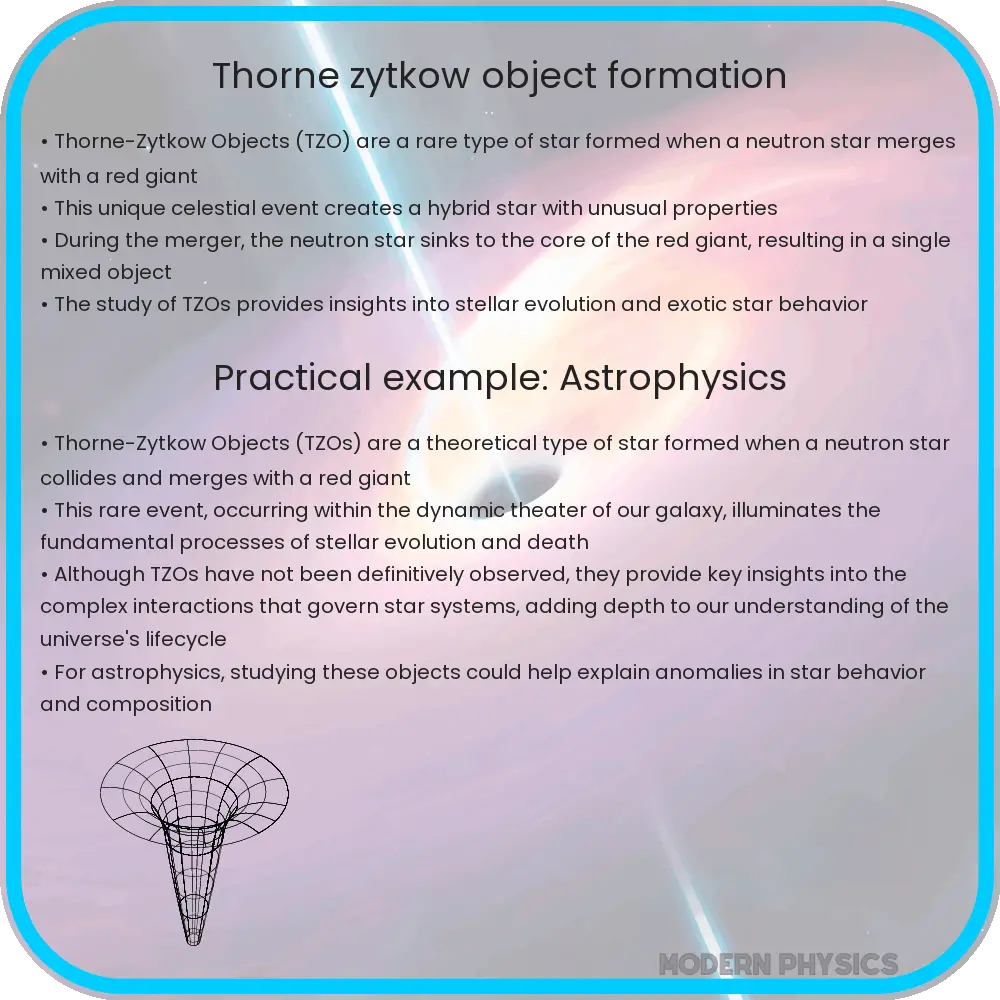
The formation of a Thorne-Zytkow Object begins with a rare celestial dance between two massive stars: a neutron star and a red supergiant. In this cosmic ballet, the neutron star, a dense remnant of a supernova explosion, spirals into the core of the supergiant. This merger results in a unique stellar hybrid, characterized by a neutron star core enveloped by a thick layer of gaseous material from the supergiant.
The theoretical structure of TZOs offers a peculiar blend of features from both parent stars. Within these stellar anomalies, the conditions are ripe for unusual nuclear reactions. These reactions are distinct from those found in typical stars, leading to the production of exotic and heavy elements. Scientists speculate that within a TZO, elements heavier than iron, such as rubidium, strontium, and zirconium, can form through a process known as the “s-process,” where slow neutron capture occurs at relatively low energies.
Mysteries and Observational Challenges
Detecting a TZO presents significant observational challenges due to their elusive nature and the rarity of their formation. To date, no definitive TZO has been identified, and their existence remains theoretical. Astronomers hunt for TZOs by looking for peculiar chemical signatures in the spectra of red supergiants, which might indicate the presence of a neutron star core. Yet, these signatures can be maddeningly subtle, leading to ongoing debates within the scientific community.
The mystery of Thorne-Zytkow Objects embodies the broader challenges of astrophysics: to observe, understand, and conceptualize phenomena that stretch the limits of current scientific knowledge. As telescopes and detection methods improve, the elusive TZO continues to tantalize researchers with the promise of unlocking new secrets of stellar alchemy and evolution.
The Scientific Implications of Thorne-Zytkow Objects
The study of Thorne-Zytkow Objects is not merely an academic exercise; it holds profound implications for various fields within astrophysics. Understanding TZOs can provide unique insights into the life cycles of stars, the formation of heavy elements, and the dynamic processes governing stellar collisions. Furthermore, these enigmatic objects can serve as natural laboratories for studying the physics under extreme conditions, offering clues about the behavior of matter under intense pressure and temperature.
Moreover, the existence of TZOs could significantly impact our understanding of cosmic chemical distribution. Since these objects are theorized to produce heavy elements, their identification and study could help explain the abundance patterns of these elements in the universe. This, in turn, could influence theories regarding the chemical evolution of galaxies and the overall distribution of matter in the cosmos.
Future Prospects and Research Directions
The quest to confirm the existence of Thorne-Zytkow Objects continues to drive technological advancements in astronomy. Future telescopes, such as the James Webb Space Telescope and the Extremely Large Telescopes, may offer the resolution and sensitivity required to detect the subtle signatures of TZOs. Additionally, advancements in computational astrophysics are enabling more detailed simulations of TZO formation and evolution, providing new theoretical insights and predictions for observers to test.
Interdisciplinary collaboration is also crucial, as the study of TZOs intersects with nuclear physics, stellar dynamics, and chemical modeling. By combining efforts across these diverse fields, scientists can enhance their understanding of the processes that govern TZOs and their implications for the broader universe.
Conclusion
Thorne-Zytkow Objects stand at the crossroads of theoretical possibility and empirical discovery, embodying the relentless pursuit of knowledge that defines astrophysics. While the direct observation of TZOs remains elusive, their conceptual impact is undeniable. They challenge astronomers to rethink traditional models of stellar evolution and to expand the boundaries of what is considered possible in the cosmos. As we stand on the cusp of a new era in astronomy, the mystery of TZOs offers a tantalizing glimpse into the universe’s hidden complexities, promising to unravel the cosmic tapestry thread by thread. In this pursuit, the journey — filled with mystery, innovation, and the potential for groundbreaking discoveries — is as significant as the destination itself.