
Thomas Precession is a relativistic effect from special relativity, involving the altered spin orientation of objects moving at near-light speeds.
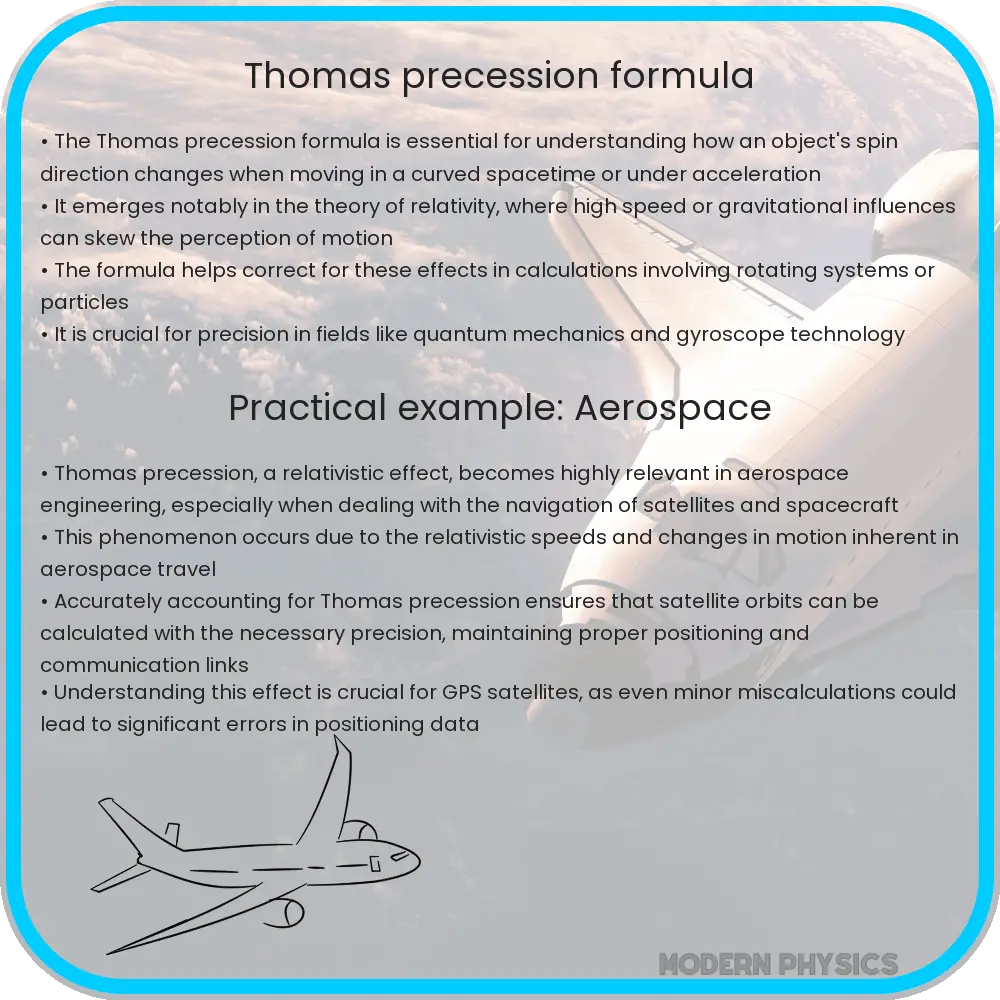
Understanding Thomas Precession in Special Relativity
Special Relativity, introduced by Albert Einstein in 1905, revolutionized our understanding of time, space, and motion. One of the intriguing aspects that emerges from special relativity is the Thomas Precession, a relativistic effect observed in the spinning motion of objects moving along a curved path at speeds close to the speed of light. This precession is a result of the time dilation effects in relativity and is particularly important in fields like particle physics and astrophysics.
What is Thomas Precession?
Thomas Precession occurs because the internal spin of a particle and its path through spacetime are relativistically out of sync. This effect was first predicted by Llewellyn Thomas in 1926 as he calculated the implications of special relativity for spinning electrons. In simpler terms, if an object is moving in a circular path and also spinning on its own axis, relativity states that the object’s time dilation—its perception of time—differs from that of its surroundings. This difference in how time is experienced leads to a tiny correction in the spin’s orientation, known as precession.
The Mathematics Behind Thomas Precession
The formula for Thomas Precession combines elements of angular velocity and relativity. The angular velocity of precession, denoted as ΩTP, can be expressed as:
ΩTP = -½ γ³ (Ωs × β) × β
where:
- Ωs is the angular velocity of the spin
- β = v/c denotes the dimensionless velocity (v is the velocity of the object and c is the speed of light)
- γ is the Lorentz factor, defined as γ = 1 / sqrt(1 – β²)
- “×” represents the vector cross product
This formula highlights the dependence of the precession on the cube of the Lorentz factor, showing how markedly effects of relativity become as objects move at speeds closer to that of light.
Real-World Implications of Thomas Precession
In practical terms, Thomas Precession has significant implications in the realm of high-energy physics. For instance, it affects the behavior of particles in accelerators where they reach relativistic speeds, influencing their trajectories and decay patterns. Understanding this effect is crucial in precision measurements and in designing the next generation of particle accelerators.
Moreover, in astrophysics, this type of precession can influence the spin alignment and rotation rates of cosmic bodies like neutron stars, which spin at nearly a fraction of the speed of light. The calculations here contribute to our understanding of phenomena such as pulsar timings and gravitational wave emissions.
Conclusion Pending…
Conclusion
The phenomenon of Thomas Precession offers a fascinating insight into the interplay between velocity and rotation under the influence of relativity. Although the concept itself may seem esoteric, its practical implications are vast and underscore the profound impact of Einstein’s theory of relativity on modern physics. The ability to account for Thomas Precession not only enhances our understanding of particle physics and astrophysics but also aids in the precise design of experiments and technologies that push the boundaries of what we currently understand about the universe.
In essence, Thomas Precession is a perfect example of how high-level theoretical physics translates into practical applications that can have far-reaching consequences in science and technology. Whether it’s helping scientists fine-tune the settings of a particle accelerator or assisting astronomers in modeling the dynamics of distant cosmic bodies, Thomas Precession plays a critical role in shaping our empirical approach to exploring and understanding complex phenomena at the extremes of speed and gravitational influence.
Through examining such intricate details of the universe’s underlying principles, we continue to unlock new knowledge and opportunities for advancement. Thus, the study of phenomena like Thomas Precession not only enriches our understanding of the cosmos but also inspires continuous innovation and curiosity in physics, pushing us ever forward in our quest for knowledge.