
Explore thermohaline circulation models, their role in climate prediction and analysis, and the challenges in understanding global climate impacts.
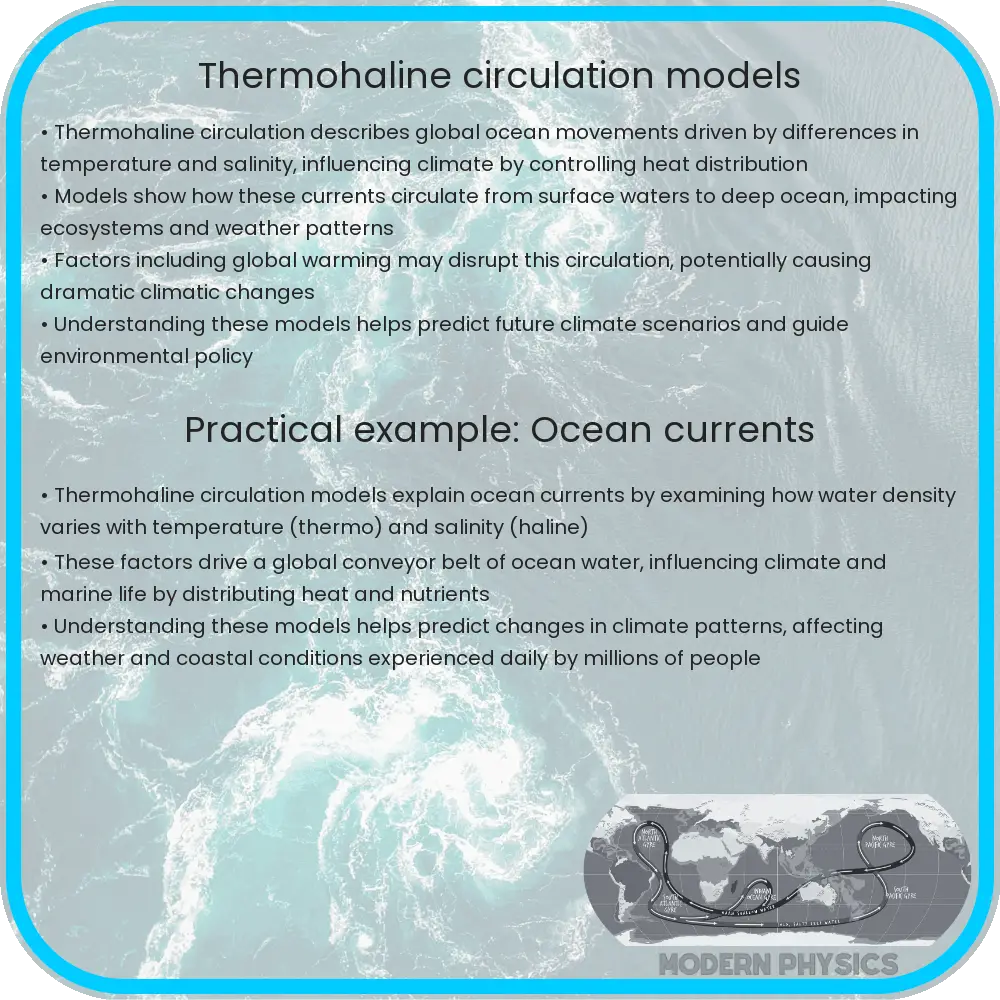
Understanding Thermohaline Circulation: Models, Predictions, and Analysis
Thermohaline circulation (THC) represents a significant component of our planet’s climate system. It’s a large-scale ocean circulation driven by global density gradients created by surface heat and freshwater fluxes. This article delves into the complex models used to predict and analyze THC, discussing their stability and the implications for our understanding of climate change.
Essence of Thermohaline Circulation
At its core, thermohaline circulation is about the movement of water driven by temperature (thermo) and salinity (haline) differences. The process involves warm, saline surface water moving polewards, cooling and becoming denser, then sinking and returning towards the equator at depth. This circulation is critical for distributing heat and regulating climate patterns globally.
Modeling Thermohaline Circulation
Modeling THC involves complex algorithms that simulate the ocean’s physical, chemical, and biological processes. The most common models are General Circulation Models (GCMs), which integrate atmospheric, oceanic, and sometimes ice components. These models provide insights into how THC responds to various climatic factors like global warming or freshwater input from melting ice.
Predictive Analysis of THC
THC models are used to predict future climate scenarios. By altering variables such as atmospheric CO2 levels or surface temperatures, scientists can project how THC might evolve. This is crucial for understanding potential future climate changes, such as shifts in weather patterns, sea level rise, or changes in marine ecosystems.
Stability of Thermohaline Circulation
The stability of THC is a major area of research. Changes in global temperature and salinity can lead to a weakening or even a shutdown of THC, as depicted in some extreme climate change scenarios. Understanding the tipping points and feedback mechanisms within THC models is vital to predict how resilient the circulation is to anthropogenic and natural changes.
Conclusion
This overview highlights the importance of thermohaline circulation models in predicting and analyzing the future of our climate. In the next section, we will delve deeper into the impacts of THC changes, how these models are informing policy decisions, and the ongoing challenges faced by researchers in this field.
Impacts of Changes in Thermohaline Circulation
Alterations in THC can have profound global impacts. A weakened circulation could lead to a colder climate in the North Atlantic, affecting weather patterns across Europe and North America. It also risks disrupting marine ecosystems, impacting fish populations crucial for food security. Furthermore, changes in THC can influence global carbon cycle dynamics, affecting atmospheric CO2 concentrations and thus global warming rates.
Thermohaline Circulation in Climate Policy
THC models are increasingly important in shaping climate policy. They provide vital data for international climate reports and agreements, helping policymakers understand the potential long-term impacts of climate change. Accurate THC predictions can inform strategies for mitigating climate change effects and adapting to potential shifts in oceanic and atmospheric patterns.
Challenges in Modeling Thermohaline Circulation
Despite advancements, THC modeling faces significant challenges. The need for high-resolution data to accurately simulate ocean dynamics is a major hurdle, given the vast scale and complexity of the oceans. Additionally, understanding and integrating biogeochemical cycles and their interaction with physical processes in the ocean remain a key challenge. There’s also the uncertainty in predicting human-induced changes and their impact on THC.
Future Directions in Research
Future research must focus on improving model accuracy, integrating more complex variables, and enhancing our understanding of deep ocean processes. Collaboration across oceanography, climatology, and other scientific disciplines is essential. Additionally, there’s a growing need for more comprehensive data collection, including from remote and deep-sea areas, to refine these models further.
Conclusion
Thermohaline circulation models are indispensable tools in understanding and predicting our planet’s climate future. They shed light on the intricate dance of ocean currents and their far-reaching impacts on global climate. While there are challenges in modeling such a complex system, advancements in this field are crucial for informed climate action. As we continue to unravel the mysteries of thermohaline circulation, it becomes increasingly clear how interconnected our world is – and how vital it is to protect this delicate balance for future generations.