
Explore the principles and applications of Thermodynamic Fluctuation Theory, its impact on material science, nanotech, and quantum computing.
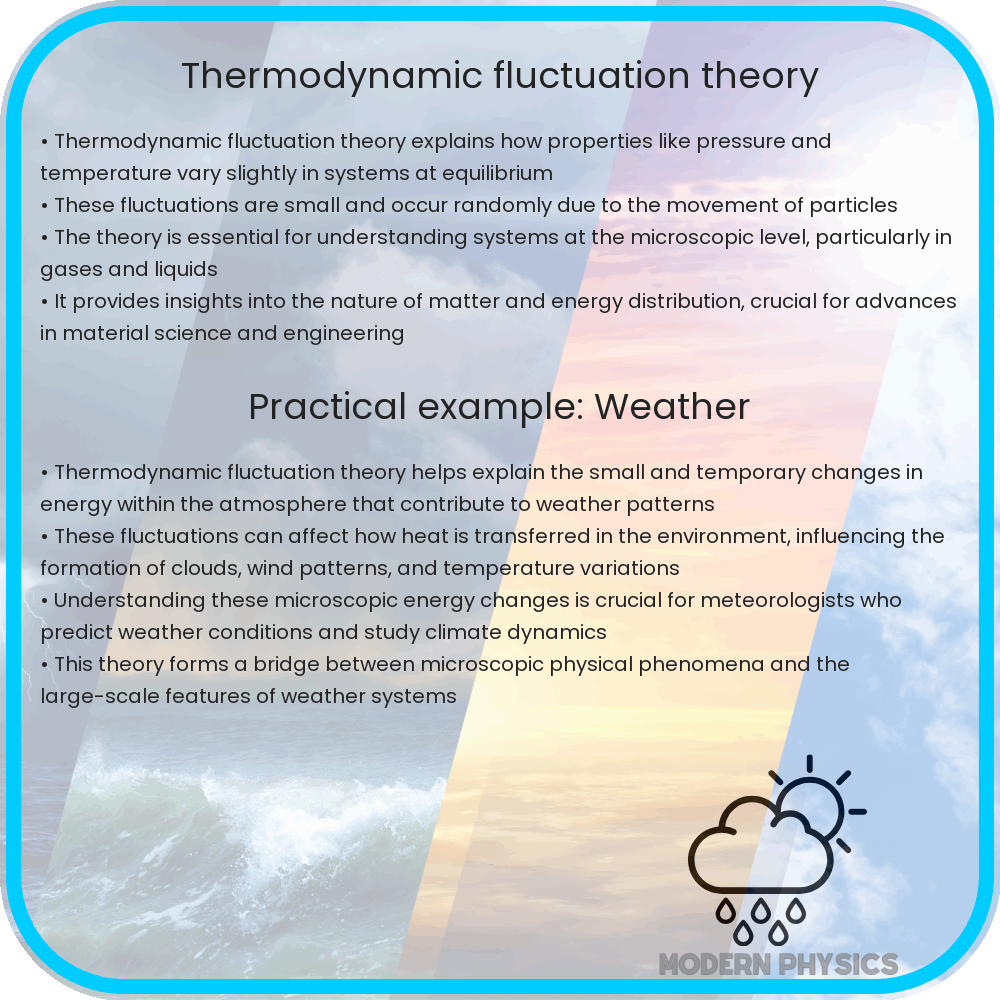
Understanding Thermodynamic Fluctuation Theory
Thermodynamic Fluctuation Theory (TFT) is a fundamental concept in statistical mechanics, providing deep insights into the behavior of systems at the microscopic level. It is crucial for comprehending how macroscopic properties emerge from the collective behavior of numerous particles.
Principles of Thermodynamic Fluctuation Theory
At the heart of TFT lies the understanding that microscopic fluctuations in thermodynamic quantities, such as energy, volume, or number of particles, lead to observable macroscopic effects. These fluctuations are inherently random and are more pronounced in smaller systems. The key principles of TFT include:
- Probability Distribution: TFT models the probability distribution of fluctuations, typically using Gaussian or normal distribution in equilibrium systems.
- Response Functions: The theory relates fluctuations to response functions like specific heat and compressibility, which describe how a system responds to changes in temperature or pressure.
- Correlation Functions: TFT examines correlation functions that describe how fluctuations in one part of the system are related to those in another, over space and time.
Applications of Thermodynamic Fluctuation Theory
TFT has a wide array of applications across various fields:
- Material Science: Understanding thermal properties and phase transitions in materials.
- Chemical Physics: Studying reaction kinetics and molecular dynamics.
- Biology: Explaining phenomena like protein folding and membrane dynamics.
The theory is particularly useful in nanotechnology and quantum computing, where the small scale of systems makes fluctuations significant. In these fields, TFT helps in designing more efficient materials and devices by understanding how microscopic properties affect macroscopic behavior.
Key Equations in Thermodynamic Fluctuation Theory
Central to TFT are equations that describe the statistical properties of fluctuations. For example, the fluctuation of energy \(E\) in a system is given by:
\[ \langle ( \Delta E )^2 \rangle = k_B T^2 C_v \]
Here, \( \langle ( \Delta E )^2 \rangle \) represents the mean square fluctuation in energy, \( k_B \) is Boltzmann’s constant, \( T \) is the temperature, and \( C_v \) is the specific heat at constant volume. This equation highlights how fluctuations are intimately linked to macroscopic quantities like specific heat.
Advanced Concepts in Thermodynamic Fluctuation Theory
The advanced aspects of Thermodynamic Fluctuation Theory delve into non-equilibrium systems and quantum fluctuations. In non-equilibrium thermodynamics, fluctuations are more complex, leading to phenomena like irreversible processes and time-dependent changes. Quantum fluctuations, on the other hand, are critical in understanding phenomena at atomic and subatomic scales.
Challenges and Future Directions
Despite its robust framework, Thermodynamic Fluctuation Theory faces challenges in accurately predicting behaviors in complex systems, such as biological organisms or highly disordered materials. The future of TFT lies in integrating it with computational methods and machine learning to predict and understand these complex systems better.
Real-World Impact of Thermodynamic Fluctuation Theory
Thermodynamic Fluctuation Theory is not just an abstract concept; it has practical implications in everyday technology. For instance, it aids in the development of more efficient engines and batteries, and in the pharmaceutical industry, it helps in the design of drugs with optimal properties by understanding the molecular-level fluctuations.
Conclusion
Thermodynamic Fluctuation Theory offers a profound understanding of the microscopic world and its connection to macroscopic phenomena. Its principles and applications span across various scientific fields, providing a framework to comprehend and predict the behavior of materials and systems. As science and technology advance, the role of TFT will become even more significant, particularly in fields like nanotechnology, quantum computing, and biophysics. By continuing to explore and apply this theory, scientists and engineers can develop innovative solutions to some of the most challenging problems in modern science and technology.