
Explore the fundamentals of thermodynamic equilibrium, its role in stability, reversibility, and balance, and its wide-ranging applications.
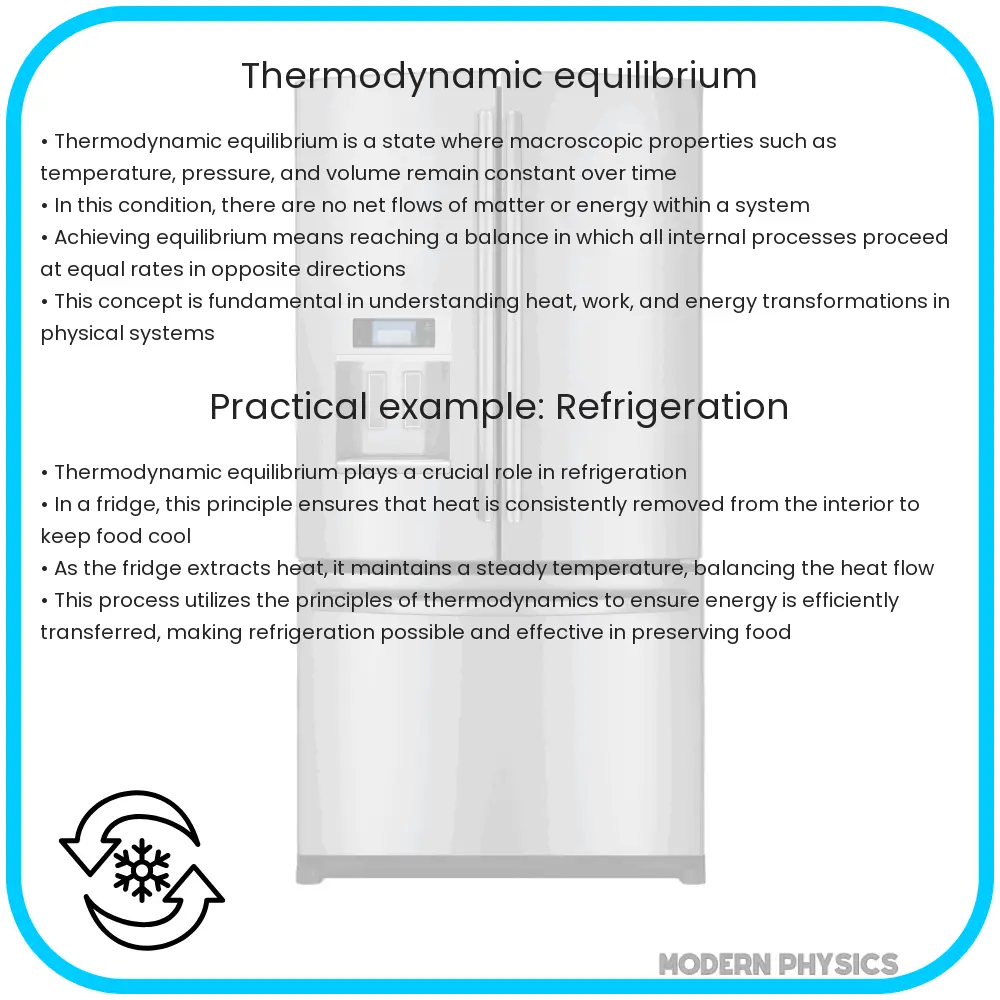
Understanding Thermodynamic Equilibrium: Stability, Reversibility, and Balance
Thermodynamics, a branch of physics, deals with the principles governing energy and matter interactions. Central to this field is the concept of thermodynamic equilibrium, a state where a system is in perfect balance, with no net flow of energy or matter in or out. This equilibrium is crucial for understanding various physical and chemical processes, from the functioning of engines to the behavior of chemical reactions.
Stability in Thermodynamic Systems
Stability in thermodynamics refers to a system’s ability to return to equilibrium after a small disturbance. This concept is vital in predicting how a system behaves under different conditions. A stable system, when slightly disturbed, will tend to return to its original state. For instance, a gas in a sealed container, when slightly compressed, will expand back to its initial volume once the pressure is removed.
Reversibility and its Role
A reversible process is an idealized concept where a system undergoing a change can be returned to its original state without any net energy change in the system and its surroundings. In reality, all natural processes are irreversible, meaning they cannot return to their initial state without external intervention. However, the concept of reversibility is crucial in thermodynamics for understanding the maximum efficiency of processes and the direction of natural processes.
Balance in Thermodynamic Systems
Balance in a thermodynamic system is achieved when all forces, reactions, and energy exchanges are in a state of equilibrium. This does not imply inactivity; rather, it means that any changes within the system are occurring at a rate that balances any opposing changes. For example, in a chemical reaction at equilibrium, the rate of the forward reaction equals the rate of the reverse reaction, maintaining a constant concentration of reactants and products.
Understanding thermodynamic equilibrium is essential for various applications. It helps in designing more efficient engines, predicting chemical reaction outcomes, and understanding natural phenomena. The principles of stability, reversibility, and balance offer a framework to comprehend how energy and matter interact in our universe.
Applications and Implications of Thermodynamic Equilibrium
The principles of thermodynamic equilibrium have widespread applications in various fields. In engineering, they are fundamental in optimizing energy systems like engines and refrigerators. For instance, understanding the efficiency limits imposed by reversible and irreversible processes aids in designing more energy-efficient machines. In the field of chemistry, the equilibrium constant, derived from the balance of a reversible reaction, is critical in predicting the yield of chemical reactions.
Environmental science also relies heavily on these principles. The study of Earth’s energy balance, crucial in understanding global warming, is an application of thermodynamic equilibrium. The balance between incoming solar radiation and outgoing heat energy determines the Earth’s temperature.
Challenges in Achieving True Reversibility
While the concept of reversible processes is a cornerstone in thermodynamics, achieving true reversibility in practical applications is a significant challenge. Every real-world process involves some degree of irreversibility, often due to factors like friction, resistance, or natural entropy increase. Engineers and scientists strive to minimize these irreversible elements to enhance system efficiency.
Conclusion: The Essence of Thermodynamic Equilibrium in Understanding Our World
Thermodynamic equilibrium, with its components of stability, reversibility, and balance, is a fundamental concept that underpins much of our understanding of the physical world. From enabling advancements in technology and industry to deepening our understanding of natural processes, its applications are vast and varied. The pursuit of efficient, balanced systems, whether in energy production, chemical manufacturing, or environmental protection, is a testament to the enduring relevance of these principles. As we continue to innovate and face new challenges, the insights provided by thermodynamic equilibrium will remain crucial in guiding our path towards sustainable and efficient solutions.