
Explore the innovative world of thermoacoustic refrigeration, a sustainable and efficient alternative to traditional cooling technologies.
Understanding Thermoacoustic Refrigeration
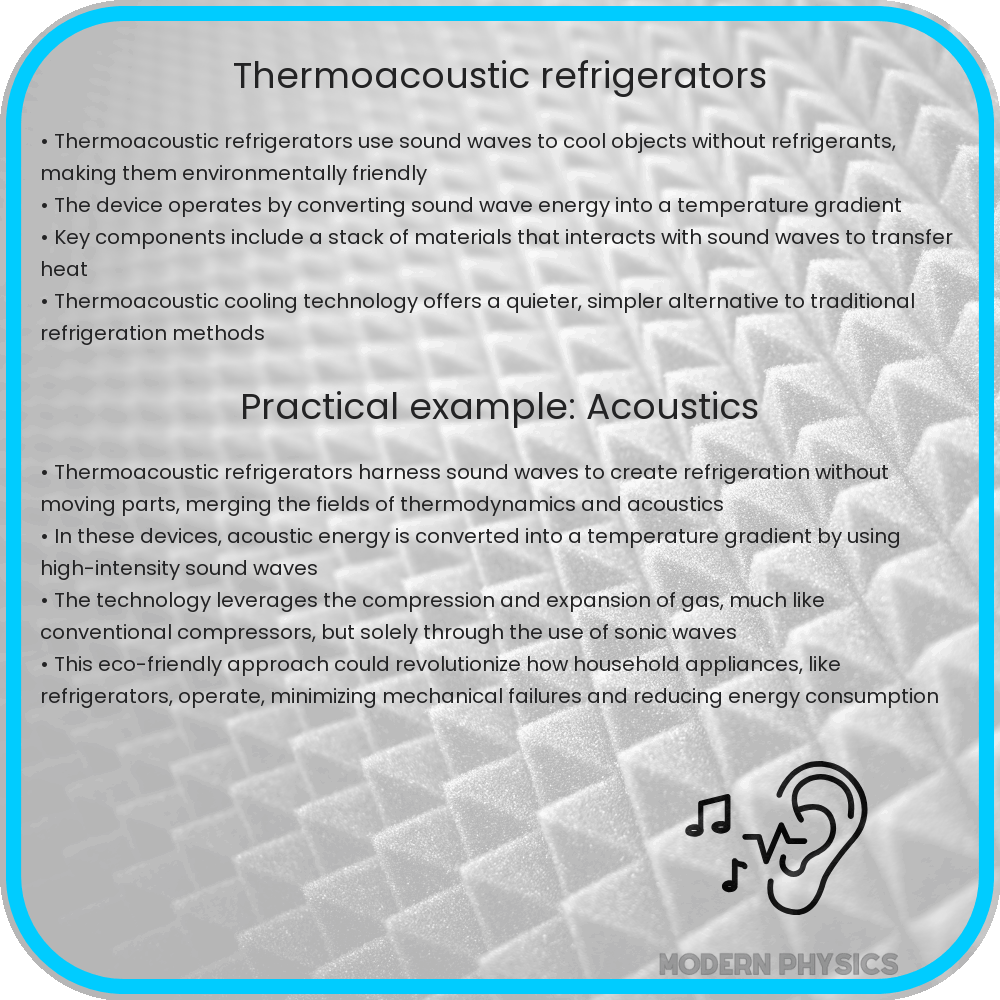
Thermoacoustic refrigeration represents a groundbreaking shift in cooling technology, harnessing sound waves to create cooling effects. This innovative approach offers a promising alternative to conventional refrigeration methods, emphasizing efficiency and sustainability.
Principles of Thermoacoustic Refrigeration
At the core of thermoacoustic refrigeration is the utilization of sound waves and their interaction with gases. When sound waves pass through a gas, areas of compression and rarefaction are created. In the compression phase, the gas’s temperature rises, and in the rarefaction phase, it falls. This temperature gradient, induced by sound waves, is harnessed for refrigeration. The process involves a stack of parallel plates or a porous medium where the temperature gradient is created, enabling the transfer of heat.
Key Components of Thermoacoustic Systems
- Sound Generator: Creates high-intensity sound waves, often through a loudspeaker or a linear motor.
- Resonator Tube: A tube that amplifies and maintains the sound waves’ frequency and intensity.
- Stack: A crucial element placed within the resonator tube, made of materials like metal or plastic, facilitating heat exchange.
- Heat Exchangers: Devices located at both ends of the stack to manage heat absorption and expulsion.
Advantages of Thermoacoustic Refrigeration
- Environmentally Friendly: Reduces reliance on harmful refrigerants like chlorofluorocarbons (CFCs) and hydrochlorofluorocarbons (HCFCs), which contribute to ozone layer depletion.
- Energy Efficiency: Potential for higher energy efficiency compared to conventional refrigeration systems.
- Low Maintenance: Fewer moving parts than traditional systems, resulting in lower maintenance requirements.
- Versatility: Adaptable to various scales, from small cooling systems to large industrial applications.
Current Challenges and Research Directions
Despite its promise, thermoacoustic refrigeration faces several challenges. Achieving optimal efficiency and performance is an ongoing research area, as is the search for ideal materials for the stack and resonator. Additionally, integrating these systems into mainstream applications and improving their cost-effectiveness remain significant hurdles.
Continued research and development are crucial in overcoming these challenges, paving the way for wider adoption of thermoacoustic refrigeration as a sustainable and efficient cooling technology.
Integrating Thermoacoustic Refrigeration into the Market
Advancing thermoacoustic technology to a level where it can compete with traditional refrigeration systems is a primary goal for researchers and engineers. This includes refining the design for compactness, increasing cooling capacity, and enhancing overall efficiency. The potential for integration in various sectors, including domestic appliances, industrial cooling, and even space technology, opens up a vast array of possibilities for this eco-friendly technology.
Case Studies and Real-world Applications
Several pilot projects and experimental setups have demonstrated the viability of thermoacoustic refrigeration. Notable examples include its use in cooling electronic components and in specialized applications where traditional refrigeration is impractical or too costly. Furthermore, its potential application in developing countries, where the need for sustainable and low-cost cooling solutions is high, is particularly promising.
The Role of Renewable Energy Sources
Pairing thermoacoustic refrigeration systems with renewable energy sources like solar or wind power can further enhance their sustainability. Such combinations could lead to completely green cooling solutions, reducing carbon footprints and dependency on non-renewable energy sources.
Future Outlook and Potential Impact
The ongoing evolution of thermoacoustic refrigeration technology, driven by research and innovation, holds significant promise for the future of cooling systems. With increased awareness and support from both the scientific community and industry, thermoacoustic refrigeration could soon become a mainstream technology, offering an efficient, sustainable alternative to conventional methods.
Conclusion
Thermoacoustic refrigeration stands at the forefront of innovative cooling technologies, offering a blend of environmental sustainability and efficiency. Its principles, rooted in the interplay of sound waves and temperature gradients, present a fascinating alternative to traditional refrigeration methods. While challenges in efficiency, cost, and integration persist, the potential benefits of this technology in terms of environmental impact and energy efficiency are substantial. As research continues to address these challenges, the future of thermoacoustic refrigeration looks promising, poised to revolutionize the way we approach cooling and refrigeration in various applications, from household appliances to large-scale industrial systems.