
Explore the efficiency, design, and applications of thermally driven oscillation, a key innovation in energy and technology fields.
Understanding Thermally Driven Oscillation: An Overview
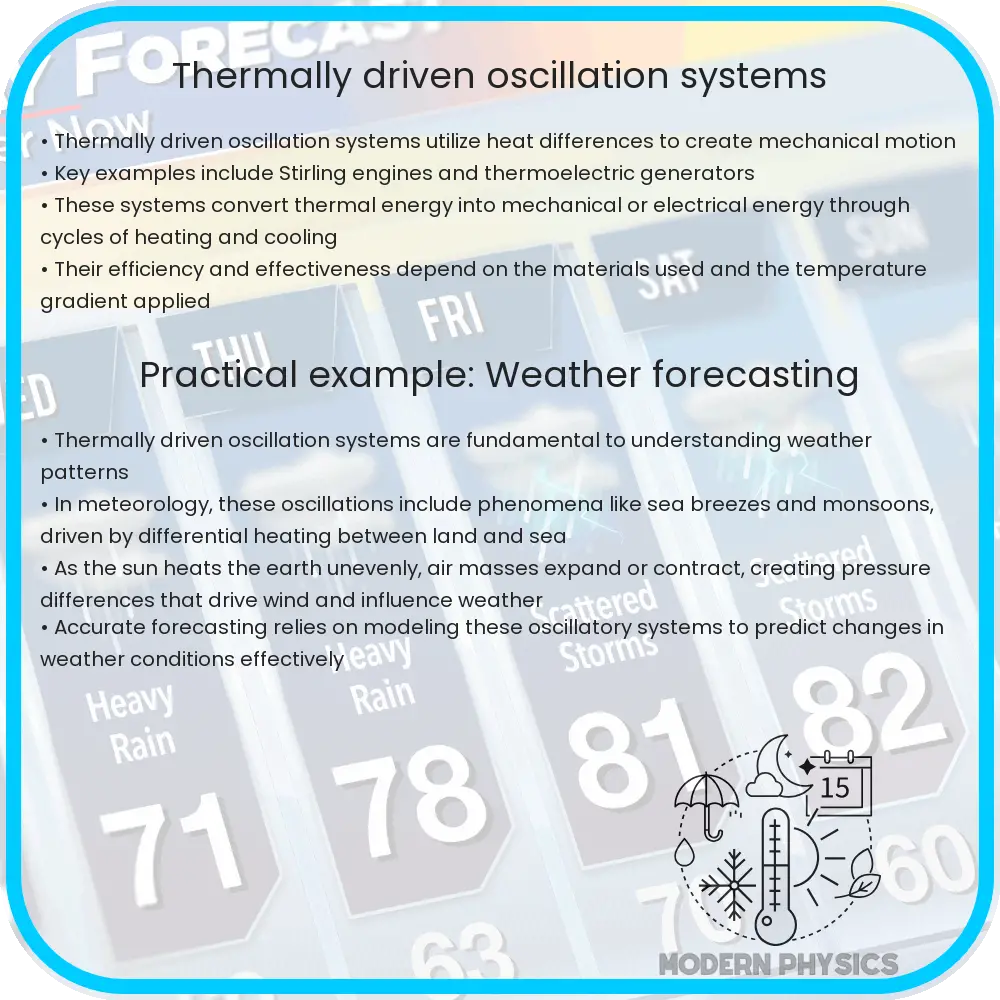
Thermally driven oscillation, a phenomenon observed in various scientific and engineering domains, has significant implications in efficiency and design applications. This physical process involves oscillatory behavior induced by thermal effects, often seen in systems where temperature variations play a critical role.
Efficiency in Thermally Driven Systems
The efficiency of thermally driven oscillatory systems hinges on the precise manipulation of thermal gradients. These systems capitalize on the expansion and contraction of materials caused by temperature changes to generate oscillatory motion. One key area where this is effectively utilized is in Stirling engines, where thermal oscillations are harnessed to produce mechanical work with high efficiency.
Design Considerations
Designing systems that employ thermally driven oscillation requires a keen understanding of thermal dynamics and material properties. For instance, in thermal actuators, materials with high thermal expansion coefficients are preferred. The choice of material impacts the system’s responsiveness and efficiency. Additionally, the design must account for heat dissipation, ensuring that the system can operate sustainably under continuous thermal cycling.
Applications of Thermally Driven Oscillation
Thermally driven oscillations find applications in various fields. In renewable energy, these systems contribute to efficient solar power generation. In micro-electromechanical systems (MEMS), thermal actuators leverage these oscillations for precise control. Furthermore, in cooling technologies, thermal oscillations aid in developing more efficient and compact heat exchangers.
The Role of Thermodynamics and Material Science
Advancements in thermodynamics and material science have been pivotal in optimizing thermally driven oscillation systems. The use of advanced materials like shape-memory alloys, which exhibit significant changes in their physical properties with temperature, has opened new avenues in this field. Understanding the thermodynamic cycles, such as the Carnot cycle, is also crucial in maximizing the efficiency of these systems.
On the molecular level, thermally induced oscillation can be represented by the formula: H2O (liquid) → H2O (gas), demonstrating the phase change from liquid to gas under heat application. Such molecular transformations are fundamental to the operation of these systems.
Emerging Trends in Thermally Driven Oscillation Technology
The field of thermally driven oscillation is rapidly evolving, with emerging trends focusing on nano-scale applications and sustainable energy solutions. Nanotechnology has enabled the development of nano-thermomechanical devices, where thermal oscillations occur at the atomic or molecular level, paving the way for more efficient and compact designs. Additionally, the integration of thermally driven systems in sustainable energy solutions, like waste heat recovery, is gaining momentum, contributing to more environmentally friendly technologies.
Challenges and Future Directions
Despite the advancements, challenges remain in optimizing the efficiency and durability of thermally driven oscillation systems. Material degradation due to repeated thermal cycling and the need for precise temperature control are significant hurdles. Future research is directed towards finding more resilient materials and improving thermal management to address these challenges. Moreover, the potential integration of artificial intelligence for predictive maintenance and operational optimization is a promising direction.
Real-world Applications and Case Studies
Real-world applications of thermally driven oscillation are extensive and varied. In the automotive industry, these principles are applied in advanced cooling systems to enhance engine efficiency. In aerospace, thermally driven oscillators are used for temperature regulation and control systems. Case studies in these sectors demonstrate significant improvements in energy efficiency and operational reliability, underscoring the practical benefits of these technologies.
Conclusion: The Future of Thermally Driven Oscillation
Thermally driven oscillation stands at the forefront of innovation in numerous engineering and technological fields. Its efficiency, combined with thoughtful design considerations, has led to diverse applications, from MEMS to renewable energy systems. While challenges persist, ongoing research and technological advancements promise to overcome these barriers, paving the way for more sophisticated, efficient, and sustainable thermally driven systems. As this field continues to evolve, it holds the potential to revolutionize how we approach energy conversion, material science, and system design, contributing significantly to a more sustainable and technologically advanced future.