
Explore the essentials of thermal radiation spectrum, its applications in science and industry, and future prospects in this insightful article.
Understanding the Thermal Radiation Spectrum
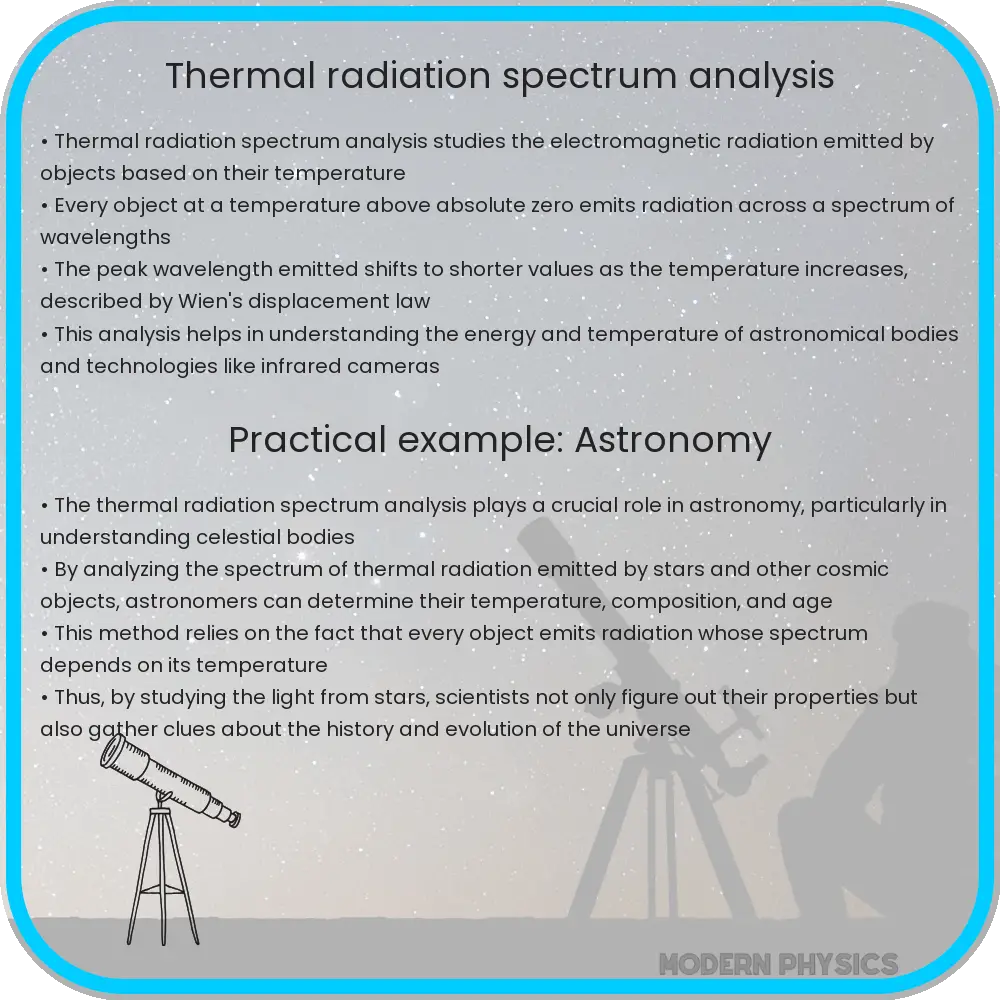
Thermal radiation, a fundamental concept in physics, refers to the emission of electromagnetic waves by all objects with a temperature above absolute zero. This article delves into the intricacies of the thermal radiation spectrum, exploring its various aspects, such as insight, accuracy, and dynamics.
Insight into Thermal Radiation
At its core, thermal radiation is governed by Planck’s law, which describes the spectrum of electromagnetic radiation emitted by a black body in thermal equilibrium at a given temperature. This law is mathematically represented as:
E(λ, T) = (2hc2λ-5) / (e(hc/λkT) - 1)
where E(λ, T) is the spectral radiance, λ is the wavelength, T is the absolute temperature, h is Planck’s constant, c is the speed of light, and k is Boltzmann’s constant. This equation reveals how the intensity of radiation varies with wavelength and temperature.
Accuracy in Measurement
Measuring the thermal radiation spectrum involves sophisticated instruments like pyrometers, bolometers, and infrared cameras. These tools help in accurately determining the temperature and the spectral distribution of radiation. The accuracy of these measurements is crucial for applications in astrophysics, climate studies, and industrial processes.
Dynamics of Thermal Radiation
The dynamics of thermal radiation are influenced by factors like temperature, emissivity of the material, and environmental conditions. For instance, the sun’s radiation, primarily in the visible and near-infrared regions, significantly impacts Earth’s climate system. Understanding these dynamics helps in modeling and predicting climate change.
In conclusion, the study of the thermal radiation spectrum is essential in various fields, from industrial temperature control to environmental science. Its application in climate models and remote sensing demonstrates its versatility and importance. By gaining a deeper understanding of this spectrum, we can enhance our knowledge in fields ranging from astrophysics to environmental science.
Practical Applications of Thermal Radiation
The practical applications of understanding the thermal radiation spectrum are vast and diverse. In the field of astrophysics, it assists in the study of celestial bodies by analyzing their thermal emissions. This is particularly useful in the identification and study of distant stars and galaxies. In industrial contexts, thermal radiation principles are applied in temperature measurement and control, crucial in processes like metallurgical furnaces and semiconductor manufacturing.
Thermal Imaging and Environmental Studies
Thermal imaging, another application, utilizes the infrared spectrum to capture images based on heat emitted by objects. This technology is widely used in surveillance, wildlife studies, and building inspections to identify heat leaks. In environmental science, thermal radiation data helps in understanding and predicting climate change by analyzing Earth’s radiation budget and the greenhouse effect.
Future Prospects in Thermal Radiation Research
Future research in thermal radiation is promising, with potential advancements in materials science, such as the development of metamaterials with custom emissivity properties. These could revolutionize thermal management in various technologies. Additionally, ongoing research in quantum theory and nanotechnology may offer deeper insights into thermal radiation processes at the microscopic level, leading to novel applications in electronics and energy conservation.
Conclusion
In summary, the study of the thermal radiation spectrum is a cornerstone in both theoretical physics and practical applications. Its implications span across various fields, from environmental science to industrial processes. The accuracy and dynamics of thermal radiation measurements continue to evolve with technological advancements, offering new insights and applications. Understanding this spectrum not only aids in current technological and scientific endeavors but also paves the way for future innovations in material science, climate study, and beyond. The continuous exploration of thermal radiation will undoubtedly contribute significantly to our scientific and technological progress in the years to come.