
Explore the efficiency, durability, and protective capabilities of thermal radiation shields in various industries, with insights into recent advancements.
Understanding Thermal Radiation Shields: Essential for Modern Applications
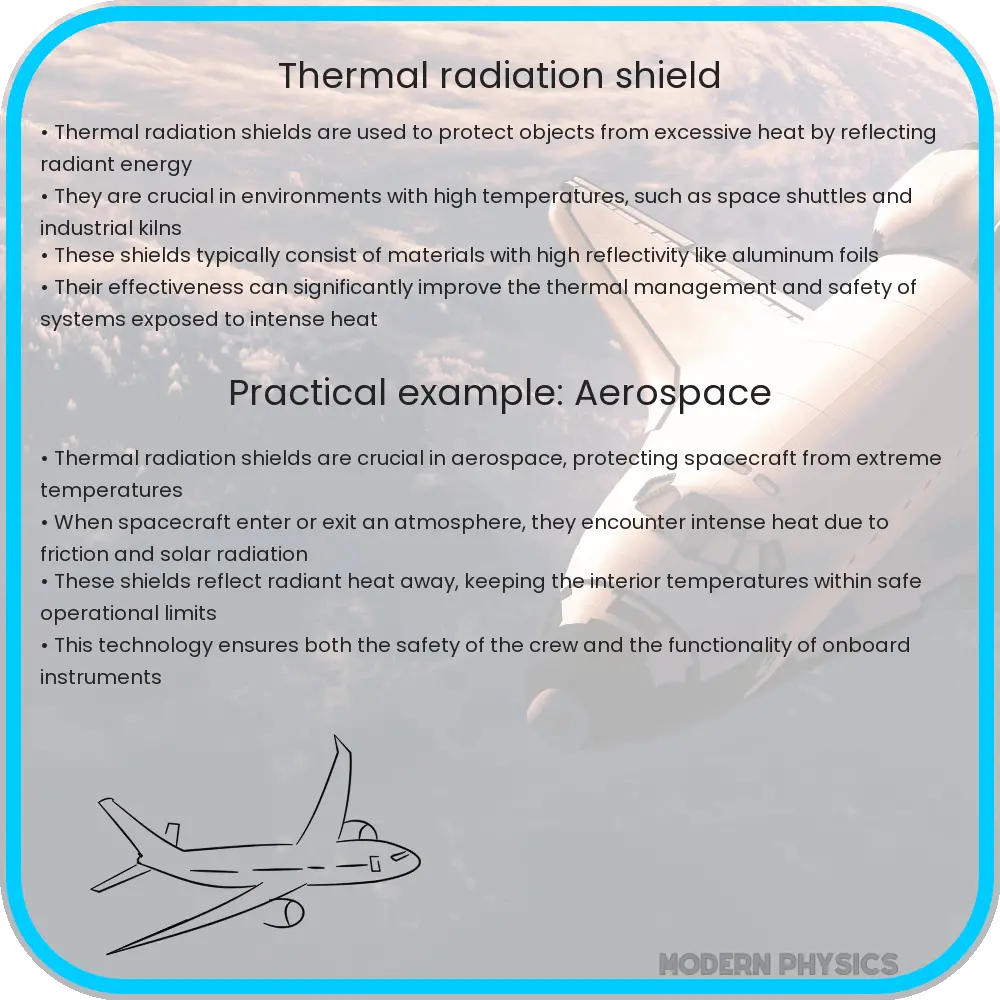
Thermal radiation shields are critical components in a wide range of industries, from aerospace to industrial manufacturing. These shields are designed to protect equipment and personnel from extreme temperatures and radiation, ensuring safety and enhancing performance. In this article, we will delve into the aspects that make thermal radiation shields both efficient and durable, as well as how they provide protective capabilities in various applications.
The Science Behind Thermal Radiation Shields
At the core of a thermal radiation shield’s functionality is its ability to reflect and absorb thermal radiation. Thermal radiation, a form of energy emitted by all objects with a temperature above absolute zero, is represented by the formula \( P = \varepsilon \sigma A T^4 \), where \( P \) is the power radiated, \( \varepsilon \) is the emissivity of the material, \( \sigma \) is the Stefan-Boltzmann constant, \( A \) is the area, and \( T \) is the absolute temperature in Kelvin. Materials used in radiation shields are selected based on their low emissivity and high reflectivity to minimize heat transfer.
Materials and Construction
The effectiveness of a thermal radiation shield largely depends on its material composition and construction. Common materials include aluminum, gold, and various multi-layer insulations (MLIs). Aluminum, with its high reflectivity and low emissivity, is often used in space applications. Gold, although more expensive, is used in environments where higher radiation resistance is needed.
Multilayer insulation is another key component, consisting of multiple layers of thin, reflective sheets separated by insulating material. This structure creates a barrier that reduces heat transfer through radiation, conduction, and convection.
Applications in Various Industries
Thermal radiation shields find applications in numerous fields. In aerospace, they protect spacecraft and satellites from extreme temperatures of space. In industrial settings, these shields are used to safeguard machinery and personnel from high-temperature environments, such as furnaces and reactors.
In the next section, we will explore more about the innovative advancements in thermal radiation shield technology and their future prospects in various industries.
Innovative Advancements in Thermal Radiation Shield Technology
Recent advancements in thermal radiation shield technology have significantly enhanced their efficiency and durability. Innovations include the development of nanomaterials and aerogels, which offer superior insulation properties with minimal weight and thickness. These materials provide better protection against extreme temperatures while maintaining structural integrity under harsh conditions.
Another notable advancement is the incorporation of smart materials that can adapt to changing environmental conditions. These materials can alter their thermal properties in response to temperature fluctuations, providing dynamic protection and improving energy efficiency.
Future Prospects in Diverse Industries
The future of thermal radiation shields is promising, with potential applications expanding into new industries. In the field of renewable energy, these shields can be used to enhance the efficiency of solar panels by protecting them from overheating. In the automotive sector, thermal shields are becoming increasingly important in electric vehicles to protect battery systems from extreme temperatures.
In addition, the ongoing exploration of space technology presents opportunities for advanced radiation shields. As missions venture further into space, the demand for more efficient and durable shields will grow, driving innovation in materials and design.
Challenges and Considerations
Despite their benefits, there are challenges in the development and application of thermal radiation shields. Cost remains a significant factor, especially when using high-end materials like gold or advanced nanomaterials. Additionally, the environmental impact of manufacturing and disposing of these materials is a growing concern, prompting the need for sustainable and recyclable options.
Manufacturers also face the challenge of balancing the trade-off between weight, thickness, and protective efficiency. In aerospace, for example, minimizing weight is crucial, but not at the expense of the shield’s protective capabilities.
Conclusion
Thermal radiation shields are indispensable in safeguarding equipment and personnel from extreme temperatures and radiation. The continuous evolution of materials and technologies in this field is opening new horizons for their application across various industries. While challenges such as cost and sustainability remain, the future of thermal radiation shields is bright, with their potential only set to expand in the years to come. As we continue to push the boundaries of technology, these shields will play a pivotal role in protecting and enhancing the performance of systems in extreme environments.