
Explore the world of thallium-based superconductors: their properties, applications, and the latest research advances transforming technology and science.
Introduction to Thallium-Based Superconductors
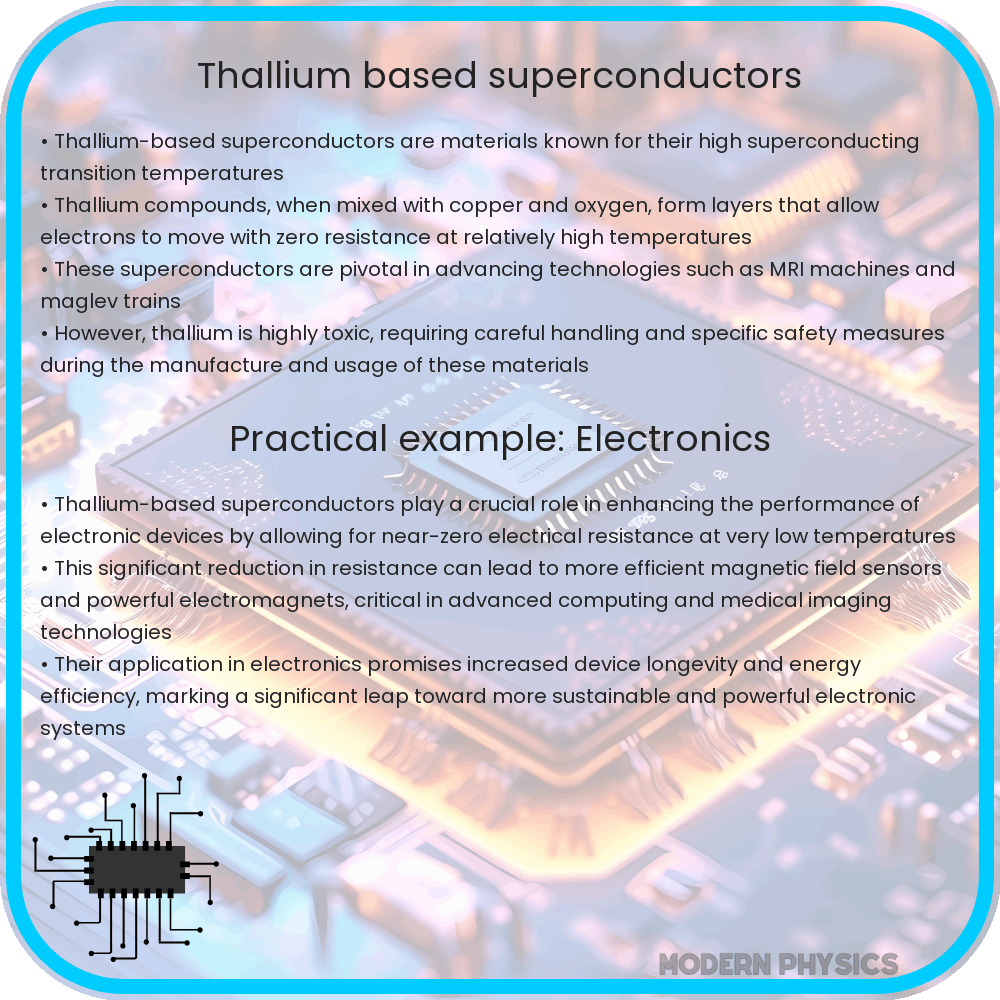
Thallium-based superconductors represent a significant advancement in the field of materials science, particularly in the study and application of high-temperature superconductivity (High-Tc). These materials, characterized by their ability to conduct electricity without resistance at temperatures significantly higher than traditional superconductors, have opened new avenues for technological innovation and scientific research.
Understanding High-Tc Superconductors
High-Tc superconductors are distinguished from conventional superconductors by their critical temperature (Tc) – the temperature below which they exhibit superconductivity. While traditional superconductors require cooling to near absolute zero, thallium-based compounds, such as thallium barium calcium copper oxide (Tl2Ba2Ca2Cu3O10), can operate at higher, more practical temperatures, though still requiring cooling well below room temperature.
Composition and Structure
Thallium-based superconductors belong to the family of cuprate perovskites, materials known for their layered structure, which is crucial for their superconducting properties. The unique arrangement of atoms within these compounds, particularly the planes of copper and oxygen atoms, allows for the pairing of electrons (Cooper pairs) at higher temperatures, facilitating superconductivity.
Applications of Thallium-Based Superconductors
- Magnetic Resonance Imaging (MRI): The high-Tc superconducting materials are employed in the construction of more efficient and powerful MRI machines, enabling clearer and faster imaging capabilities.
- Power Transmission: They are also being explored for use in power cables and other components of the electrical grid, with the potential to significantly reduce energy losses.
- Scientific Research: In research settings, these materials help create powerful superconducting magnets used in particle accelerators and experimental reactors.
Current Research and Challenges
Despite their potential, thallium-based superconductors face challenges, particularly in terms of their toxicity and the difficulty in handling and processing the material safely. Moreover, research continues to focus on understanding the exact mechanisms of high-temperature superconductivity, with the aim of discovering new materials that can superconduct at even higher temperatures and under less stringent conditions.
Advancements and Future Directions
Recent advancements in the field of thallium-based superconductors have been promising, with researchers focusing on enhancing the material’s stability, critical temperature, and critical current density. Innovations in fabrication techniques, such as thin-film deposition and doping with other elements, have shown potential in overcoming some of the existing limitations. Additionally, the exploration of nanostructuring and interface engineering offers new pathways to improve the performance and applicability of these materials.
Environmental and Economic Considerations
The environmental impact and economic viability of thallium-based superconductors are critical considerations for their future development. Efforts are underway to address the toxicity concerns associated with thallium and to develop safer, more sustainable alternatives. Moreover, scaling up the production and integration of high-Tc superconductors into existing systems pose significant challenges that need to be addressed to make this technology economically viable and environmentally sustainable.
Conclusion
Thallium-based superconductors hold immense potential for revolutionizing various technological fields, from medical imaging to power transmission. Despite the significant challenges, including toxicity and material handling, the advancements in this area offer a glimpse into a future where superconductivity can operate at more practical temperatures and conditions. As research continues to unravel the mysteries of high-temperature superconductivity, the dream of widespread application of these materials inches closer to reality. The journey of thallium-based superconductors from laboratory curiosities to integral components of next-generation technologies exemplifies the transformative power of material science and engineering.