
Explore the principles, applications, and advanced analysis of Tension Field Action in statics, essential for structural engineering and design.
Tension Field Action: An Overview
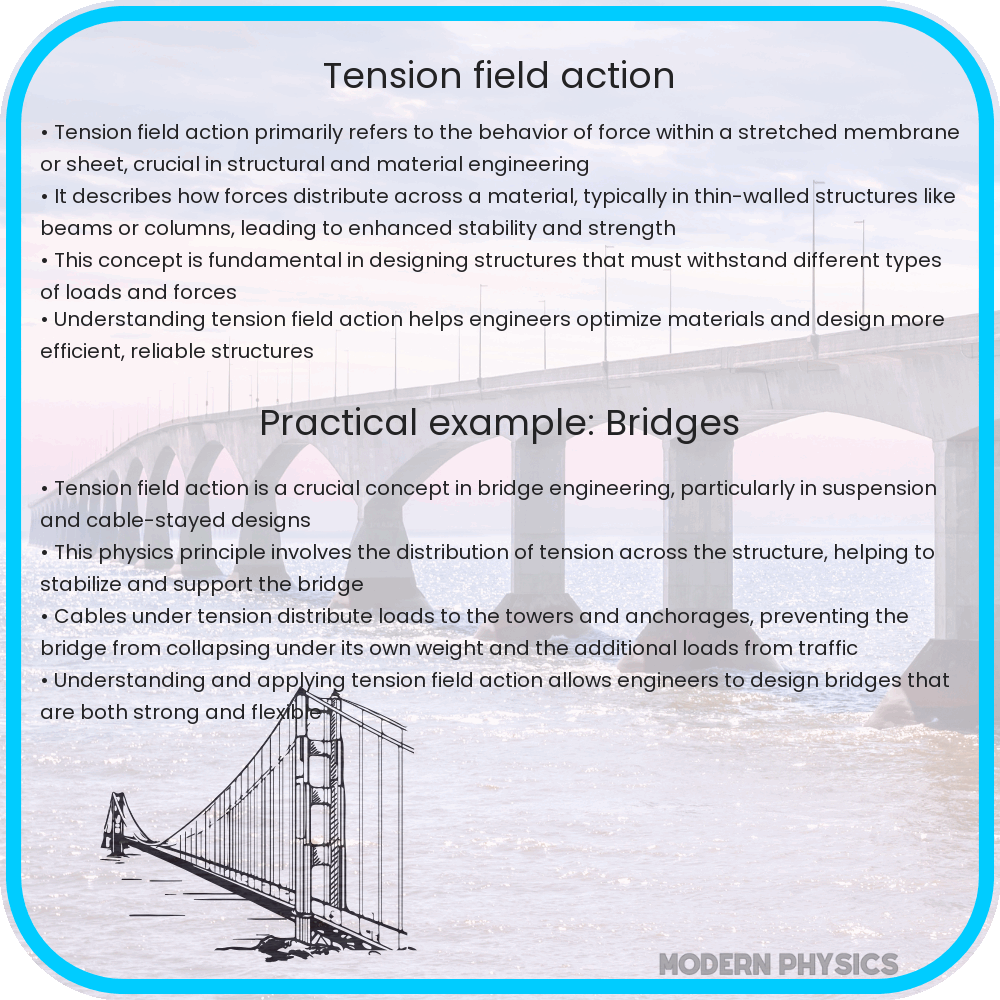
Tension field action is a crucial concept in the field of structural engineering, particularly in the analysis of static structures. It involves the study of how tensile forces, or forces that attempt to stretch an object, are distributed and managed within a structure. This principle is essential in understanding the behavior of materials under load and plays a pivotal role in the design and analysis of various engineering structures.
Principles of Tension Field Action
The fundamental principle of tension field action is based on the idea that when a structural element, like a beam or a plate, is subjected to bending or shear forces, certain regions of the element experience tensile stresses. These stresses form a ‘tension field’, a pattern of tension that helps to resist applied loads. The behavior of this tension field is influenced by factors such as material properties, geometry of the structure, and the type and magnitude of the applied forces.
Applications in Engineering
Tension field action finds extensive applications in various engineering fields. In civil engineering, it is used in the design of bridges, roofs, and large-span structures, where understanding the tension distribution is critical for stability and safety. In mechanical engineering, it applies to the design of components such as springs, cables, and beams, where tensile forces are predominant. Moreover, in the field of aerospace engineering, tension field action is vital for the design of aircraft structures and space vehicles, where weight optimization and structural integrity are of paramount importance.
Analytical Approach in Statics
In the context of statics, analyzing tension field action involves calculating the stress distribution in a static structure under load. The process typically involves the use of mathematical models and numerical methods like Finite Element Analysis (FEA). These tools help in predicting how the structure will behave under various loading conditions, allowing engineers to optimize the design for strength, efficiency, and safety.
For instance, in a simple beam subjected to bending, the tension field action can be visualized as the distribution of tensile stresses across the beam’s cross-section. This analysis helps in understanding where the material is most likely to fail under load and is crucial for designing safe and efficient structures.
Advanced Analysis Techniques
Advancements in computational methods have significantly enhanced the analysis of tension field action. Techniques like nonlinear finite element analysis allow for a more accurate representation of material behavior under high stress or strain. This is particularly important in materials that do not follow linear elastic behavior, such as composites or certain metals at high temperatures. Additionally, the use of digital modeling and simulation tools has enabled engineers to visualize tension fields and predict failure points more accurately, leading to safer and more efficient designs.
Challenges and Limitations
Despite its importance, the analysis of tension field action comes with certain challenges. Accurately predicting the behavior of complex materials and structures under load can be difficult, especially in cases where multiple factors like fatigue, impact, and environmental conditions come into play. Furthermore, the assumptions made in theoretical models may not always perfectly align with real-world scenarios, requiring careful validation and testing.
Future Trends
Looking forward, the field of tension field action is set to evolve with the integration of advanced materials and innovative design approaches. The use of smart materials and structures that can adapt to changing load conditions is a promising area of research. Additionally, the incorporation of machine learning and artificial intelligence in predictive modeling could revolutionize the way engineers analyze and design structures subjected to tensile forces.
Conclusion
In conclusion, tension field action is a fundamental concept in structural engineering, playing a critical role in the analysis and design of various structures. From bridges to aerospace vehicles, understanding how tensile forces affect materials and structures is crucial for ensuring safety and efficiency. While challenges exist in predicting complex behaviors, advancements in computational methods and materials science continue to push the boundaries of what is possible. As the field evolves, it will undoubtedly contribute to the development of more innovative and resilient structures in the future.