
Explore the precision, methods, and applications of surface charge density measurement in this insightful article on its scientific significance.
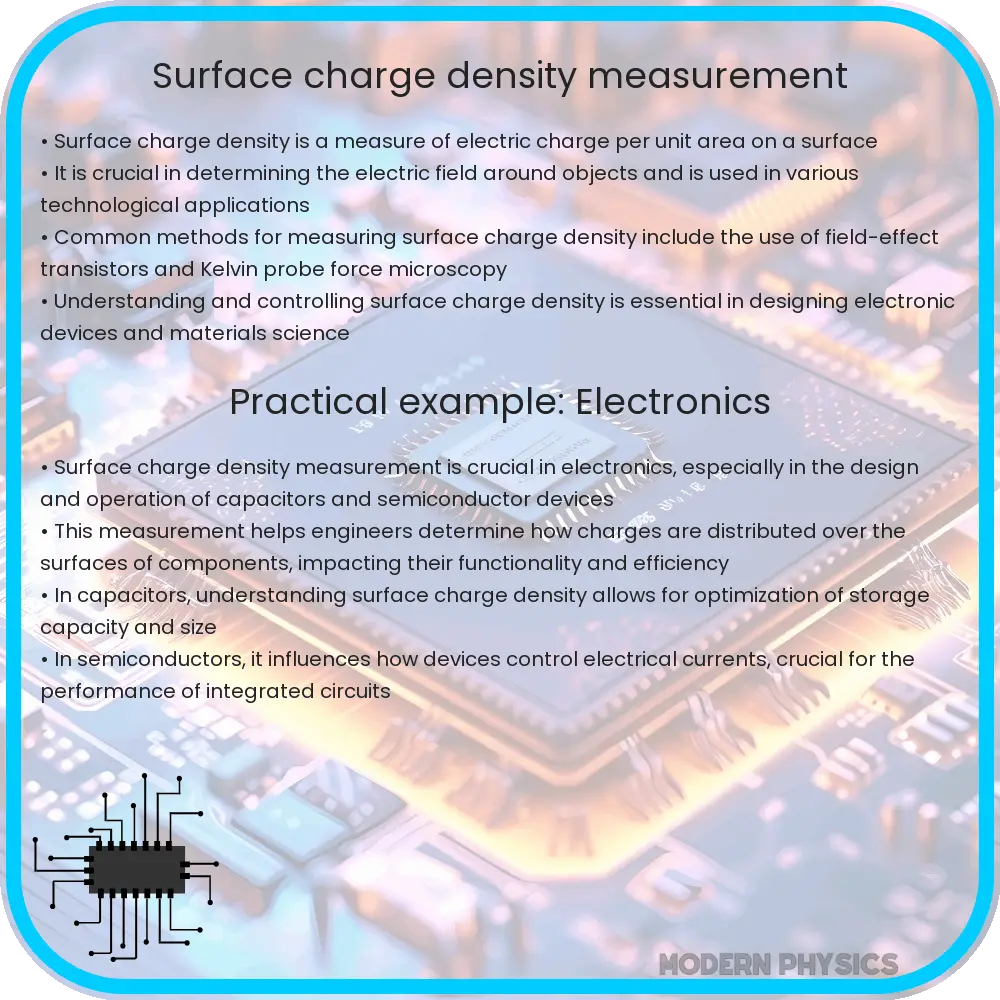
Understanding Surface Charge Density: Precision, Methods & Applications
The concept of surface charge density plays a pivotal role in various scientific and industrial domains. It refers to the amount of electric charge per unit area on a surface, influencing numerous phenomena in fields like electronics, material science, and electrochemistry. This article delves into the precise measurement of surface charge density, its methods, and applications, providing insights into this crucial aspect of modern science and technology.
Precision in Surface Charge Density Measurement
Measuring surface charge density with high precision is crucial for accurate scientific research and industrial applications. The precision of these measurements affects the performance and reliability of electronic devices, the effectiveness of chemical reactions, and the properties of materials. Advanced techniques and instruments have been developed to ensure that these measurements are as accurate and precise as possible, thereby enhancing the quality and efficiency of various processes and products.
Methods of Measuring Surface Charge Density
There are several methods employed to measure surface charge density, each with its unique approach and level of accuracy. These include:
- Electrostatic Probe Method: This technique involves using an electrostatic probe to measure the electric field near the charged surface. The surface charge density is then calculated based on the electric field data.
- Kelvin Probe Force Microscopy (KPFM): KPFM is a non-contact atomic force microscopy technique that measures the contact potential difference between the tip and the sample, providing information about the surface charge distribution.
- Electron Spectroscopy: This method uses the analysis of emitted or scattered electrons to deduce the surface charge density. Techniques like X-ray Photoelectron Spectroscopy (XPS) are often used.
Applications of Surface Charge Density Measurement
Surface charge density measurement finds applications in a wide range of fields:
- Semiconductor Industry: It is essential for understanding and controlling the properties of semiconductors, impacting the design and function of electronic components.
- Material Science: In material science, these measurements are crucial for studying surface phenomena, like corrosion, adhesion, and wetting properties.
- Chemistry and Electrochemistry: Surface charge plays a significant role in chemical reactions, particularly in catalysis and electrochemical processes.
Accurate surface charge density measurements are integral to progress in these fields, driving innovation and efficiency in various scientific and industrial applications. The next part of this article will explore the challenges in measuring surface charge density and the future outlook of this field.
Challenges in Surface Charge Density Measurement
While the methods for measuring surface charge density have advanced, several challenges persist. One of the primary issues is the sensitivity of measurements to environmental factors, such as humidity and temperature. These variables can significantly affect the readings, making it difficult to obtain consistent and reliable data. Additionally, the complexity of surfaces, especially those with irregular geometries or heterogeneous compositions, poses significant challenges in obtaining accurate measurements.
Future Outlook in Surface Charge Density Measurement
The future of surface charge density measurement is likely to witness significant advancements, driven by the need for more precise, reliable, and versatile measurement techniques. Emerging technologies, including more sophisticated forms of microscopy and spectroscopy, are expected to offer greater resolution and sensitivity. The integration of artificial intelligence and machine learning could also play a crucial role in analyzing and interpreting complex data, leading to more accurate and efficient measurement processes.
Conclusion
The measurement of surface charge density is a vital aspect of modern science and technology, with far-reaching implications across various fields. From the production of electronic devices to the exploration of material properties and chemical processes, the ability to measure and understand surface charge density is crucial. Despite the challenges, the continuous evolution of measurement methods and technologies promises to enhance our understanding and manipulation of surface phenomena. As we advance, the precision and applications of surface charge density measurement will undoubtedly expand, opening new horizons in scientific research and industrial innovation. This progress will not only deepen our understanding of the physical world but also pave the way for groundbreaking developments in technology and material science.