
Superradiance occurs when a group of atoms collectively emits a burst of light, greatly amplified by their synchronized energy states.
Understanding Superradiance: The Basics
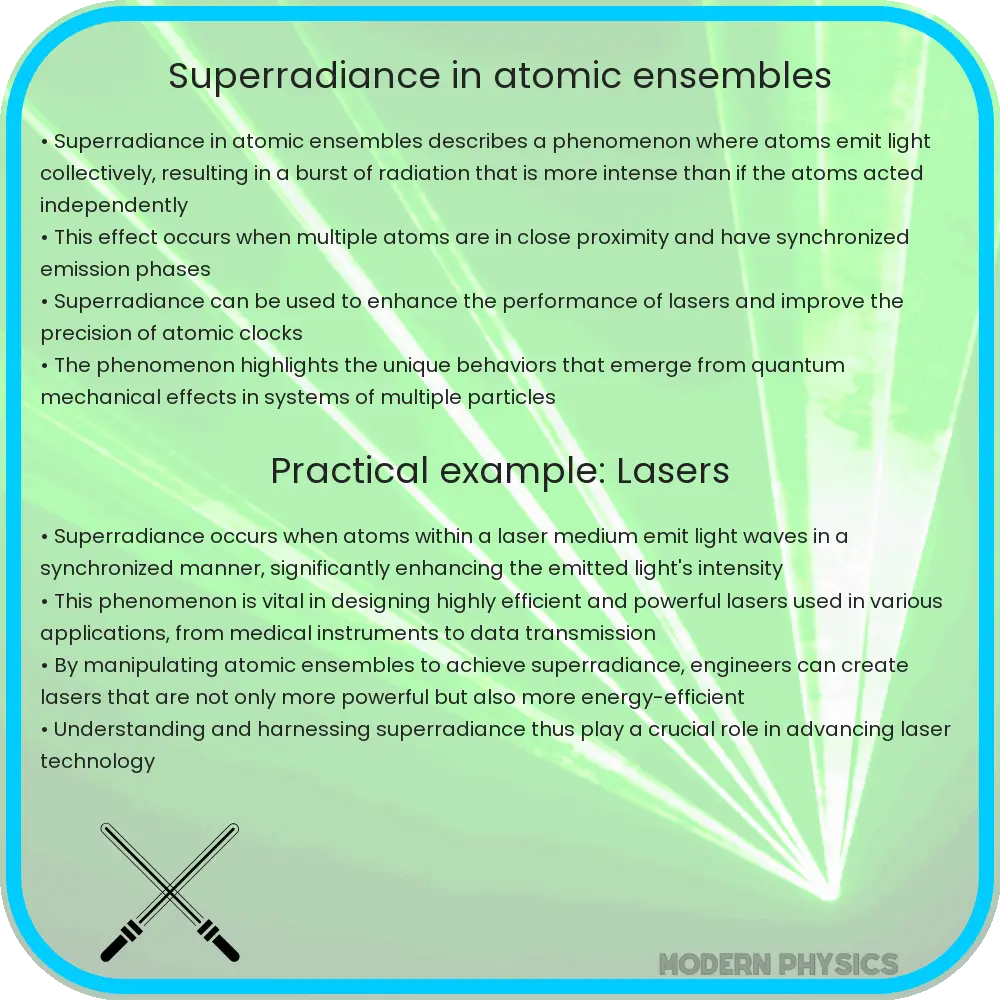
Superradiance is a fascinating phenomenon in physics where a group of atoms collectively emits a burst of energy far stronger than if each atom emitted radiation separately. This happens under specific conditions where the phases of individual atoms become synchronized, allowing for a constructive interference and an enhanced emission of radiation.
How Superradiance Occurs
To grasp the concept more clearly, imagine a group of atoms that have been excited to a higher energy level. Usually, these atoms would independently release photons (light particles) as they return to their ground state. However, if these atoms are in close proximity and their energies are coherent, the emission of photons occurs collectively and in-phase. This synchronicity in photon emission results in a powerful burst of light much greater than the sum of individual emissions, termed as “superradiance”.
Key Effects of Superradiance
- Intensity Enhancement: The total radiative output during superradiance is phenomenally higher compared to normal emission. The intensity of radiation can be orders of magnitude greater than what would be observed if each atom acted independently.
- Shorter Emission Time: Another notable effect of superradiance is the significantly reduced time over which the radiation is emitted. This is because the enhanced cooperative interaction amongst atoms speeds up the process of returning to their ground state.
- Directional Emission: Unlike regular spontaneous emission which is usually isotropic (emitted equally in all directions), superradiant emissions tend to be highly directional. This directional nature of the emitted radiation can be controlled by the configuration of the atomic ensemble.
Superradiance in Atoms
In the context of atoms, superradiance can provide insightful information about the quantum mechanical properties and interaction of light with atomic systems. When atoms within a medium like a gas or a crystal lattice exhibit superradiance, it hints at strong coupling and coherency among the atoms, which is a key aspect in the study of quantum optics and atomic physics.
Researchers can induce superradiance in atomic systems by preparing the atoms in an excited state with a precise coherence. Such setups often involve using laser fields to pump the atoms uniformly, aligning their energy states accordingly to achieve the required synchronization for superradiance to occur.
Applications of Superradiance
Superradiance has potential applications in various fields of science and technology. Here are a few noteworthy ones:
- Laser Development: Understanding and harnessing superradiance can lead to the development of new types of lasers that could operate more efficiently and with higher power outputs than conventional lasers.
- Quantum Computing: Superradiance may enhance the performance of quantum computers by enabling better synchronization and coherence among qubits, potentially speeding up quantum calculations and information processing.
- Imaging Techniques: The directional nature of superradiant emission could improve the resolution and precision of optical imaging systems and microscopes, benefiting medical imaging and materials science.
- Communication Systems: Superradiant devices could be used to create more effective communication links that offer faster data transmission over longer distances with lower losses.
Challenges in Realizing Superradiance
Despite its promising applications, achieving and maintaining superradiance in practical systems involves overcoming several challenges:
- Environmental Interactions: External environmental factors such as temperature fluctuations and electromagnetic interference can disrupt the delicate state of coherence necessary for superradiance.
- System Stability: Keeping a large number of atoms in an excited, coherent state long enough to exhibit superradiance is technologically demanding and requires precise control over the atomic system.
- Scalability: Scaling up the superradiant effect from small groups of atoms to larger assemblies while maintaining efficiency and control is a significant engineering hurdle.
Conclusion
Superradiance represents a remarkable example of quantum mechanics in action, showing how properties like phase synchronization among atoms can lead to extraordinary physical phenomena. While still primarily in the domain of experimental physics, the underlying concepts of superradiance are paving the way for advancements in areas such as laser technologies, quantum computing, and much more. As researchers continue to unravel the complexities of this phenomenon, we may soon see its integration into practical applications that could revolutionize modern technology.
Understanding such intricate physical concepts not only brings us closer to harnessing their potential, but also deepens our appreciation of the natural world. The study of superradiance, therefore, is not just about practical benefits; it is also a compelling journey into the heart of quantum theory and atomic interactions.