
Explore how superconductor-based metamaterials revolutionize energy efficiency, advance technology, and pave the way for future innovations.
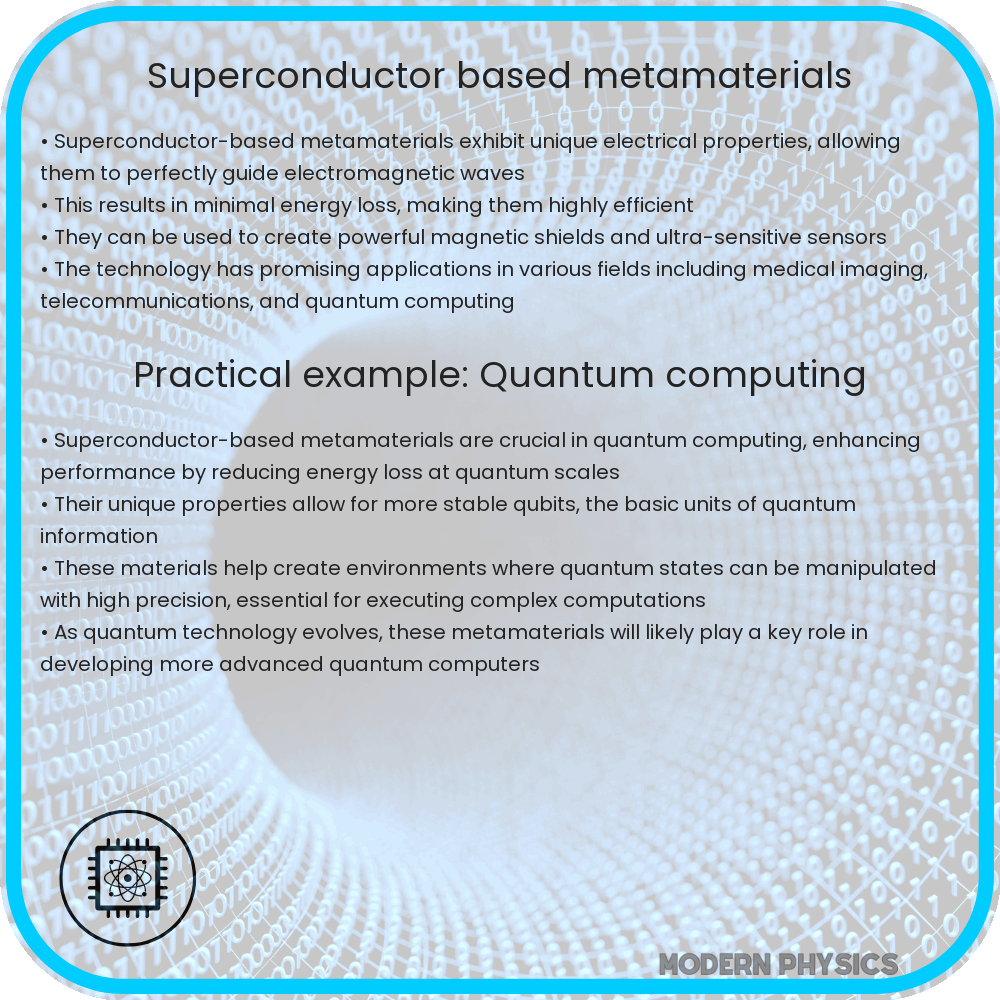
Understanding Superconductor-Based Metamaterials
Superconductor-based metamaterials represent a groundbreaking advancement in the field of materials science, merging the unique properties of superconductors with the versatile design of metamaterials. These innovative materials exhibit characteristics not found in nature, primarily due to their ability to conduct electricity without resistance at very low temperatures. The efficiency and innovation brought about by superconductor-based metamaterials pave the way for new applications across various industries, including telecommunications, medical imaging, and energy.
Efficiency and Innovation in Superconductor-Based Metamaterials
The efficiency of superconductor-based metamaterials lies in their zero electrical resistance at critical temperatures. This property significantly reduces energy losses compared to conventional materials, making them highly desirable for power transmission and electromagnetic applications. Moreover, the innovation in their design allows for the manipulation of electromagnetic waves in unprecedented ways, such as cloaking, superlensing, and the development of perfect absorbers.
- Electromagnetic Manipulation: By designing metamaterials with superconducting elements, scientists can create structures that bend and shape electromagnetic fields, leading to advancements in stealth technology and imaging techniques.
- Quantum Levitation: Superconductor-based metamaterials can exhibit quantum levitation, where they float above a magnetic source due to the Meissner effect, which could revolutionize transportation systems.
- Enhanced Sensing and Imaging: The unique properties of these materials can lead to significant improvements in sensing and imaging technologies, particularly in medical diagnostics and security scanning.
Applications of Superconductor-Based Metamaterials
The potential applications of superconductor-based metamaterials are vast and varied. In telecommunications, they are used to develop filters and antennas that operate with greater efficiency and lower power consumption. In medical imaging, they enhance the performance of MRI machines, providing clearer images while reducing operational costs. Furthermore, their energy-efficient characteristics hold the promise of revolutionizing power grids by reducing transmission losses and improving the overall reliability of electrical systems.
Superconductor-Based Metamaterials: Harnessing Quantum Phenomena for Advanced Applications
Superconductor-based metamaterials represent a groundbreaking frontier in materials science, merging the quantum mechanical properties of superconductors with the engineered structures of metamaterials to create novel functionalities not found in nature. These advanced materials promise to revolutionize industries by significantly enhancing efficiency and enabling new technologies.
Efficiency and Innovation in Energy Systems
One of the most compelling applications of superconductor-based metamaterials lies in energy systems. By leveraging the zero resistance properties of superconductors, these materials can dramatically reduce energy losses in electrical systems, from power grids to electronic devices. This translates into higher efficiency and lower operational costs, addressing global energy challenges and reducing environmental impacts.
- Lossless Power Transmission: Superconducting materials can carry large currents without energy loss, making them ideal for lossless power cables and transformers in electrical grids.
- Enhanced Magnetic Storage: The unique magnetic properties of superconductor-based metamaterials enable more compact and efficient energy storage solutions, crucial for renewable energy integration.
Innovative Applications in Technology and Research
The unique electromagnetic properties of superconductor-based metamaterials have paved the way for revolutionary applications in various technological fields. These include high-performance computing, magnetic resonance imaging (MRI), and even quantum computing, where the manipulation of quantum states requires materials with exceptional electromagnetic characteristics.
- Quantum Computing: Superconductors provide the necessary low-temperature environment for qubits, the basic units of quantum computers, to function without decoherence, enabling faster and more reliable quantum calculations.
- Advanced Imaging Techniques: In medical imaging, superconductor-based metamaterials can improve the signal-to-noise ratio of MRI machines, providing clearer, more detailed images without increasing the magnetic field strength.
Conclusion
Superconductor-based metamaterials stand at the confluence of quantum physics and materials engineering, offering unprecedented efficiencies and enabling technologies that were once deemed impossible. As research continues to advance, these materials are set to transform energy systems, computing, medical imaging, and more, heralding a new era of innovation and sustainability. The journey from theoretical concepts to practical applications highlights the importance of interdisciplinary collaboration in unlocking the full potential of these quantum materials for the betterment of society.