
Explore the efficiency, applications, and emerging trends of superconducting thin films, a key technology shaping the future of energy and tech.
Introduction to Superconducting Thin Films
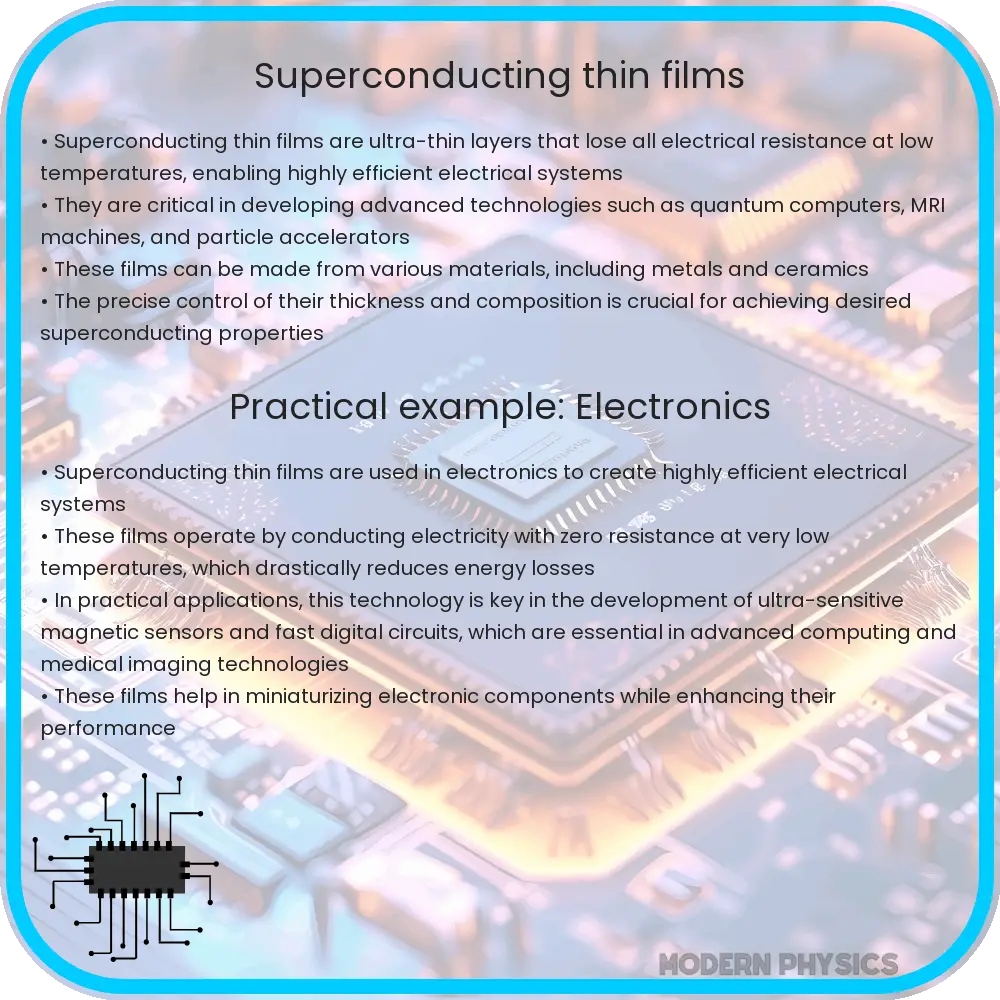
Superconducting thin films represent a significant advancement in the field of materials science, offering unprecedented efficiency and novel applications. These films, typically only a few nanometers thick, are made from superconducting materials that exhibit zero electrical resistance and the expulsion of magnetic fields (Meissner effect) when cooled below a critical temperature. This transformative technology impacts various sectors, including medical, telecommunications, and energy.
Efficiency and Mechanism
Superconducting thin films operate by carrying electric current with no energy loss, a stark contrast to conventional conductors that suffer from resistive heating. This efficiency stems from the pairing of electrons into ‘Cooper pairs’, a phenomenon explained by the BCS (Bardeen-Cooper-Schrieffer) theory. These electron pairs move through a lattice without scattering, eliminating resistance. The critical temperature (Tc), below which this phenomenon occurs, varies among materials but is typically below 20K for conventional superconductors and can be higher in high-temperature superconductors.
Applications of Superconducting Thin Films
One of the most notable applications of superconducting thin films is in the medical field, particularly in magnetic resonance imaging (MRI) machines. These films are used to create powerful and stable magnetic fields, improving image quality while reducing operational costs. Additionally, in telecommunications, superconducting thin films are utilized in radio frequency (RF) filters for cell phone base stations, enhancing signal quality and reducing noise.
- Energy Sector: Superconducting thin films are revolutionizing the energy sector by enabling the development of lossless power cables and more efficient power transformers, significantly reducing transmission losses and improving grid stability.
- Scientific Research: In particle accelerators and fusion reactors, superconducting thin films are critical for generating strong magnetic fields required to control high-energy particles.
The versatility and efficiency of superconducting thin films make them a cornerstone technology in advancing current systems and enabling new applications across various industries.
Emerging Trends and Challenges
The landscape of superconducting thin films is rapidly evolving, with new materials and fabrication techniques emerging. The discovery of iron-based and cuprate superconductors has shifted research towards high-Tc materials, potentially operable at higher temperatures and thus more practical for wider applications. Moreover, advancements in thin film deposition methods, such as molecular beam epitaxy (MBE) and pulsed laser deposition (PLD), have improved the quality and reproducibility of superconducting films.
Despite these advancements, challenges remain. The high cost of material production, the complexity of layering techniques, and the necessity for cryogenic cooling systems are significant hurdles. Additionally, the brittle nature of many high-Tc superconducting films poses durability and longevity issues. Researchers are continuously working to overcome these challenges, aiming to create more robust, cost-effective, and higher temperature superconducting materials.
Future Outlook
The future of superconducting thin films is promising, with potential breakthroughs that could revolutionize energy transmission, quantum computing, and magnetic levitation transport systems. The ongoing research aims not only to enhance the operational efficiency of these films but also to make them more accessible and practical for commercial and industrial applications. As technology advances, the integration of superconducting thin films into everyday devices and systems appears increasingly feasible, promising a future with significantly reduced energy losses and enhanced technological capabilities.
Conclusion
Superconducting thin films are at the forefront of modern materials science, offering unparalleled efficiency and a broad spectrum of applications across various fields. From revolutionizing medical imaging equipment to enabling the development of cutting-edge technological systems, these materials hold the key to significant advancements. Despite facing challenges such as high production costs and the need for cryogenic temperatures, ongoing research and development are paving the way for more practical and economically viable solutions. As the field continues to evolve, superconducting thin films are set to play a crucial role in shaping the future of technology and energy management, heralding a new era of efficiency and innovation.