
Explore the groundbreaking world of superconducting nanomechanical resonators, their precision, uses, and the future of quantum technologies and sensing.
Introduction to Superconducting Nanomechanical Resonators
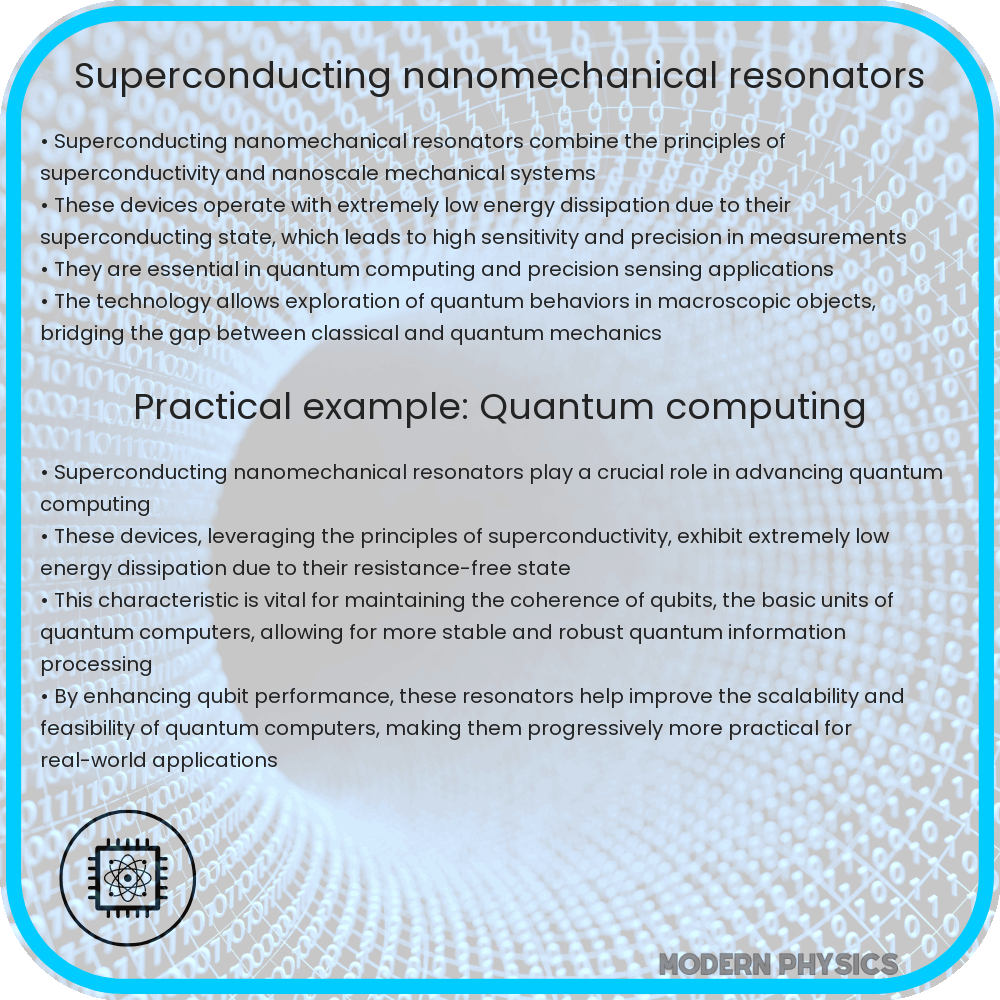
Superconducting nanomechanical resonators represent a pivotal advancement in the field of nanotechnology and quantum computing. These devices, integrating the principles of superconductivity and nanomechanics, are at the forefront of enabling ultra-sensitive measurements and innovative quantum applications. By leveraging the zero-resistance state of superconductors at cryogenic temperatures, these resonators exhibit exceptionally high quality factors and minimal energy dissipation, making them ideal for a variety of high-precision applications.
Precision and Sensitivity
The hallmark of superconducting nanomechanical resonators is their extraordinary precision and sensitivity. These characteristics stem from their ability to operate in the superconducting regime, where electrical resistance vanishes and magnetic flux lines are expelled, a phenomenon known as the Meissner effect. This unique state allows the resonators to maintain coherent oscillations for extended periods, making them highly effective in detecting minute forces, masses, or displacements with unparalleled accuracy.
Key Uses and Applications
- Quantum Computing: Superconducting nanomechanical resonators are integral in the development of quantum computers. They act as quantum bits (qubits) or interfaces between qubits and classical electronic systems, facilitating quantum information processing and storage.
- Sensing and Metrology: Their high sensitivity makes them perfect for applications in sensing tiny changes in mass, force, or displacement, crucial in fields like materials science, biology, and medicine.
- Signal Processing: Leveraging their high quality factors, these resonators can filter or store signals with exceptional precision, benefiting telecommunications and radio-frequency (RF) technologies.
Innovative Advancements and Challenges
Recent innovations in superconducting nanomechanical resonators include the development of hybrid systems that combine with other quantum technologies, such as optomechanical systems or spintronics. These advancements expand their utility in quantum sensing and information processing. However, challenges remain, particularly in maintaining superconductivity at higher temperatures and integrating these systems into larger scalable networks for practical quantum computing and sensing applications.
Materials and Fabrication Techniques
The fabrication of superconducting nanomechanical resonators involves sophisticated processes and materials. Commonly used superconducting materials include niobium (Nb), aluminum (Al), and tantalum (Ta), which exhibit superconducting properties at cryogenic temperatures. The resonators are typically fabricated using advanced nanofabrication techniques such as electron beam lithography (EBL), reactive ion etching (RIE), and atomic layer deposition (ALD), enabling the precise control of their geometric and material properties. This meticulous fabrication process is crucial for achieving the desired quantum mechanical behavior and performance of the resonators.
Future Prospects and Challenges
The future of superconducting nanomechanical resonators is promising, with potential breakthroughs in various domains including quantum computing, nanoscale metrology, and ultra-sensitive detection systems. However, significant challenges remain, such as improving the temperature range in which these devices can operate to reduce reliance on expensive and complex cryogenic systems. Additionally, integrating these resonators into practical and scalable quantum networks requires overcoming technical hurdles related to coherence times, coupling efficiencies, and device uniformity.
Conclusion
Superconducting nanomechanical resonators are at the cutting edge of nanotechnology and quantum mechanics, offering unparalleled precision and sensitivity for a range of applications. Their integration into quantum computing, sensing, and signal processing technologies has the potential to revolutionize these fields. Despite the challenges in material science, fabrication techniques, and quantum coherence, ongoing research and development are paving the way for innovative solutions and the broader application of these remarkable devices. As we continue to unlock the capabilities of superconducting nanomechanical resonators, we move closer to realizing the full potential of quantum technologies and nanoscale engineering, setting the stage for the next generation of scientific and technological advancements.