
Learn about the Strut and Tie Model (STM), a method used in structural engineering for designing reinforced concrete structures.
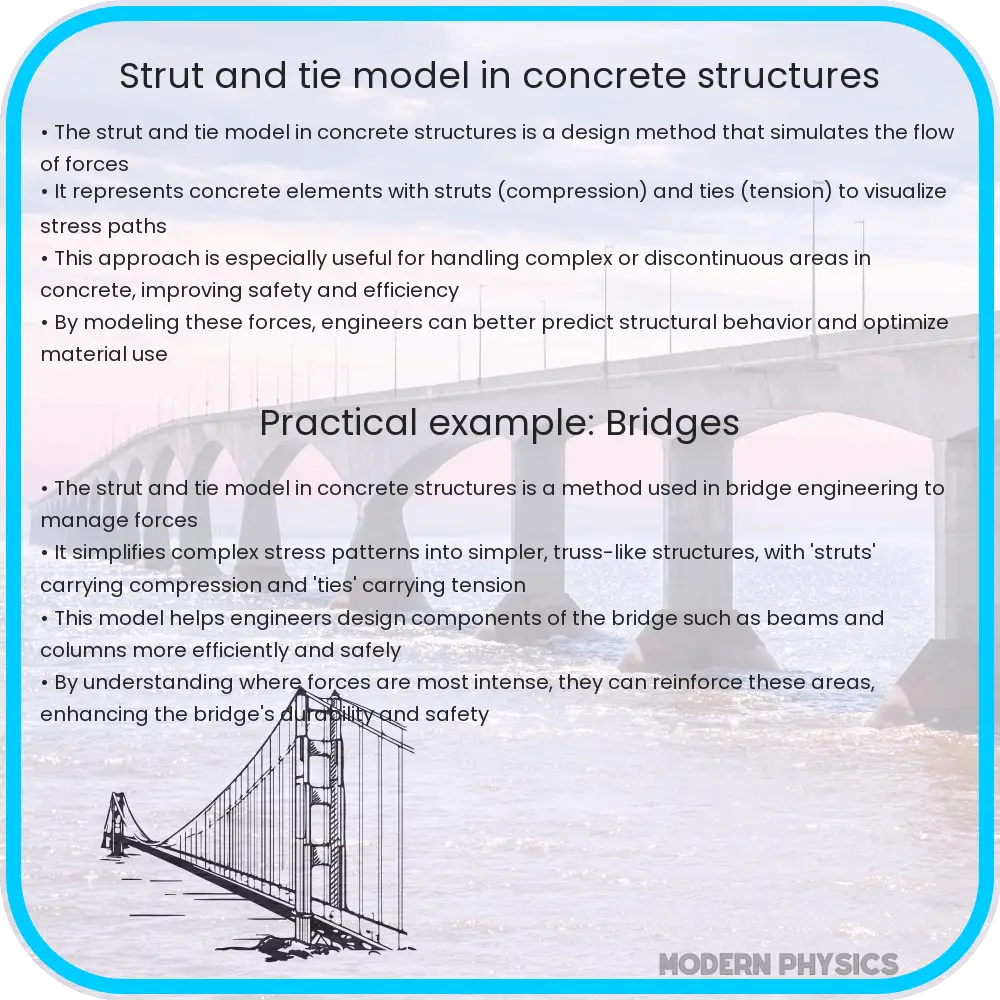
Understanding the Strut and Tie Model in Structural Engineering
The Strut and Tie Model (STM) is a pragmatic method utilized in the design of complex reinforced concrete structures. It is particularly effective in handling parts of a structure that undergo significant stress concentrations, such as disturbances from loads or geometric discontinuities. The beauty of STM lies in its ability to simplify these complexities into a manageable and analyzable form.
This model represents the structure as a collection of struts, ties, and nodes, creating a truss-like model that segments the forces acting on an element into compressive and tensile components. Understanding each component:
- Struts – These are elements that carry compression forces within the structure. Typically, struts are visualized as concrete diagonals transferring loads from points of load application to points of support or discontinuity.
- Ties – These elements handle the tension forces. In reinforced concrete, the ties are represented by the reinforcement bars (rebar).
- Nodes – Nodes are the joint regions within the truss where struts and ties converge and interact. Nodes transfer and distribute forces between struts and ties and are critical to the stability and integrity of the model.
The proper consideration and creation of the strut and tie model follow a sequence of logical steps:
- Delineate the Load Path: Recognize and define the flow of forces through the structure, starting from points of load application to the supports. This step is crucial for identifying where struts and ties will be placed.
- Identification of D-Regions: Detect areas known as D-regions (Discontinuity Regions) where stress concentrations occur or the structural behavior is dominated by shear force or torsion rather than flexural behavior.
- Model Setup: Establish an idealized model using struts, ties, and nodes, ensuring it captures the essence of the stress paths and respects equilibrium and compatibility of deformations.
- Detailing: Apply correct reinforcement detailing principles to ensure the ties and nodes can adequately carry the predicted forces, particularly at the D-regions.
The STM is not just about creating a practical framework for handling concrete’s discontinuities; it’s also about optimizing the usage of materials and ensuring the structural efficiency of elements under various load conditions. By using STM, engineers can design more effective and safer structures, as it contributes significantly to a better understanding of concrete behavior under complex load configurations.
Moreover, the method provides significant insights into the potential failure mechanisms which can influence the design decisions from the conceptual stage all the way to the construction phase. Implementing STM can also aid in avoiding overly conservative designs, thereby saving resources and reducing unnecessary costs.
Key Benefits and Applications of the Strut and Tie Model
Utilizing the Strut and Tie Model in engineering not only simplifies the complexities involved in structural design but also enhances safety and manages materials effectively. Here are some of the key benefits:
- Clarity in Complex Areas: STM excels in areas with geometrical or loading complications, providing a clear method for engineers to follow and rationalize these irregular sections.
- Resource Efficiency: By effectuating a more accurate prediction of how much material is needed and where, STM can lead to significant material savings and structural cost reductions.
- Enhanced Safety: The method allows for a more detailed consideration of force transmissions and potential failure paths, leading to designs that inherently integrate safety considerations.
- Auniversal Application: While particularly valuable in concrete construction, STM’s principles can be adapted for use in understanding and designing other structural forms and materials.
With these profound benefits, the Strut and Tie Model finds applications across a range of engineering tasks..shortcuts in solving complex structural issues. From bridge piers to beam-column joints and even in retrofitting works, STM has proven to be an indispensable tool in the engineer’s toolkit.
Practical Case Studies Demonstrating STM Effectiveness
Several real-world applications underscore the effectiveness of the Strut and Tie Model. For instance:
- Bridge Design: In bridge design, specifically for areas under heavy vehicle load, STM has been used to identify and enhance the stress distribution patterns in the bridge deck and supports, ensuring durability and reliability.
- High-rise Buildings: For skyscrapers subject to various forces such as wind and seismic activity, STM aids in designing robust nodes and connections essential to withstand these dynamic loads.
- Restoration Projects: Historical building renovations employ STM to maintain structural integrity while introducing modern reinforcements in a manner consistent with the original architecture.
These practical implementations highlight STM’s versatility and its capability to provide tailored solutions which ensure both structural integrity and cost-effectiveness.
Conclusion
The Strut and Tie Model stands out as a crucial conceptual and practical tool in structural engineering. By breaking down complex structural problems into more manageable components, STM allows engineers to focus on critical stress points and optimal material distribution. This approach not only leads to safer and more dependable structures but also promotes a resource-efficient and economical construction process. Moreover, the universal adaptability of the Strut and Tie Model ensures its relevance across different architectural and engineering scenarios, making it a valuable asset in the field of structural engineering. In embracing STM, the engineering community takes a significant step towards innovative, rational, and sustainable design.