
Learn about structure-borne sound, which refers to vibrations that travel through solid materials and contribute to unwanted noise in various environments.
Understanding Structure-Borne Sound
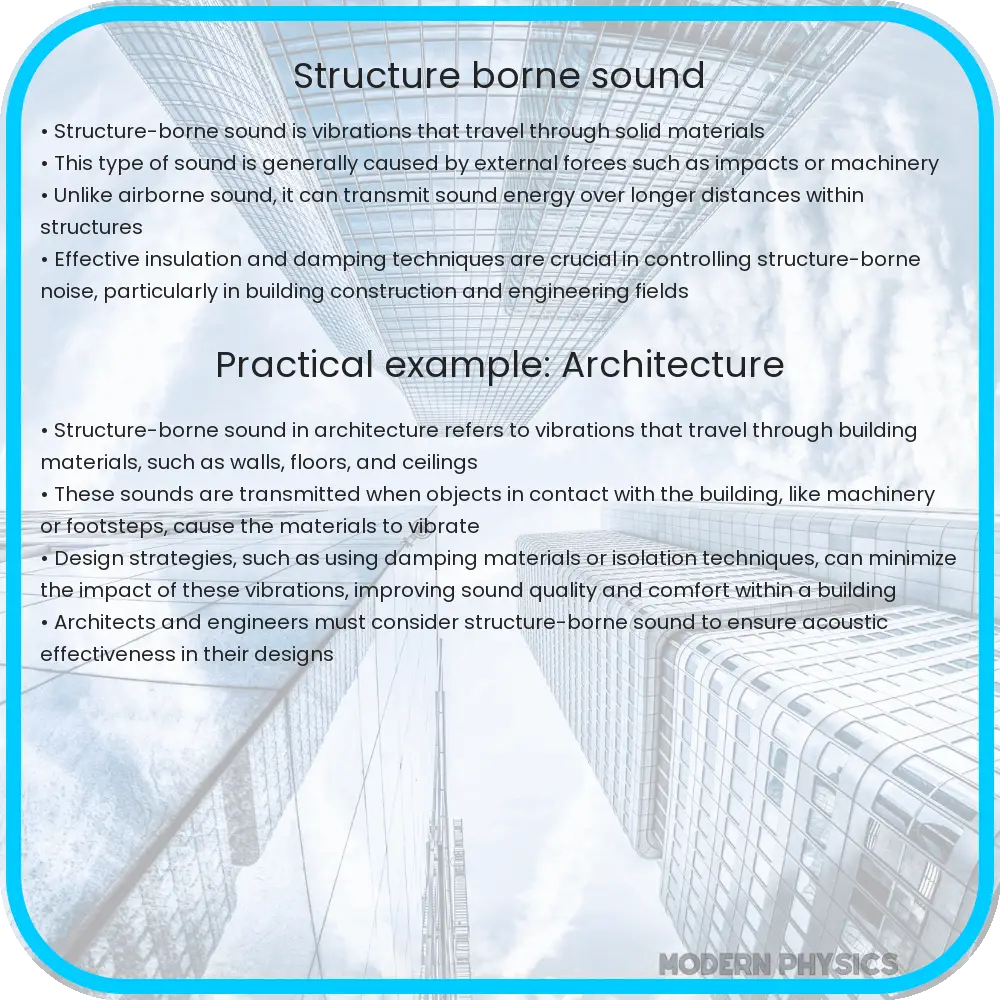
Structure-borne sound refers to the vibrations that travel through solid materials—often resulting in unwanted noise. This type of sound transmission is a common concern in building acoustics, machinery, and transportation industries. Understanding how structure-borne sound is generated and propagated can help in designing more effective noise control strategies.
Sources and Propagation of Structure-Borne Sound
The primary sources of structure-borne sound include mechanical machinery, human activities (like walking or moving furniture), and environmental factors (such as wind or traffic). When an object vibrates, it causes microscopic displacements in the molecules of the material it is in contact with, transferring energy in the form of sound waves. Unlike airborne sound, which propagates through gases (like air), structure-borne sound travels through solids—such as metals, wood, and concrete.
Once initiated, these vibrations travel through buildings or other structures in various ways, depending on the type of material and its inherent properties like elasticity, density, and internal damping. The efficiency of this sound transmission is usually measured using parameters such as transmission loss or insertion loss.
Mathematical Modeling of Structure-Borne Sound
The propagation of structure-borne sound can be described using mathematical equations that relate the vibrational energy to the physical properties of the material. One basic equation often used is:
v(t) = A*sin(2πf*t + φ)
Where:
v(t)represents the velocity of the particle at timet,Ais the amplitude of the wave,fis the frequency,φis the phase angle,tis the time.
This simple model helps in understanding the wave nature of sound traveling through structures, though real-world applications often require more complex calculations involving multiple dimensions and materials with varying characteristics.
Effects of Structure-Borne Sound
The presence of structure-borne sound can significantly impact the acoustic comfort within a space. In residential and office buildings, for example, this type of noise can lead to increased stress and decreased productivity. Moreover, in industrial settings, excessive vibration can cause damage to machinery and infrastructure, leading to higher maintenance costs and potential safety hazards.
Mitigation Techniques in Brief
To reduce the effects of structure-borne sound, several mitigation techniques are employed. These include the use of damping materials, isolation systems, and structural modifications aimed at absorbing or blocking the path of sound energy. Simple solutions might involve using rubber pads under machinery or floating floors to minimize direct contact with the building structure. More advanced strategies could include designing building elements with specific geometric properties to disrupt the transmission pathway.
By applying these principles, engineers and architects can significantly improve the acoustic environment, enhancing the comfort and safety of inhabitable spaces. In the next part, we will delve deeper into specific mitigation strategies and their applications in real-world scenarios.
Real-World Applications of Mitigation Strategies
Across various industries, practical applications of structure-borne sound mitigation strategies can be observed. In the construction sector, engineers use specially designed joists and building materials that reduce the transmission of vibrations between floors. Automotive manufacturers incorporate vibration damping materials within engine mounts and body panels to enhance the acoustic comfort of vehicles. Furthermore, in the field of precision manufacturing, isolation tables and anti-vibration mounts are essential to ensure the accurate functioning of sensitive equipment like microscopes and scales.
Measuring the Effectiveness of Mitigation Techniques
To determine the effectiveness of various sound mitigation techniques, specific metrics and testing procedures are utilized. The most common method is to measure the Sound Transmission Class (STC) rating, which quantifies how well a structure isolates airborne sound. For structure-borne sound, similar tests assess the vibration reduction index or evaluate the impact insulation class (IIC) of a material or assembly. These measurements help compare different materials and designs, guiding the selection of the most effective noise control solutions.
Challenges in Controlling Structure-Borne Sound
Despite advancements in technology and material science, controlling structure-borne sound presents several challenges. One major difficulty is accurately predicting how sound waves travel through complex materials and structures. Each building or machine has its unique characteristics, meaning standardized solutions often require customization. Additionally, balancing sound mitigation with other design necessities, such as structural integrity and cost-effectiveness, requires innovative thinking and careful planning.
Conclusion
Structure-borne sound, a prevalent issue in many engineering and architectural fields, affects both the integrity of structures and the well-being of individuals. Through the careful study of its sources and propagation, along with effective mitigation techniques, professionals can design environments that minimize unwanted noise and enhance comfort. The continued development and application of advanced materials and designs highlight the ever-evolving nature of engineering solutions aimed at combating noise pollution. As we move forward, the synergy between theoretical research and practical applications will be key to addressing the multifaceted challenges of structure-borne sound in our dynamically built and industrial environments.