
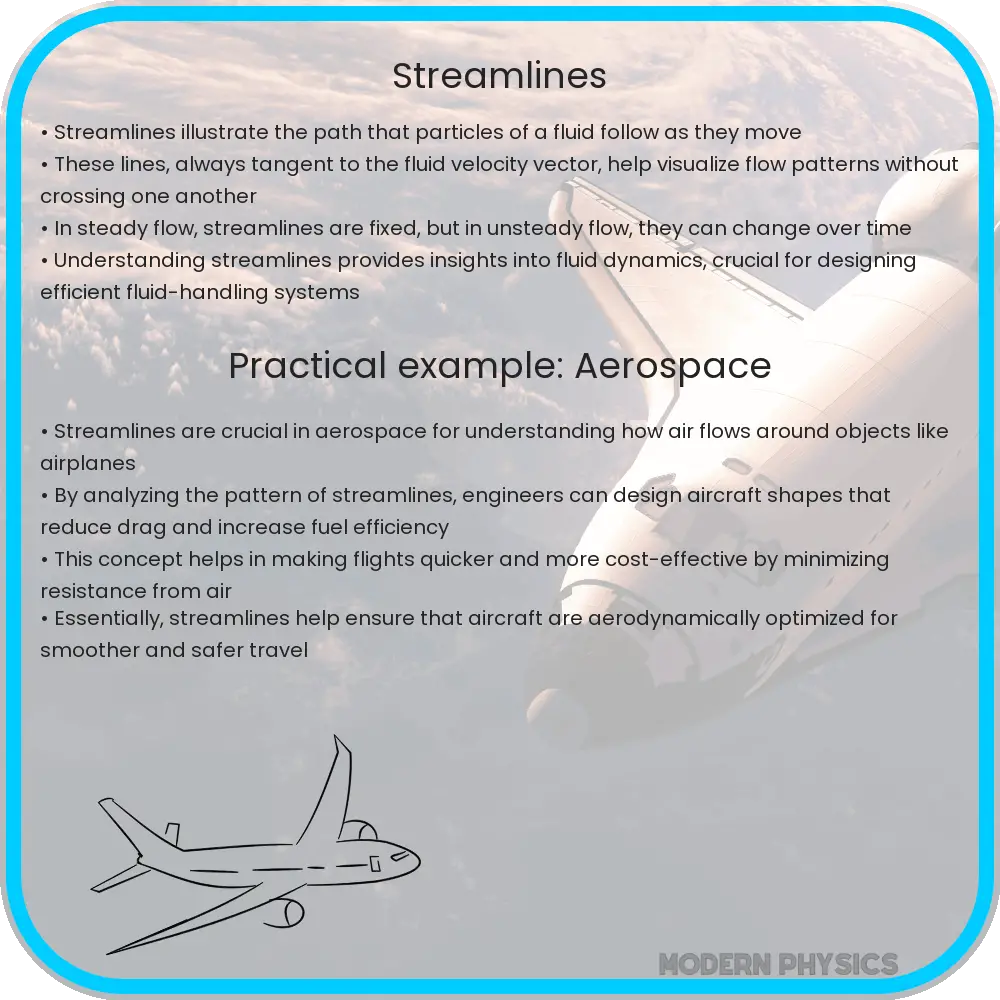
Streamlines in hydrodynamics represent the flow of fluids, with tangents at any point indicating the fluid’s velocity direction, crucial for engineering and scientific analysis.
Understanding Streamlines in Hydrodynamics
Hydrodynamics, a subfield of fluid dynamics, plays a crucial role in understanding how fluids such as water and air move. One of the fundamental concepts in hydrodynamics is that of streamlines. Streamlines are imaginary lines that show the flow of a fluid in a way that a tangent to the curve at any point gives the direction of the velocity field at that point. This visualization helps scientists and engineers comprehend how fluids flow around objects and can be pivotal in various applications ranging from aviation to hydropower generation.
Flow Visualization Techniques
To study how fluids behave in different situations, engineers use various flow visualization methods. These methods make the invisible air or water flow patterns visible, allowing for a more tangible understanding of how fluids move. Some common techniques include:
- Smoke or Dye Injection: In this technique, a colored dye or smoke is introduced into the fluid. As the fluid moves, the dye traces out the flow lines, creating visible streamlines.
- Particle Image Velocimetry (PIV): This sophisticated technique involves seeding the fluid with tracer particles and using advanced cameras and lasers to capture images of particle movement over time. By analyzing these images, the flow pattern can be mapped accurately.
- Computational Fluid Dynamics (CFD): CFD uses algorithms and numerical analysis to simulate and study fluid flows based on the Navier-Stokes equations, which describe the motion of fluid substances. This method allows for highly detailed and technically exhaustive flow modeling.
Each of these techniques offers a unique way to understand fluid dynamics and optimize the flow for various engineering purposes.
Efficiency in Fluid Flow
The efficiency of fluid flow is an essential consideration in many engineering designs, particularly in systems involving the transport of liquids or gases. Streamlines play a key role in enhancing efficiency by influencing the design of flow channels to minimize resistance and turbulence. For instance, a smoothly curving duct encourages laminar flow which is less chaotic and more energy-efficient compared to turbulent flow. Moreover, understanding streamline patterns helps in reducing drag on submerged or flying objects, thus improving performance and reducing energy costs.
Streamline Patterns and Their Significance
Streamline patterns can vary greatly depending on the fluid’s velocity, viscosity, and interactions with surfaces. Some typical patterns include:
- Laminar Flow: In laminar flow, streamlines are parallel, indicating smooth and orderly motion of the fluid. This type of flow is typical at low velocities and in viscous fluids.
- Turbulent Flow: At high velocities or in less viscous fluids, the flow tends to become chaotic and mixed, which is indicated by crossed or intertwined streamlines.
- Reattachment and Separation: Strikingly evident in airflows around wings or water flows around bridge piers, these features occur when the fluid flow separates from the surface and later reattaches, creating complex streamline patterns.
Each of these patterns has specific implications for the design of equipment and structures via which fluids move. By optimizing these structures according to the flow patterns, engineers can achieve more efficient, durable, and effective designs.
Real-World Applications of Hydrodynamic Principles
Understanding hydrodynamics and streamline behavior is critical for practical applications across various industries. Here are a few examples where streamlines and fluid dynamics broadly impact design and functionality:
- Aerospace Engineering: In aircraft design, streamline analysis helps in shaping the body and wings to reduce air resistance, thereby enhancing fuel efficiency and speed.
- Marine Engineering: Ship hulls are designed to optimize water flow, minimizing drag and preventing turbulent flows that can decrease operational efficiency.
- Civil Engineering: Streamlines are crucial in the design of bridges and buildings to ensure they withstand environmental pressures caused by wind or water flows.
- Environmental Science: Ecologists use hydrodynamics to study and manage aquatic ecosystems, ensuring that water flow supports biodiversity and pollutant dispersion is minimized.
By integrating these principles, professionals not only optimize design but also contribute to sustainability through more efficient resource utilization.
Conclusion
Streamlines are much more than just theoretical constructs in fluid dynamics; they are integral to a vast array of practical applications in engineering and environmental management. Whether through creating more efficient aircraft, designing better-performing cars, shaping the flow of rivers, or even predicting weather patterns, the visualization and understanding of streamline flows allow for innovations that enhance performance and reduce environmental impact. As visualization technology advances and our understanding of fluid dynamics deepens, the future of engineering and environmental optimization looks promising. Embracing these concepts is crucial not only for engineers and scientists but also for anyone interested in the sustainable management and design of our physical world.