
Explore the essentials of step-down transformers, focusing on their efficiency, compact design, and versatile applications in modern electrical engineering.
Understanding Step-Down Transformers: Efficiency, Compactness, and Versatility
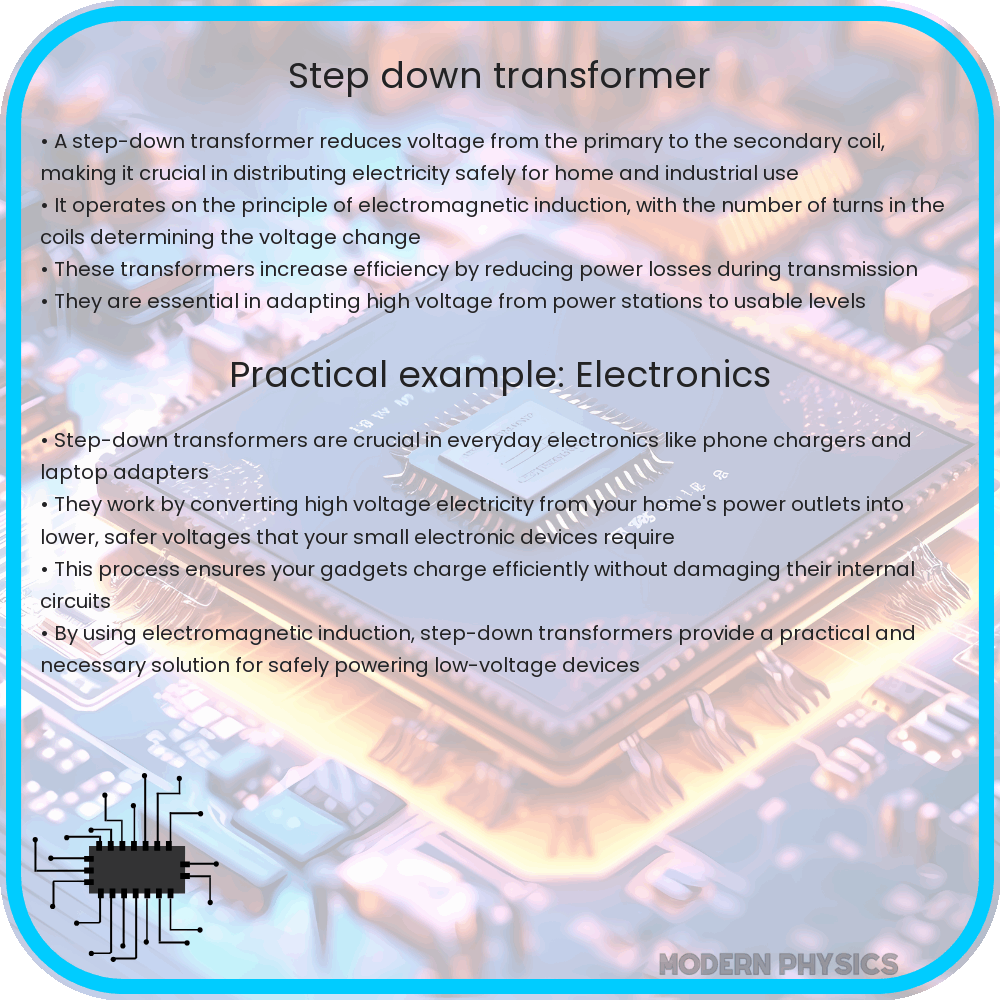
Step-down transformers are a pivotal component in modern electrical engineering, playing a crucial role in the efficient and safe distribution of electricity. These devices “step down” the voltage from a higher level to a lower level, making it suitable for use in homes, offices, and various industrial applications. In this article, we explore the fundamentals of step-down transformers, their efficiency, compact design, and versatility, providing an essential guide for both professionals and enthusiasts.
Principle of Operation
At the heart of a step-down transformer is the principle of electromagnetic induction, discovered by Michael Faraday in 1831. A transformer consists of two coils: the primary coil, which receives the high voltage input, and the secondary coil, which delivers the reduced voltage output. These coils are wound around a core, typically made of iron, to enhance magnetic coupling. When an alternating current (AC) flows through the primary coil, it creates a varying magnetic field that induces a voltage in the secondary coil, thus stepping down the voltage.
Efficiency and Energy Losses
One of the key advantages of step-down transformers is their high efficiency. Most transformers achieve an efficiency rate of 95-99%. This efficiency is due to minimal energy loss, primarily in the form of heat. The losses are categorized into two types: copper losses (occurring due to resistance in the coils) and iron losses (caused by hysteresis and eddy currents in the core). Advanced design techniques, such as using high-quality materials and minimizing the gap between coils, further reduce these losses.
Compact Design
The compactness of modern step-down transformers is a result of advanced design and material innovations. By optimizing the core material and coil windings, manufacturers have significantly reduced the size of transformers without compromising their capacity or efficiency. This compactness is particularly beneficial in applications where space is a premium, such as in urban power distribution networks or onboard electronic devices.
Versatility in Applications
Step-down transformers are extremely versatile, finding applications in various sectors. In power distribution, they are crucial for adjusting the voltage from high-voltage transmission lines to levels suitable for residential and commercial use. In electronics, they are used in adapters and chargers to convert the standard mains voltage to lower levels required by devices. Their role is also significant in industrial settings, where they are used to operate machinery at safe voltage levels.
Advanced Features and Safety Considerations
Modern step-down transformers incorporate several advanced features enhancing their functionality and safety. One such feature is voltage regulation, which maintains a constant output voltage even with fluctuations in the input voltage. This is crucial for sensitive electronic equipment that requires a stable power supply. Additionally, thermal overload protection is often integrated to prevent damage from overheating, thereby extending the transformer’s lifespan and ensuring safety.
Environmental Impact and Energy Efficiency
Environmental considerations are increasingly becoming a priority in transformer design. The latest models are designed to be more energy-efficient, thereby reducing carbon footprints. Some are filled with biodegradable insulating fluids, which are less harmful to the environment compared to traditional oil-based coolants. The focus on reducing electromagnetic field emissions also contributes to a safer and more environmentally friendly operation.
Customization and Specialized Applications
The adaptability of step-down transformers extends to their customization possibilities. Manufacturers can tailor transformers to specific needs, such as particular voltage requirements, size constraints, or environmental conditions. This customizability makes them ideal for specialized applications in industries like aerospace, marine, and renewable energy, where standard solutions might not suffice.
Conclusion
In conclusion, step-down transformers are indispensable in our modern electrical infrastructure, characterized by their efficiency, compactness, and versatility. Their advanced design minimizes energy losses and accommodates a wide range of applications, from household electronics to large-scale industrial machinery. The continuous evolution in their design, focusing on energy efficiency and environmental friendliness, underscores their critical role in a sustainable future. As technology advances, step-down transformers will undoubtedly continue to evolve, playing a key role in meeting the world’s growing and diverse energy needs.