
Explore the fascinating world of starquakes: uncover their causes, detection methods, and the astrophysical insights they provide into the universe’s stellar phenomena.
Understanding Starquakes: Causes and Detection
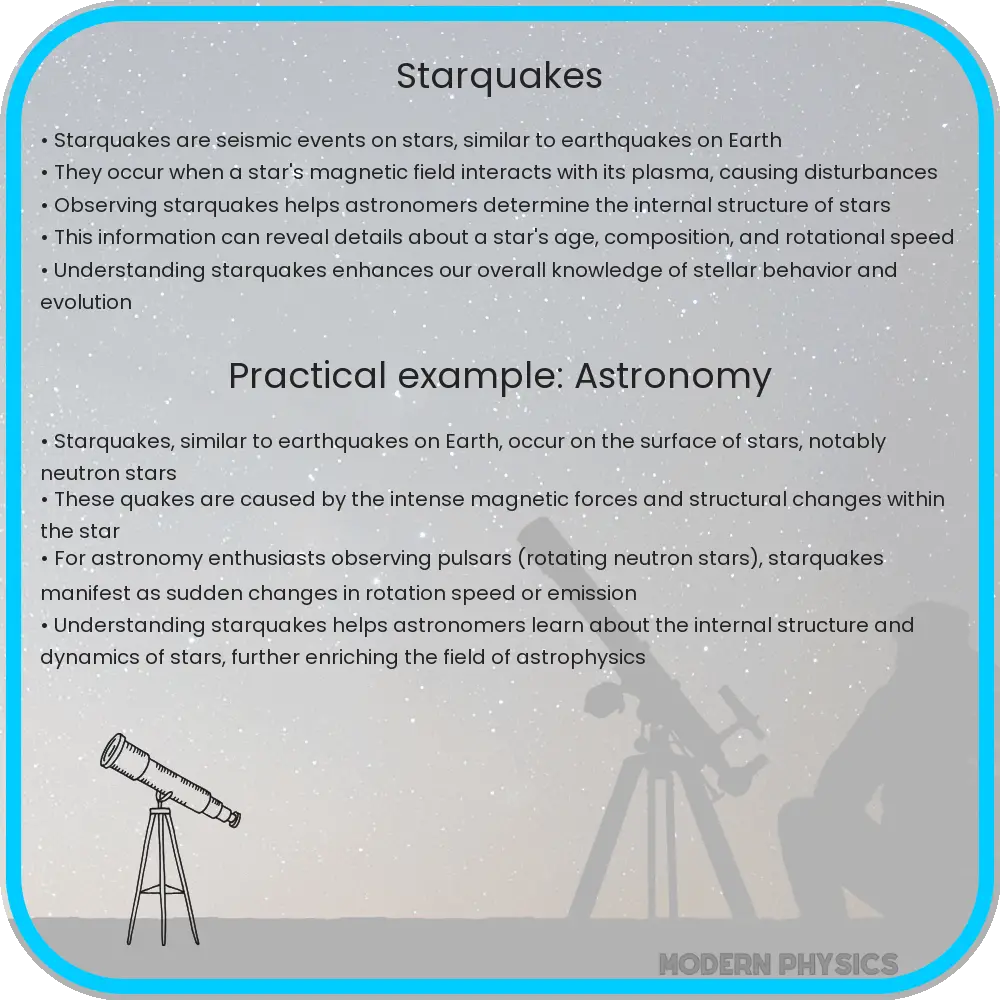
Starquakes, akin to earthquakes on Earth, are seismic events that occur on the surface of stars. These cosmic quakes provide astronomers and astrophysicists with valuable insights into the internal workings of stars. Understanding the causes and detection of starquakes is essential for unraveling the mysteries of stellar structures and evolution.
Causes of Starquakes
The primary cause of starquakes is the immense and complex magnetic activity within a star. In stars like the Sun, magnetic energy accumulates and gets stored in the star’s outer layers. This energy can become suddenly released, causing the stellar surface to shake or quake, similar to the release of tectonic stress during an earthquake.
Another contributing factor is the rotational energy of a star. Stars are not solid bodies; they can rotate at different speeds at the equator compared to the poles. This differential rotation can cause stresses that lead to starquakes. Additionally, as stars age and their nuclear fuel depletes, changes in their internal structure can also trigger seismic activities.
Detection of Starquakes
Starquakes are primarily detected through asteroseismology, a branch of astronomy that studies the oscillations and seismic waves in stars. By analyzing variations in the light emitted by a star, scientists can infer the presence of seismic activities. These variations occur because the oscillations change the star’s shape, affecting its brightness.
The most common method used to detect these variations is photometry, which involves measuring the star’s brightness over time. Space telescopes like Kepler and TESS have been instrumental in detecting thousands of starquakes, providing data that help scientists understand the interior composition and processes of stars.
Spectroscopy is another method used to detect starquakes. By examining the spectrum of a star, astronomers can detect shifts caused by the Doppler effect as the star’s surface oscillates. This information helps determine the size, density, and even the internal rotation of stars.
Together, these methods allow astrophysicists to “listen” to the stars, decoding the information carried by seismic waves to paint a detailed picture of a star’s internal structure and dynamics.
Understanding Starquakes
Starquakes are seismic phenomena occurring on the surface of stars, including our Sun. They are similar to earthquakes but occur in the high-pressure, plasma-filled environments of stars. Starquakes provide critical insights into the internal structure and dynamics of stars, helping astrophysicists understand stellar life cycles, magnetic fields, and energy transport mechanisms.
Causes of Starquakes
Starquakes can be triggered by various factors. One primary cause is the magnetic activity within the star, where magnetic energy accumulated in the star’s atmosphere is suddenly released. This process is akin to the magnetic reconnection events seen in the Earth’s magnetosphere but on a vastly larger scale. Another cause is structural rearrangements within the star, particularly in neutron stars, where the crust undergoes sudden shifts due to the intense gravitational and magnetic forces at play.
Detection and Measurement
Starquakes are detected through astroseismology, which analyzes the oscillations and vibrations within a star. Techniques such as Doppler imaging and photometric measurements allow scientists to record these oscillations, leading to a better understanding of the star’s internal processes. In the case of neutron stars, starquakes can lead to sudden changes in rotation speed, known as “glitches,” which are detectable by precise timing of pulsar signals.
Astrophysical Insights
Studying starquakes reveals information about the internal composition and structure of stars. For neutron stars, this includes insights into the state of matter under extreme pressures and temperatures. For other stars, starquake data can reveal details about internal rotation, magnetic field structures, and energy transfer processes. This information is crucial for validating theoretical models of stellar dynamics and evolution.
Conclusion
Starquakes offer a unique window into the complex internal mechanics of stars. They not only help scientists validate existing astrophysical models but also challenge and refine our understanding of stellar phenomena. The ongoing advancements in detection methods and theoretical models continue to illuminate the mysterious inner workings of stars, contributing significantly to our knowledge of the cosmos. As we unlock more secrets held by these celestial bodies, we edge closer to unraveling the mysteries of the universe.