
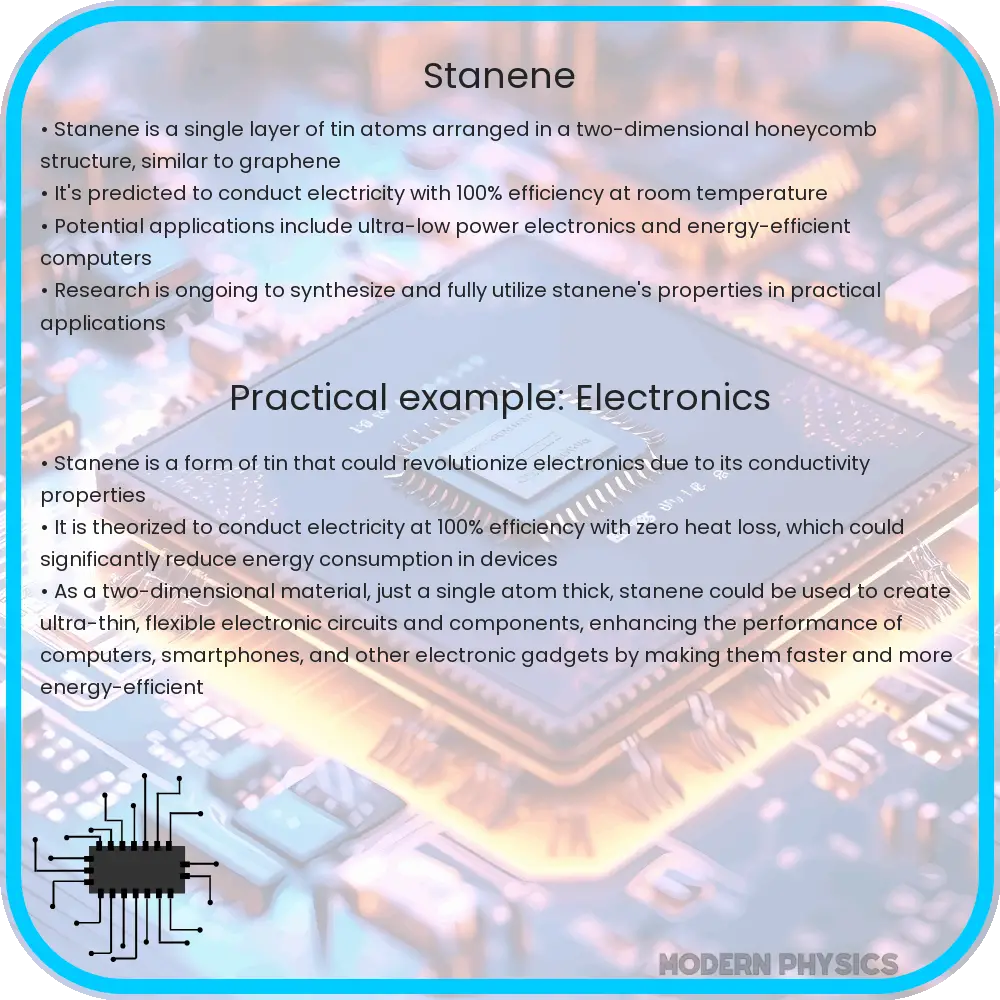
Stanene is a revolutionary 2D material made of tin atoms, predicted to offer zero-resistance conductivity and outstanding thermal properties, potentially transforming electronics and energy efficiency technologies.
Introduction to Stanene: The Next Frontier in Material Science
Stanene is a groundbreaking new material in the field of condensed matter physics and material science. Its discovery and subsequent development have illustrated potential applications that could revolutionize multiple industries, from electronics to energy efficiency technologies. At its core, stanene is a single layer of tin atoms arranged in a two-dimensional (2D) lattice. Its structure and unique properties have placed it at the forefront of innovative materials that are expected to shape the future of conductivity and electronic devices.
Discovery of Stanene
Stanene was first predicted by theorists in 2013 and has since captured the attention of researchers worldwide. This material belongs to the family of 2D materials, similar to graphene, which consists of a single layer of carbon atoms. Stanene’s structure exhibits a hexagonal arrangement reminiscent of graphene, but with potentially superior properties in electrical conduction, particularly at room temperature.
Unique Properties of Stanene
What makes stanene particularly interesting is its promise as a topological insulator which supports conductive properties along its edges while remaining insulating in its middle. This unique feature stems from its robust “spin-orbit” interaction among the tin atoms.
- Zero-Resistance Conductivity: The most compelling property of stanene is its predicted ability to conduct electricity with zero resistance at temperatures up to 100 degrees Celsius. This characteristic could reduce energy losses in electronic circuits, making devices more energy-efficient than ever before.
- Thermal Conductivity: Stanene might not only revamp electrical applications but also thermal ones. Its high thermal conductivity suggests it could play a crucial role in heat management in electronics, potentially leading to faster, smaller, and more efficient devices.
- Compatibility with Silicon: Another advantage of stanene is its compatibility with existing semiconductor technology. Stanene can potentially be integrated with silicon, encouraging more efficient electronics without necessitating a complete overhaul of current manufacturing processes.
Applications and Future Potential
Stanene’s intrinsic properties promote its application in several key areas of technology. In electronics, it could lead to the development of transistors that are not only faster but also more energy-efficient. Furthermore, stanene might pave the way for advancements in quantum computing by facilitating stable, high-performance qubits. Additionally, its unique conductivity could find applications in the creation of ultra-sensitive sensors, enhancing detection and diagnostic technologies.
The potential uses of stanene extend even beyond the realm of electronics and sensors. Its robustness against degradation and environmental resilience suggest it could also serve well in harsh or extreme environments, opening up possibilities in aerospace and automotive industries.
Challenges and Research Directions
Despite stanene’s promising characteristics, its journey from the laboratory to industrial application faces several challenges. Key among these is the difficulty in producing large quantities of high-purity stanene sheets. Current synthesis methods are complex and not yet suitable for large-scale production. Innovations in these processes are crucial for stanene to fulfill its potential.
Another challenge is the stability of stanene’s unique properties under practical working conditions. Researchers are exploring the effects of temperature fluctuations, exposure to air, and mechanical stress on stanene to ensure its robustness in real-world applications.
- Scalability: Efforts are ongoing to refine techniques like chemical vapor deposition (CVD) to improve the yield and quality of stanene.
- Durability: Studies are being conducted to enhance the environmental stability of stanene, preventing degradation over time and under various conditions.
- New Alloy Compositions: Scientists are experimenting with doping stanene with other elements to enhance its properties, potentially opening new applications and improving performance.
Collaborative Opportunities
The development of stanene offers ample opportunities for collaboration between academia, industry, and governmental agencies. Such partnerships are essential for pooling resources, sharing expertise, and accelerating the research and development phases. Through collaborative efforts, the scientific community can overcome the hurdles more effectively and bring stanene closer to practical application.
Conclusion
Stanene is more than just another material; it represents a significant advancement in the field of material sciences with the potential to transform technologies across various industries. Its extraordinary electrical and thermal conductivity, combined with the ability to integrate with existing semiconductor technology, makes it a candidate likely to play a pivotal role in the future of electronics, computing, and beyond. While challenges remain in synthesizing and implementing stanene on a commercial scale, the ongoing research and development aimed at understanding and leveraging its unique properties hold great promise. With continued effort and collaboration, the development of stanene is poised to mark a new era in material innovation.