
Stall delay in hydrodynamics affects the flow around marine vehicles and turbine blades, impacting their performance and efficiency.
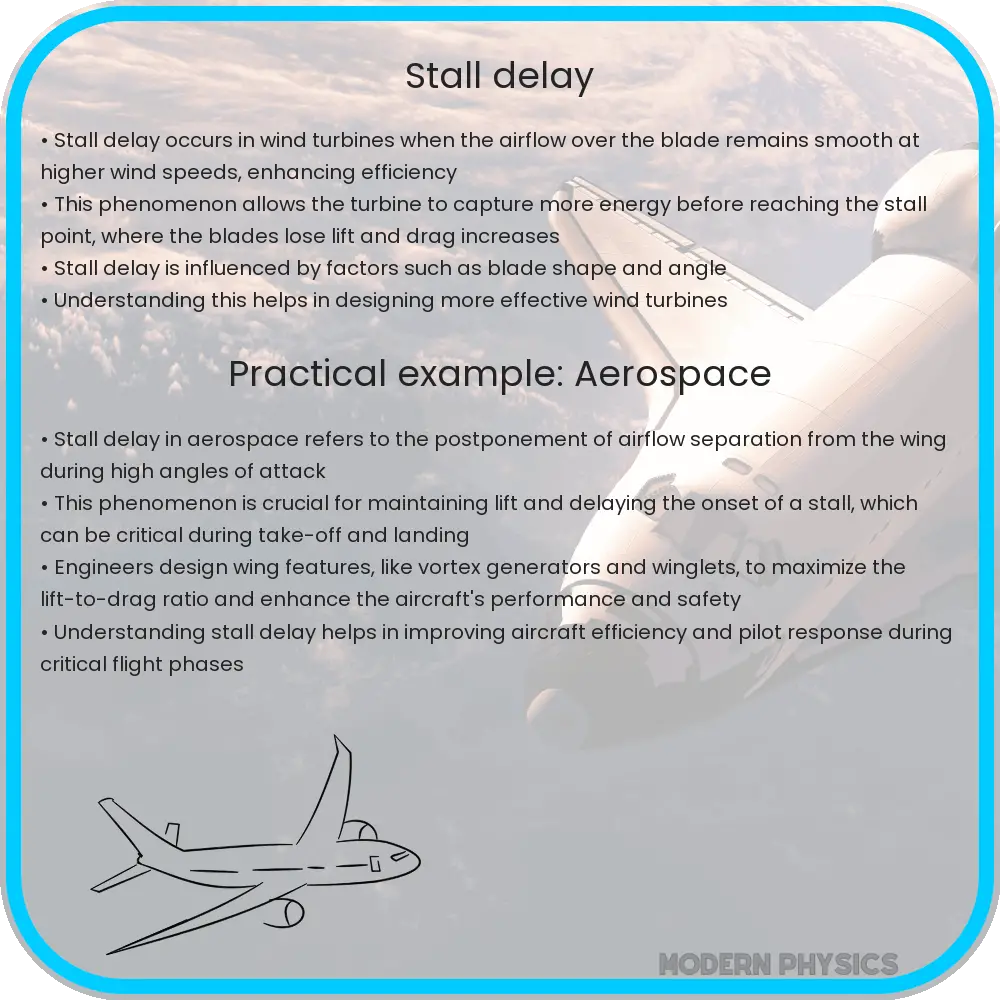
Understanding Stall Delay in Hydrodynamics
Stall delay is an important concept in the field of hydrodynamics, particularly relevant to the design and operation of marine vehicles and turbine blades. This phenomenon occurs when the flow of liquid around a body, such as a propeller blade or a ship’s hull, encounters conditions that disrupt the usual smooth flow, leading to a reduction or delay in the stall.
Causes of Stall Delay
Stall delay primarily arises due to the interaction between fluid dynamics and the geometry of the object moving through the fluid. Several factors contribute to this phenomenon:
- Angle of Attack: The angle at which a blade or a surface meets the flow of fluid is crucial. A higher angle of attack may increase lift but can lead to stall as flow separation begins at lower speeds.
- Speed of the Fluid: As speed increases, the flow may transition from laminar (smooth) to turbulent, affecting the pressure distribution around the object and influencing stall characteristics.
- Surface Roughness: The texture of the surface in contact with the fluid can affect flow attachment. A smoother surface typically reduces flow separation delay, whereas rough surfaces may promote it.
- Pressure Gradients: Adverse pressure gradients, where pressure increases along the flow direction, can encourage flow separation, leading to an earlier onset of stall or a stall delay under certain conditions.
Effects of Stall Delay
Understanding the effects of stall delay is critical for improving the efficiency and safety of marine and aeronautical designs. Key impacts include:
- Performance Efficiency: Stall delay can significantly affect the lift-to-drag ratio, a key indicator of performance efficiency. Delays in stall can lead to higher lift at critical angles, enhancing performance.
- Control and Stability: In vehicles like ships and submarines, delayed stall can impact maneuverability and stability, particularly in challenging conditions.
- Noise and Vibration: Changes in flow patterns due to stall delay may cause increased noise and vibration, which can impact the integrity and operational lifespan of equipment.
- Energy Consumption: For turbines and propellers, managing stall delay effectively can lead to more optimal operation, reducing energy consumption and increasing the lifespan of the machinery.
Stall delay represents a complex interplay between fluid properties, object geometry, and motion dynamics. By studying this phenomenon, engineers can design more effective, stable, and efficient systems for marine and airborne vehicles. The next section will delve into the methodologies to mitigate and leverage stall delay effects in real-world applications.
Methodologies to Mitigate and Leverage Stall Delay
To optimize the performance of marine vehicles and turbines under the influence of stall delay, several strategies and technologies are employed:
- Active Flow Control: This technique involves manipulating the flow around the object using devices like flaps or blown jets to reduce the risk of premature flow separation and delay stalling.
- Boundary Layer Control: By using devices such as vortex generators or riblets that tailor the surface properties, engineers can alter the characteristics of the boundary layer to better control the onset of stall.
- Shape Optimization: Modifying the shape of blades and bodies to optimize the flow dynamics can greatly enhance the ability to manage stall delay, especially by smoothing pressure gradients and minimizing abrupt changes.
- Computational Fluid Dynamics (CFD): With advanced simulations, engineers can predict how changes to designs might influence stall characteristics and make more informed decisions on improving performance while managing stall delays.
Conclusion
The phenomenon of stall delay, while presenting challenges, also offers opportunities for engineering innovation. By understanding the factors that lead to stall delay and the impacts it can have on system performance, engineers can develop strategies to mitigate negative effects and enhance overall system efficiency. Techniques such as active flow control, boundary layer control, shape optimization, and the use of computational fluid dynamics are crucial in pushing the boundaries of what is possible with marine and airborne vehicle design. As our understanding and technology evolve, so too will our ability to harness and control the effects of stall delay, leading to safer, more efficient, and more reliable marine and aeronautical applications.
The ongoing research and development in the field of hydrodynamics are leading to increasingly sophisticated solutions that address not just stall delay but other critical challenges as well. As we continue to innovate, the insights gained from studying stall delay will undoubtedly contribute to more advanced engineering practices that benefit both industry and society.