
Explore the precision, techniques, and applications of spin magnetic moment measurement in quantum mechanics and material science.
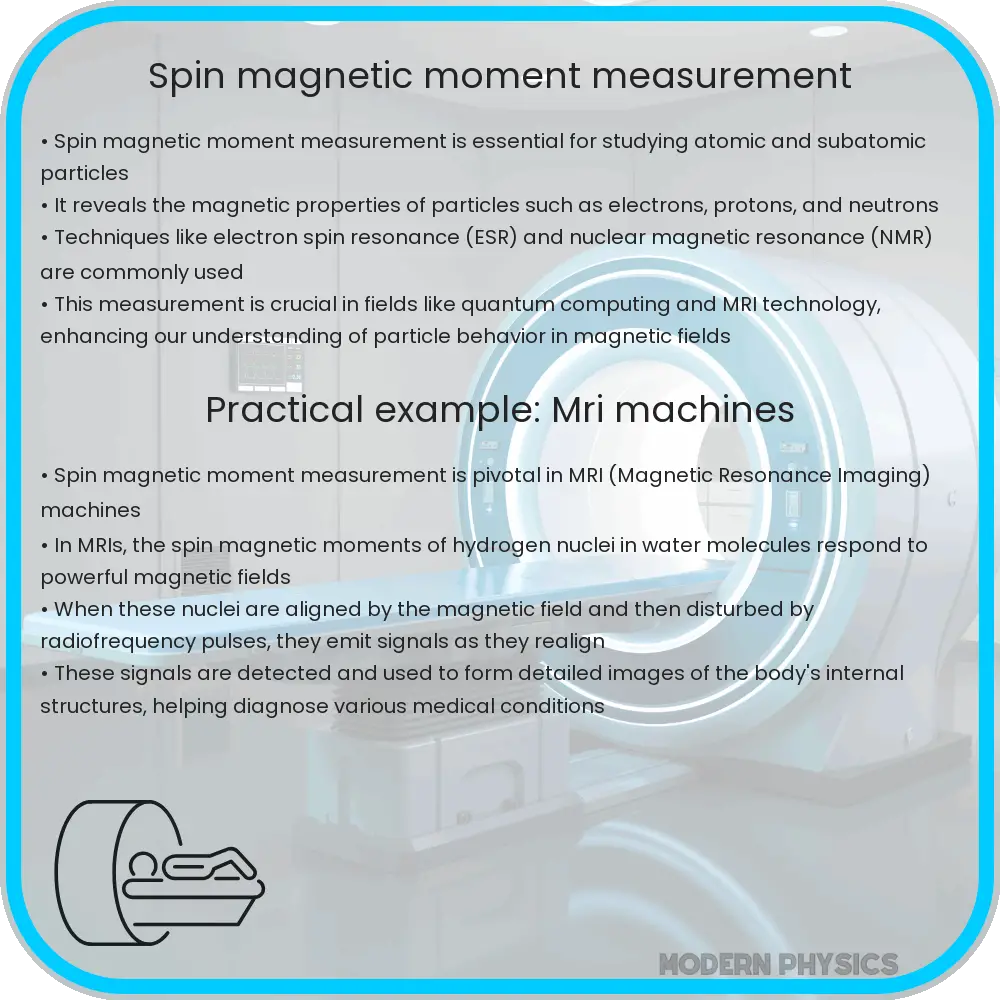
Understanding Spin Magnetic Moment Measurement
The concept of spin magnetic moment is a fundamental aspect in the realm of quantum mechanics and material science. It refers to the magnetic moment that is due to the intrinsic spin of electrons in an atom or molecule. This measurement is crucial in various applications ranging from medical imaging to material characterization. In this article, we delve into the accuracy, techniques, and applications of spin magnetic moment measurement.
Accuracy in Spin Magnetic Moment Measurement
Accuracy in measuring the spin magnetic moment is paramount for the reliability of experimental data. It is influenced by several factors, including the precision of the measuring instrument, the sample’s purity, and the environmental conditions during the measurement process. Advanced techniques like Electron Spin Resonance (ESR) and Nuclear Magnetic Resonance (NMR) are employed to achieve high levels of accuracy. These methods rely on the interaction of magnetic fields with the spin of electrons or nuclei, providing a detailed insight into the magnetic properties of the sample.
Techniques for Measuring Spin Magnetic Moment
Two primary techniques are widely used for spin magnetic moment measurement: ESR and NMR.
- Electron Spin Resonance (ESR): ESR is a spectroscopic technique that detects the spins of unpaired electrons in a magnetic field. It is highly sensitive and can detect minute changes in the electron spin states. This method is particularly useful in studying paramagnetic substances and radicals.
- Nuclear Magnetic Resonance (NMR): Unlike ESR, NMR focuses on the nuclear spins in a magnetic field. It is a powerful tool in analyzing the molecular and crystal structure of compounds. NMR is extensively used in organic chemistry and biochemistry for structural determination.
Applications of Spin Magnetic Moment Measurement
The measurement of spin magnetic moments finds its applications in various scientific and industrial fields. Some of the notable applications include:
- Material Science: Understanding the magnetic properties of materials is crucial in developing magnetic storage devices, superconductors, and magnetic sensors.
- Medical Imaging: Techniques like Magnetic Resonance Imaging (MRI) are based on the principles of NMR. They are instrumental in providing detailed images of the internal structures of the body.
- Chemical Analysis: NMR and ESR are vital in elucidating the molecular structure of chemical compounds, aiding in the discovery of new materials and pharmaceuticals.
The accurate measurement of spin magnetic moments not only enhances our understanding of atomic and molecular structures but also paves the way for advancements in technology and medicine.
Challenges and Future Prospects in Spin Magnetic Moment Measurement
Despite the advancements in measurement techniques, there are still challenges that researchers face. One of the primary challenges is the sensitivity of the instruments to external magnetic fields, which can lead to measurement errors. Additionally, the sample preparation process, particularly for NMR, is complex and can influence the accuracy of the results. Ongoing research is focused on improving the sensitivity and resolution of these techniques, making them more robust against external interferences.
Advancements in Measurement Techniques
Recent advancements in technology have led to significant improvements in the measurement of spin magnetic moments. For instance, the development of ultra-high-field NMR spectrometers has greatly enhanced the resolution, allowing for more precise structural determinations. Similarly, innovations in ESR spectroscopy, such as the introduction of pulse ESR, have enabled more detailed studies of electron spin dynamics.
Interdisciplinary Applications
The applications of spin magnetic moment measurements extend beyond traditional fields. For example, in environmental science, these techniques are used to study the magnetic properties of soils and rocks, which can provide insights into environmental changes and pollution. In archaeology, NMR and ESR can help in the dating and analysis of historical artifacts.
Conclusion
In conclusion, the measurement of spin magnetic moments is a critical aspect of modern scientific research, offering deep insights into the magnetic properties of atoms and molecules. The techniques of Electron Spin Resonance and Nuclear Magnetic Resonance have revolutionized various fields, from material science to medicine. Despite the challenges, ongoing advancements in these techniques are continually enhancing their accuracy and application range. As we look towards the future, the interdisciplinary applications and continuous improvement of these measurement methods hold great promise for new discoveries and technological advancements. The profound impact of these techniques on scientific understanding and practical applications underscores their importance in the ever-evolving landscape of science and technology.