
Explore the principles, accuracy, applications, and methods of specular reflection analysis, and its impact on technology and material science.
Understanding Specular Reflection: A Detailed Overview
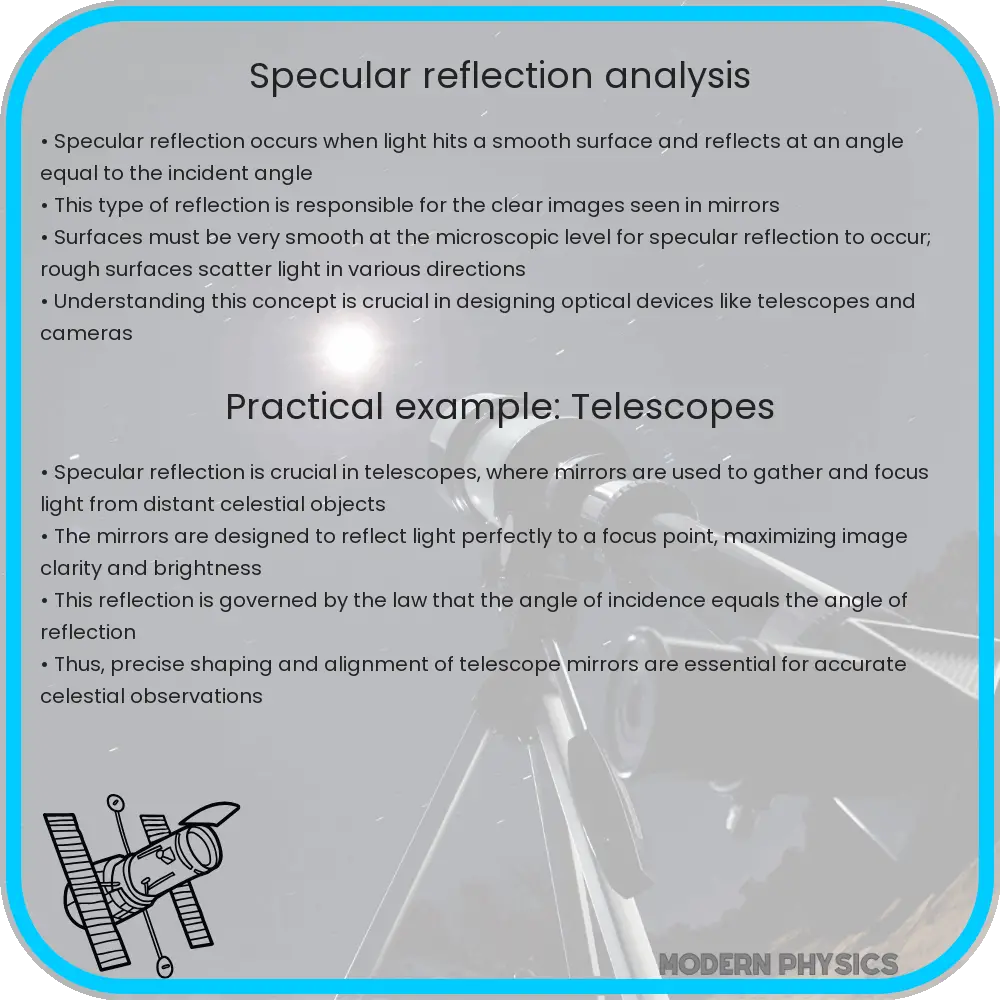
Specular reflection is a fundamental concept in physics and material science, referring to the mirror-like reflection of light or other waves from a surface. Unlike diffuse reflection, where light scatters in many directions, specular reflection occurs when light reflects at angles equal to its incidence angle, relative to the normal at the surface. This phenomenon is crucial in various applications, ranging from optical engineering to the creation of reflective coatings.
Accuracy in Specular Reflection Analysis
The accuracy of specular reflection analysis is paramount for designing and optimizing devices like lasers, telescopes, and solar panels. It involves precise measurements of the angle of incidence and reflection, as well as the surface’s smoothness and reflectivity. Advanced techniques, including laser scanning and interferometry, are employed to achieve high precision, allowing scientists and engineers to model and predict the behavior of reflective surfaces under different conditions.
Applications of Specular Reflection
- Optical Devices: In optics, specular reflection is harnessed to direct light precisely in instruments such as mirrors, lenses, and prisms, enhancing the efficiency and performance of cameras, microscopes, and telescopes.
- Solar Energy: Reflective materials with high specular reflection are used in solar panels and concentrators to maximize the capture of sunlight, significantly increasing energy conversion efficiency.
- Decorative Finishes: The automotive and jewelry industries utilize specular reflection principles to create high-gloss finishes that are aesthetically pleasing and durable.
Methods of Specular Reflection Analysis
Several methods are applied in the analysis of specular reflection, each with its advantages and suitability for different applications:
- Ray Tracing: A computational method used to model the path of light as it interacts with surfaces, enabling detailed analysis of reflection patterns and intensity distribution.
- Ellipsometry: This technique measures the change in polarization as light reflects off a surface, providing insights into the surface’s optical properties and thickness.
- Scanning Electron Microscopy (SEM): SEM is used to observe the surface topography at a microscopic level, identifying imperfections that affect specular reflection.
Understanding the principles and methods of specular reflection analysis is essential for advancing in fields where light manipulation and material properties play critical roles. It ensures the development of more efficient, precise, and innovative applications across industries.
Challenges and Future Directions in Specular Reflection Analysis
Despite significant advancements, specular reflection analysis faces challenges, particularly in handling materials with complex surfaces or when operating at the nanoscale. Variabilities in surface roughness, contamination, and environmental factors can influence reflectivity and necessitate sophisticated analytical techniques. Future research is geared towards improving the sensitivity and accuracy of measurement methods, incorporating artificial intelligence to predict and simulate specular reflection phenomena, and developing new materials with enhanced reflective properties.
Enhancing Material Properties for Better Specular Reflection
Material science plays a pivotal role in optimizing specular reflection. Innovations in nanotechnology and surface coating techniques aim to create surfaces with near-perfect reflectivity. For example, the development of superhydrophobic coatings not only enhances reflectivity but also protects surfaces from environmental damage, extending their lifespan and performance in optical applications.
Conclusion
Specular reflection analysis is a cornerstone in the understanding and application of optical phenomena, bridging fundamental physics with practical applications in technology and industry. The accuracy of these analyses underpins the effectiveness of a wide range of devices and systems, from energy generation to information technology. While challenges remain in measuring and optimizing specular reflection, ongoing research and technological advancements promise to overcome these hurdles, leading to new innovations and applications. As we continue to explore the intricacies of light and materials, the future of specular reflection analysis holds the potential for significant breakthroughs in science and engineering, enhancing our ability to harness light with unprecedented precision and efficiency.