
Understanding the basics and techniques of spectroscopy, the study of matter’s interaction with electromagnetic radiation.
Introduction to Spectroscopy
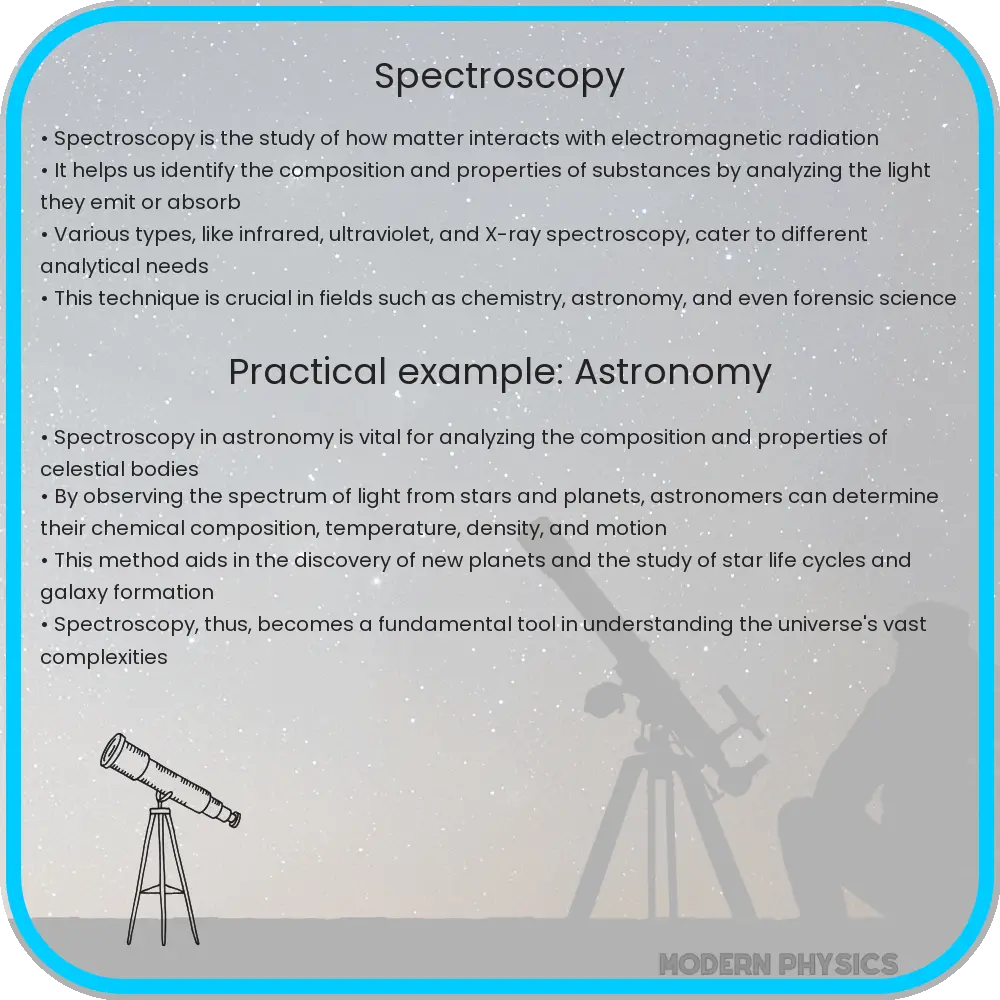
Spectroscopy is a fascinating field in physics that revolves around the study of the interaction between matter and electromagnetic radiation. Historically, it was first used to study visible light dispersed according to its wavelength, by a prism. Modern spectroscopy covers a wide range of techniques depending on the nature of the interaction between the energy and material and the types of radiation involved.
Basics of Spectroscopy
At its core, spectroscopy involves measuring how light interacts with materials. This interaction can tell us a lot about the material’s composition, structure, and properties. There are a few fundamental concepts in spectroscopy:
- Wavelength (λ): The distance between consecutive peaks of a wave.
- Frequency (ν): The number of waves that pass a fixed point in one second.
- Energy (E): Directly proportional to frequency, the energy of light can be described by Planck’s equation, E = hν, where h is Planck’s constant.
When light interacts with matter, several processes can occur such as absorption, emission, or scattering. Each of these interactions provides different information and thus forms the basis for different spectroscopic techniques.
Techniques in Spectroscopy
Spectroscopy techniques can be broadly classified into several types based on the nature of the interaction between light and matter:
- Absorption Spectroscopy: Measures the amount of light absorbed as it passes through a sample. Analysis of the absorbed wavelengths can help identify the material and determine its concentration and structure.
- Emission Spectroscopy: Involves measuring the light emitted by excited atoms or molecules as they return to a lower energy state. This technique is vital in analyzing the chemical composition and properties of heated materials or gases.
- Scattering Spectroscopy: This technique investigates how light is scattered when it hits a particle. Raman spectroscopy, a type of scattering spectroscopy, is particularly useful in studying molecular vibrations, rotational and other low-frequency modes in systems.
Each technique uses different instruments ranging from simple spectrometers to advanced imaging equipment. These instruments typically include a source of radiation, a method to collect the light that has interacted with the sample, and a detector to measure the specifics of the interaction.
Applications of Spectroscopy
Spectroscopy has a variety of applications across multiple disciplines. Its ability to determine material composition and properties without destroying the sample makes it invaluable in many fields:
- Chemistry: Used to identify compounds and determine their structure.
- Astronomy: Helps in analyzing the composition of stars and galaxies by studying the light they emit.
- Meteorology: Spectroscopy aids in analyzing atmospheric gases, which can help in understanding and forecasting weather.
- Medicine: Used in diagnosing diseases by studying the spectra of blood and tissues.
- Environmental Science: Helps in monitoring air and water quality by detecting pollutants spectroscopically.
With advancements in technology, the scope of spectroscopy is continually expanding, facilitating an even greater understanding of the physical and biological worlds.
Conclusion
Spectroscopy is a powerful tool that bridges the gap between the microscopic and macroscopic worlds, providing detailed insight into the molecular and atomic levels of matter. From simple prisms to advanced electromagnetic equipment, spectroscopy techniques have evolved, but the essence remains the same: understanding the interaction between light and matter. With its diverse range of applications, from medical diagnostics to environmental monitoring, spectroscopy remains a cornerstone of scientific research, enriching our understanding of the complex nature of the universe.