
Explore the role of spectrographs in astrophysics: precision tools for analyzing celestial light, unlocking secrets of the universe’s composition and evolution.
Understanding Spectrographs in Astrophysics
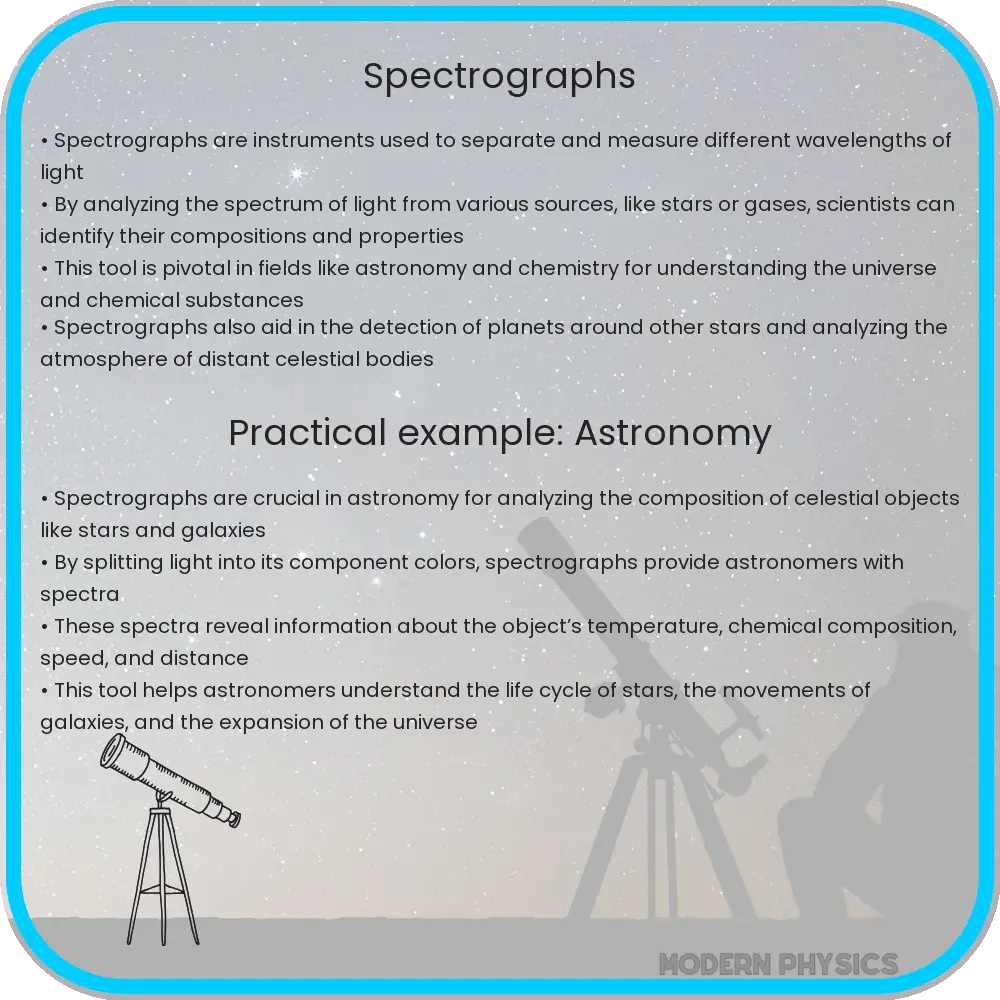
Spectrographs are vital instruments in astrophysics, allowing scientists to dissect the light from celestial objects into its component colors or wavelengths. This process, known as spectroscopy, helps in understanding the physical properties of stars, galaxies, and other astronomical bodies. By analyzing the spectrum of an object, astronomers can deduce its temperature, chemical composition, density, and motion.
The Precision of Spectrographs
The precision of spectrographs is crucial for accurate measurements and analyses. Modern spectrographs, used in conjunction with telescopes, can detect minute changes in the light from distant stars and galaxies. This sensitivity allows for the detection of exoplanets through the Doppler shift method, where the slight wobble of a star caused by an orbiting planet’s gravitational pull is observed. Additionally, precision in spectrographs enables the measurement of the redshift of galaxies, providing vital clues about the universe’s expansion rate.
Analysis Techniques in Spectroscopy
Spectroscopic analysis involves several techniques tailored to different types of astronomical observations. One common method is emission spectroscopy, where the spectrum consists of bright lines on a dark background, indicating the presence of hot, ionized gases emitting light at specific wavelengths. Conversely, absorption spectroscopy reveals dark lines on a bright background, characteristic of cooler gases absorbing light from a hotter source behind them. These spectral lines correspond to specific chemical elements, such as hydrogen (H2), helium (He), or carbon (C), allowing astronomers to identify the chemical composition of celestial objects.
The Role of Spectrographs in Discovery
Spectrographs have been instrumental in numerous astronomical discoveries. For example, they played a key role in the discovery of dark matter through the observation of galaxy rotation speeds that did not match the visible mass. Furthermore, spectrographs have been essential in studying the atmospheres of exoplanets, leading to the detection of water vapor, methane, and other chemicals, hinting at the possibility of life beyond Earth.
Advancements in Spectrographic Technology
Technological advancements have significantly enhanced the capabilities of spectrographs, enabling more detailed and distant cosmic studies. Adaptive optics, for example, compensates for Earth’s atmospheric distortions, allowing for sharper images and more precise spectral data from ground-based telescopes. Additionally, space-based telescopes equipped with advanced spectrographs, free from atmospheric interference, provide even clearer insights into the universe’s secrets. These improvements have expanded our understanding of cosmic phenomena, such as the chemical processes in young stellar objects and the dynamics of supernova explosions.
Interdisciplinary Applications of Spectroscopy
Astrophysical spectroscopy intersects with various scientific disciplines, enriching our understanding of the universe. In astrobiology, spectrographs search for biosignatures, chemical indicators of life, on distant exoplanets. In cosmology, spectroscopic data helps map the large-scale structure of the universe and understand its evolution. The interdisciplinary nature of spectroscopy fosters collaboration across scientific fields, leading to comprehensive insights into complex cosmic phenomena.
Challenges and Future Directions
Despite its advancements, astrophysical spectroscopy faces challenges. The faintness of distant celestial objects requires highly sensitive instruments and long observation times. Additionally, the vast amount of data generated necessitates sophisticated software and algorithms for analysis. Future developments in spectrographs aim to address these challenges by enhancing sensitivity, reducing noise, and improving data processing techniques. As technology progresses, so too will our capacity to explore the unseen corners of the universe.
Conclusion
Spectrographs are indispensable tools in the field of astrophysics, offering a window into the composition, dynamics, and history of the universe. Their precision and versatility have enabled groundbreaking discoveries and continue to push the boundaries of our cosmic knowledge. As technology advances, the potential for new discoveries grows, promising deeper insights into the mysteries of the cosmos. The ongoing evolution of spectrographic technology not only underscores the importance of continuous innovation but also highlights the collaborative spirit of scientific inquiry, propelling us toward a more comprehensive understanding of the universe.