
Understanding the space-time manifold: a four-dimensional model merging three spatial dimensions with one temporal, fundamentally crucial in physics for describing the universe’s structure and behavior.
Understanding the Space-Time Manifold
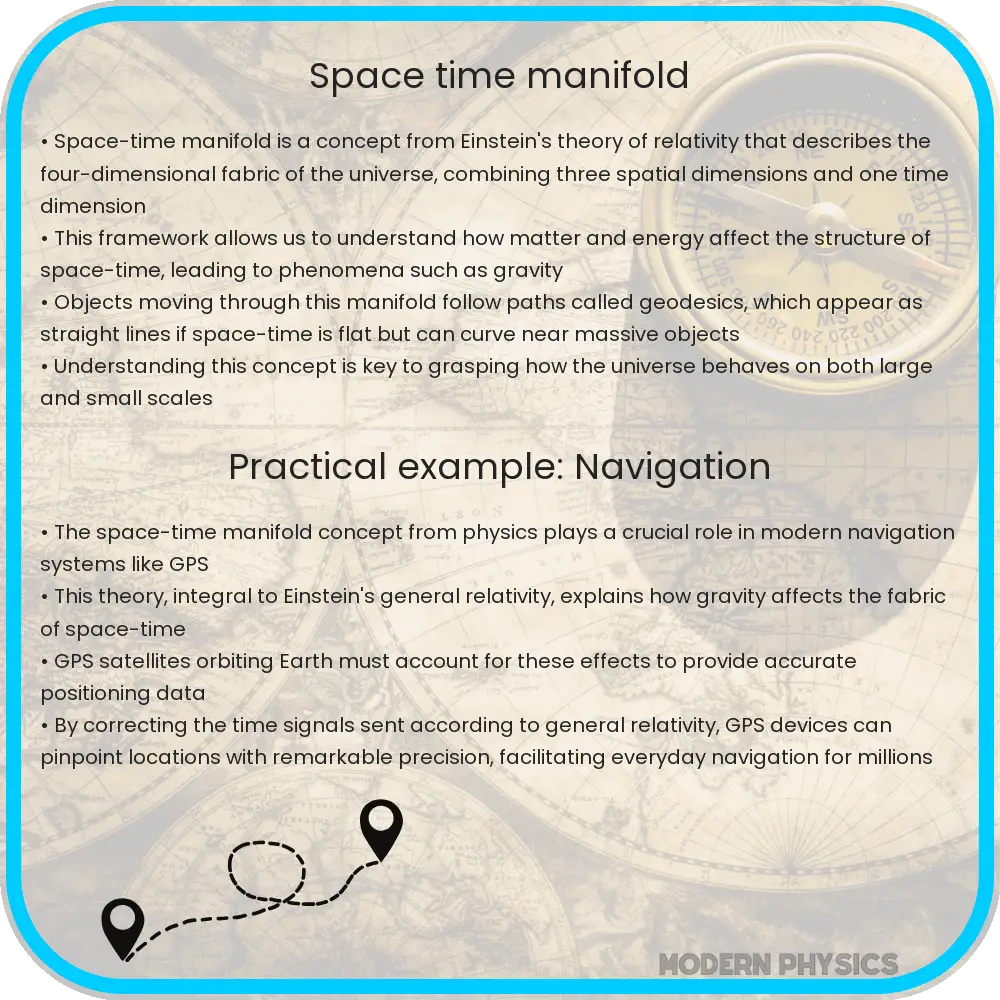
The term “space-time manifold” might sound like something out of a science fiction novel, but it’s a fundamental concept in the field of physics that provides a framework for understanding the universe. At its core, a space-time manifold is a mathematical model that combines three dimensions of space and one dimension of time into a single four-dimensional continuum.
What Is Space-Time?
To understand the space-time manifold, let’s first decompose the term. Space refers to the three-dimensional arena in which objects and events occur, while time is what we consider a one-dimensional component that orders these events. When we merge these dimensions, we get a four-dimensional universe where each point defines a position at a specific time. These points are what form the space-time manifold.
Curvature of Space-Time and Gravity
One of the most revolutionary aspects of the space-time concept is its curvature, which is directly related to gravity, as described by Albert Einstein’s General Theory of Relativity. According to Einstein, what we perceive as the force of gravity actually arises from the bending of this four-dimensional fabric by massive objects. This curvature instructs how objects move through space-time and how they influence each other’s paths.
Einstein’s famous field equation can be expressed as: Gμν + Λgμν = 8πGTμν, where:
- Gμν represents the Einstein tensor, which encodes the geometric curvature of space-time due to matter and energy.
- Λgμν includes the cosmological constant, Λ, which can represent a force like dark energy.
- Tμν is the stress-energy tensor, describing the density and flow of energy and momentum in space-time.
- G is the gravitational constant.
This equation suggests that the distribution and movement of matter and energy determine the curvature of space-time. Conversely, this curvature tells matter how to move. Hence, there is a dynamic relationship between the geometry of the universe and the behavior of objects within it.
Gravitational Lensing: A Consequence of Curvature
An observable effect of space-time curvature is gravitational lensing, a phenomenon that occurs when a massive body like a galaxy or black hole bends the path of light passing near it. This bending causes the light from objects behind the massive body to appear distorted or magnified when viewed from Earth. Gravitational lensing not only confirms Einstein’s theory but also helps astronomers study distant galaxies and detect dark matter.
Exploring the Cosmos through Space-Time
The concept of space-time is pivotal not only in understanding gravity but also in the broader exploration of the cosmos. By studying the cosmic microwave background radiation, the afterglow of the Big Bang, scientists can gather information about the early universe and its expansion over time. Additionally, anomalies in galaxy movements or cosmic radiation patterns can provide clues about the overall geometry of the cosmos and the mysterious dark energy accelerating its expansion.
Applications in Modern Technology
The principles of space-time curvature and the associated concepts of General Relativity have practical applications in modern technology as well. One significant example is the Global Positioning System (GPS). GPS satellites orbiting the Earth must account for the effects of gravitational time dilation—a prediction of General Relativity—where time is observed to run slower closer to a massive object. The atomic clocks on these satellites are adjusted to account for these differences, ensuring that the positioning information they transmit to Earth is accurate.
Future Prospects in Space-Time Research
The study of space-time is an ongoing field of research. Advanced experiments, such as the detection of gravitational waves by facilities like LIGO (Laser Interferometer Gravitational-Wave Observatory), are opening new avenues for understanding the universe. Gravitational waves, ripples in space-time caused by some of the most violent and energetic processes in the Universe such as colliding black holes, confirm the dynamic nature of space-time and provide a new tool for astronomical observations.
In the future, further insights into space-time could lead to more accurate models of the universe’s structure and the development of new technologies in navigation, communication, and beyond. The explored and yet-to-be-discovered nuances of the space-time manifold could unlock further secrets of the cosmos, potentially leading to groundbreaking advances in both theoretical physics and practical engineering.
Conclusion
The concept of the space-time manifold is more than just a fascinating scientific theory; it is the foundation upon which much of modern physics is built. From the mind-bending realities of black holes and the vast expanse of cosmic structures to the practical applications in technologies like GPS, understanding space-time is key to unlocking the mysteries of the universe. As research continues and technology advances, our grasp of the intricate dance between space, time, matter, and energy will only deepen, bringing new revelations and innovations. By delving into the complexities of the space-time manifold, we not only enhance our knowledge of the universe but also expand the potential for future scientific and technological breakthroughs.