
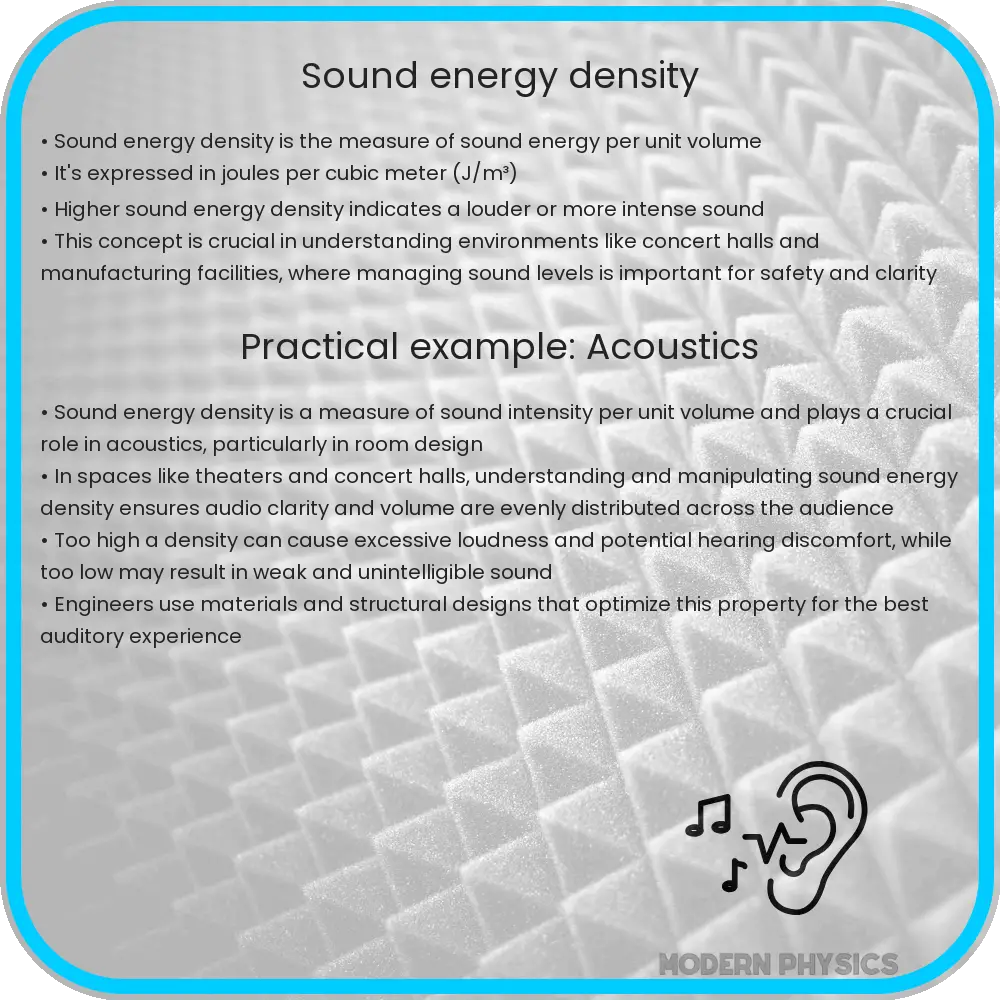
Sound energy density is the measure of energy carried by sound waves per unit volume in a medium, key for applications in acoustics and noise control.
Understanding Sound Energy Density
Sound energy density is a fundamental concept in acoustics and physics, describing the amount of energy carried by sound waves in a specified area of a medium, typically air. This measurement is crucial for various applications ranging from noise control in urban planning to the enhancement of audio quality in theaters and recording studios.
Measuring Sound Energy Density
The sound energy density (SED) is defined as the energy per unit volume in the space through which the sound propagates. It is measured in Joules per cubic meter (J/m3). The formula to calculate sound energy density is:
SED = 0.5 * ρ * v2
Where:
- ρ represents the density of the medium (in kg/m3), and
- v is the particle velocity (in m/s)
Particle velocity, which is different from the speed of sound, refers to the velocity of the individual particles of the medium oscillating back and forth as the sound wave passes through.
Importance of Sound Energy Density
The measurement of sound energy density holds vital applications in various fields. It helps sound engineers and acousticians to design more effective soundproofing materials and noise control applications. This is crucial in environments such as hospitals or schools, where excessive noise can disrupt the intended activities.
Moreover, understanding SED can lead to the implementation of better acoustical planning in urban environments to mitigate the adverse effects of noise pollution. This includes the strategic placement of buildings and the use of materials that adequately reflect or absorb sound based upon their sound energy density characteristics.
Applications in Acoustics
In the realm of acoustics, sound energy density is utilized to assess the acoustic environment of spaces such as theaters, concert halls, and recording studios. The science of adjusting the sound energy density in a room involves the use of various materials and structural designs to enhance sound clarity and control reverberations.
The correct application of SED-related knowledge enables engineers to tailor the acoustic properties of a space to match its intended use, providing optimal sound quality for performances and recordings. In addition, sound energy density measurements are used in the development and testing of audio equipment, like speakers and microphones, to ensure that they produce and capture sound with high fidelity.
By carefully controlling the sound energy density in these environments, venues can provide audiences with the best possible auditory experience, supporting the precision and warmth that is often associated with high-quality audio performances.
Understanding and harnessing the power of sound energy density also facilitates advancements in fields beyond traditional acoustics. For example, in medicine, precise control of acoustic energy is critical in technologies such as ultrasound imaging and therapy.
Challenges in Measuring Sound Energy Density
Accurately measuring sound energy density poses certain challenges, especially in environments with complex geometries or varying medium properties. Factors such as air pressure, temperature, and humidity can affect both the speed of sound and the density of the medium, thereby influencing the measurements. Advanced equipment and calibration are required to take these variables into account and ensure accurate measurements.
Technological advancements have led to the development of sophisticated instruments that help overcome these challenges. For instance, precise microphones and digital signal processors are capable of analyzing sound waves in great detail and across different environmental conditions.
Future Perspectives
With ongoing research and technological innovation, the measurement and application of sound energy density are expected to grow and improve. New materials with enhanced acoustic properties are being developed, which could revolutionize the way soundproofing and sound enhancement are approached. Moreover, the integration of artificial intelligence in acoustic analysis promises even more precise control over sound environments, making it possible to auto-adjust acoustics in real-time based on the current SED measurements.
Research in fields like quantum acoustics might also reshape our understanding of sound energy at microscopic levels, opening new frontiers in both theoretical and applied physics.
Conclusion
Sound energy density is not just a theoretical concept in physics but a practical tool with wide-ranging applications in everyday life. From enhancing the audio experience in entertainment venues to improving noise control in urban environments, the implications of understanding and manipulating sound energy density are vast. The challenges in measurement and the future developments only add to the intrigue and importance of this field. As technology progresses, so too will our ability to refine and utilize sound energy density, potentially leading to breakthroughs in areas as diverse as healthcare, environmental science, and entertainment. By continuing to explore and expand on this fundamental aspect of acoustics, scientists and engineers can open up new possibilities for innovation and quality of life improvements.
For both enthusiasts and professionals in the field of acoustics, keeping abreast of the latest research and technological advances in sound energy density measurement and application is essential for pushing the boundaries of what can be achieved with sound control and design.