
Explore the mysteries of solar neutrinos, their detection methods, and their impact on astrophysics, particle physics, and cosmology in this enlightening article.
Solar Neutrinos: Unlocking the Mysteries of the Sun
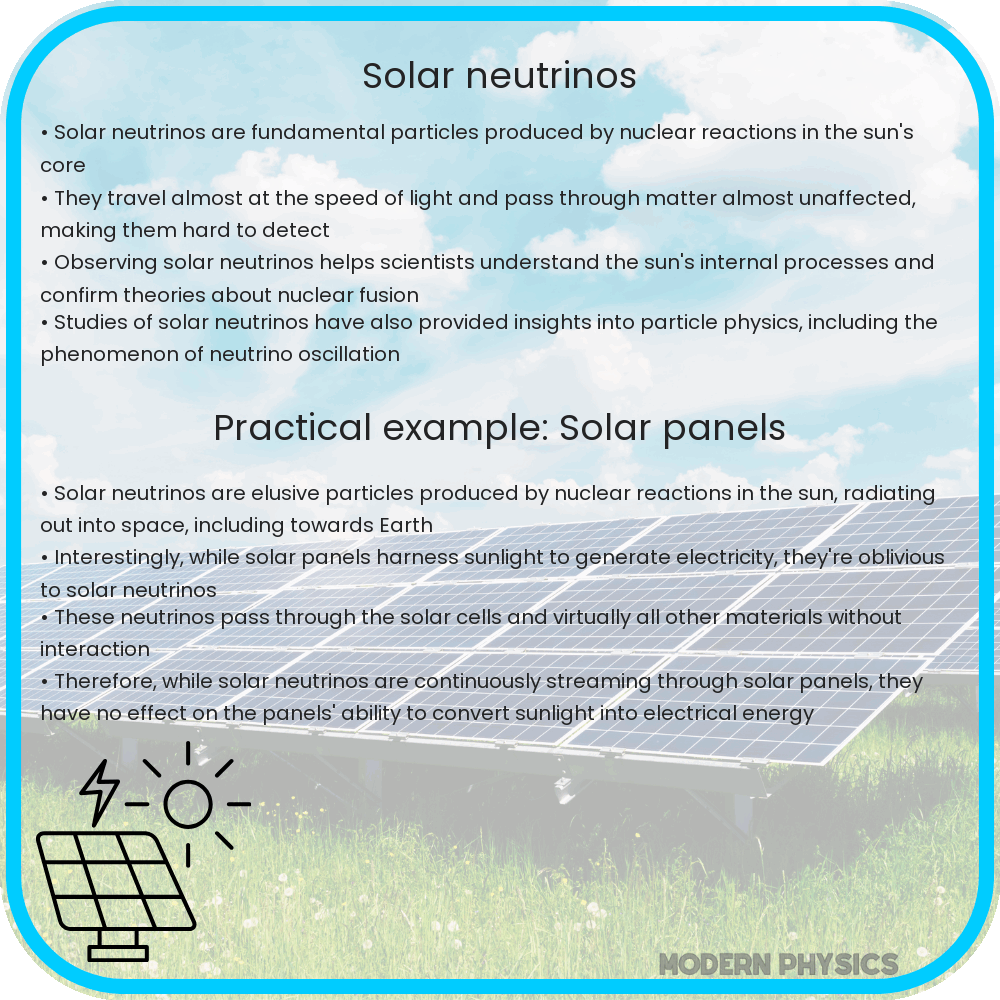
Solar neutrinos are elementary particles that are produced in vast quantities by the nuclear reactions that power the sun. These tiny, almost massless particles offer a unique window into the workings of our closest star and have significant implications for both astrophysics and particle physics. Understanding solar neutrinos is crucial for unraveling the mysteries of solar energy production and the fundamental properties of neutrinos themselves.
Detection of Solar Neutrinos
The detection of solar neutrinos presents a formidable challenge due to their weak interaction with matter. Early attempts to detect these elusive particles were pioneered in the 1960s by Raymond Davis Jr. and colleagues, who constructed a large underground detector filled with a cleaning fluid rich in chlorine. The concept was straightforward: neutrinos, upon interacting with chlorine atoms, would convert them into argon atoms, which could then be counted. However, the number of neutrinos detected was significantly lower than predicted, leading to the famous “solar neutrino problem.
This discrepancy spurred advancements in neutrino detection and the development of new types of detectors, such as water Cherenkov detectors and heavy water detectors. These instruments have not only confirmed the presence of solar neutrinos but also helped in understanding the phenomenon of neutrino oscillation, whereby neutrinos switch between different “flavors” (types) as they travel through space.
Impact in Astrophysics
The study of solar neutrinos has profound implications for astrophysics. They provide direct evidence of the nuclear processes occurring at the sun’s core, supporting the theory of nuclear fusion as the sun’s energy source. Moreover, the observation of neutrino oscillations has significant implications for our understanding of the fundamental properties of neutrinos, leading to the realization that these particles have mass, contrary to previous assumptions.
Additionally, solar neutrino research has enhanced our understanding of the sun’s composition and dynamics, including insights into solar metallicity and the solar cycle. As solar neutrinos pass unhindered through the sun’s layers, they offer an unobstructed view of its inner workings, unlike electromagnetic radiation, which is heavily scattered and absorbed.
Advancements in Solar Neutrino Research
Recent advancements in solar neutrino research have been propelled by technological innovations and international collaborations. New generations of neutrino observatories, such as the Sudbury Neutrino Observatory (SNO) in Canada and Super-Kamiokande in Japan, have utilized heavy water and ultra-pure water respectively to detect neutrinos. These facilities have significantly improved our understanding of neutrino oscillations and the solar neutrino flux. Furthermore, ongoing projects like the IceCube Neutrino Observatory in Antarctica and the upcoming Jiangmen Underground Neutrino Observatory (JUNO) in China promise to push the boundaries of neutrino physics even further.
The development of real-time neutrino detection techniques has also opened new avenues for solar physics and beyond. By observing the fluctuations in neutrino flux, scientists can probe the dynamic processes within the sun’s core, offering new insights into the mechanics of solar flares and other phenomena. This real-time monitoring represents a significant step forward from previous methods, which could only provide averaged data over longer periods.
Impact on Particle Physics and Cosmology
The implications of solar neutrino research extend beyond astrophysics into the realms of particle physics and cosmology. The discovery of neutrino mass has necessitated revisions to the Standard Model of particle physics and has provided critical data for understanding the asymmetry between matter and antimatter in the universe. Furthermore, solar neutrinos could play a role in probing new physics beyond the Standard Model, such as the search for dark matter and studies of neutrino-less double beta decay.
In cosmology, neutrinos affect the evolution of the universe from the Big Bang to the present day. Their mass has implications for the rate of the universe’s expansion and the formation of large-scale structures. As such, solar neutrinos offer a unique tool for testing cosmological models and theories of the early universe.
Conclusion
Solar neutrinos, once considered mere byproducts of stellar processes, have emerged as key players in the fields of astrophysics, particle physics, and cosmology. The study of these elusive particles has led to groundbreaking discoveries about the sun’s inner workings, the properties of neutrinos, and the fundamental laws governing the universe. Despite the challenges associated with detecting and studying neutrinos, continued advancements in technology and methodology promise to unravel further mysteries. As we stand on the brink of new discoveries, the study of solar neutrinos continues to illuminate our understanding of the cosmos, demonstrating the interconnectedness of the microcosmic and macrocosmic realms.