
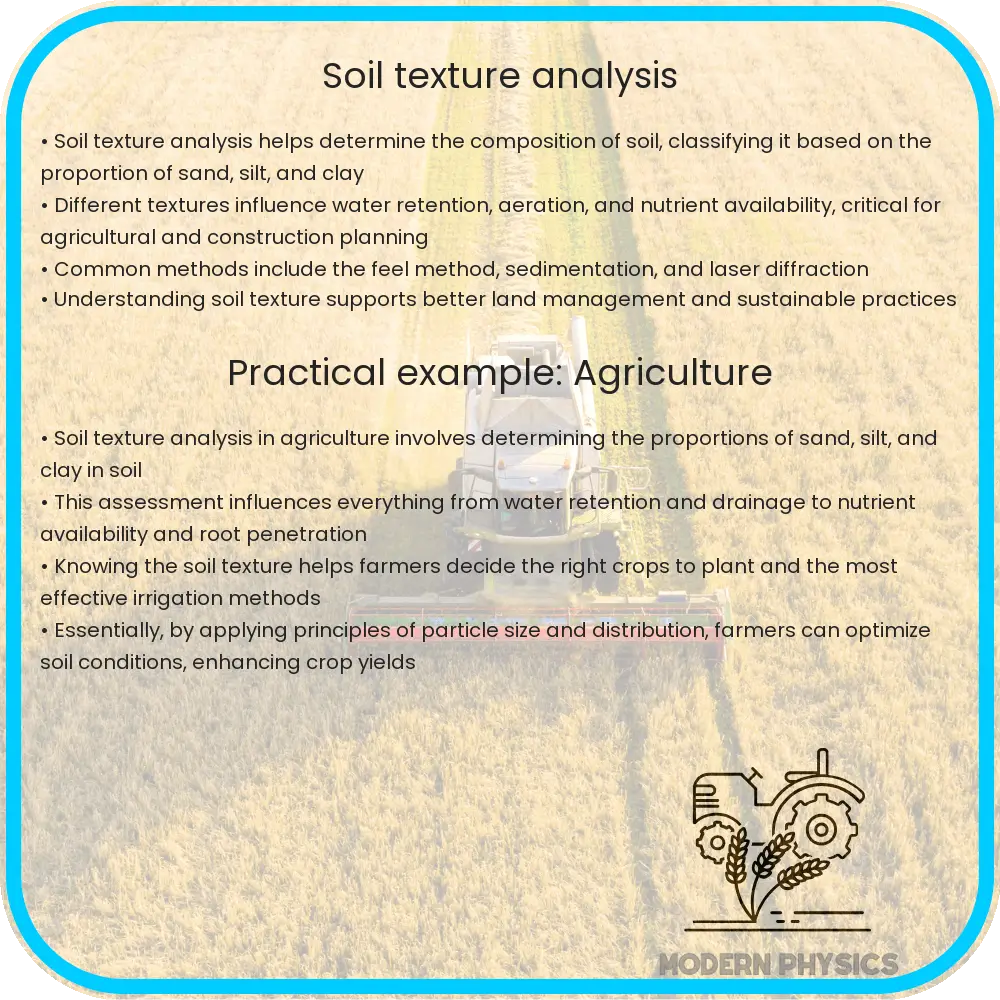
Soil texture analysis assesses the proportions of sand, silt, and clay in soil, crucial for agricultural decision-making and crop yield optimization.
Understanding Soil Texture Analysis
Soil texture analysis is a fundamental aspect of agricultural science, influencing everything from water retention and aeration to nutrient availability and erosion control. By understanding soil texture, farmers and agronomists can make more informed decisions regarding crop selection, irrigation practices, and fertilization strategies, ultimately impacting the efficiency and yield of agricultural operations.
Components of Soil Texture
Soil texture is determined primarily by the proportions of sand, silt, and clay present in the soil. Each component contributes differently to soil behavior:
- Sand: Larger particles that provide good drainage and aeration but poor nutrient and water retention.
- Silt: Medium-sized particles that offer moderate water retention and nutrient availability.
- Clay: Very small particles that excel in water and nutrient holding capacity but can lead to poor drainage and aeration when overly abundant.
The Process of Soil Texture Analysis
Soil texture analysis typically involves several steps to accurately assess the ratio of sand, silt, and clay. The most common method employed is the sedimentation process, which utilizes Stokes’ Law to determine the settling rates of different soil particles in water. The formula employed is:
\[ v = \frac{(d^2 \cdot (p_s – p_l) \cdot g)}{18 \cdot \mu} \]
Where:
- v = settling velocity
- d = particle diameter
- p_s = density of the soil particle
- p_l = density of the liquid
- g = acceleration due to gravity
- \(\mu\) = dynamic viscosity of the fluid
This mathematical approach allows researchers to calculate the proportions of each soil type by observing the time taken for particles to settle at the bottom of a settling column.
Accuracy and Challenges
While sedimentation is widely used due to its accuracy in distinguishing between particle sizes, it does come with challenges. Measuring the precise time for each type of particle to settle requires meticulous observation and can be susceptible to experimental errors such as disturbances in the settling column or variations in particle shape and density.
Additionally, the physical and chemical properties of the soil can also affect the results. Organic matter, for example, can alter the density and viscosity of the solution, leading to inaccuracies unless properly accounted for before the analysis.
Impact of Soil Texture on Crop Yield
The knowledge gained from soil texture analysis plays a crucial role in agricultural yield. Soils with a balanced mix of sand, silt, and clay are typically most favorable for crop growth, as they retain nutrients and water adequately while still providing sufficient drainage and aeration. Understanding the specific texture of the soil can help in selecting the right crops suited for the soil type, optimizing irrigation schedules, and tailoring nutrient management plans accordingly.
Soil texture also directly influences the efficiency of other agricultural practices such as tilling, harvesting, and even pest management. Adjustments in these practices based on soil texture analysis can lead to significant improvements in both yield and the sustainability of farming operations.
It’s also noteworthy that different crops require different soil textures for optimal growth. For instance, root crops like carrots and potatoes generally perform better in sandy soils, which facilitate easier root penetration. In contrast, loamy soils, with a balanced mix of sand, silt, and clay, are generally preferred for most other crop types due to their optimal moisture and nutrient retention capabilities.
Therefore, accurate soil texture analysis not only enhances agricultural efficiency but also plays a crucial role in resource management and sustainable farming practices.
Technological Advances in Soil Texture Analysis
Innovations in technology have transformed traditional methods of soil texture analysis, introducing automation and increased precision. Advanced devices and software now allow for rapid on-site assessments, minimizing the time and potential inaccuracies associated with manual sedimentation methods. These technologies often utilize laser diffraction and other optical techniques to measure soil particle sizes directly, providing results in a matter of minutes.
Such technology not only speeds up the analysis process but also enhances the accuracy by reducing human error. Environmental researchers and agronomists can now obtain real-time data, enabling more dynamic and responsive farming practices and soil management strategies.
Education and Soil Management
The dissemination of knowledge on soil texture and its management is crucial for advancing sustainable agricultural practices. Educational programs aimed at farmers, agricultural technicians, and students emphasize the importance of soil analysis and its role in enhancing crop yield and environmental sustainability.
Workshops, online courses, and field demonstrations are some of the tools used to spread this knowledge effectively. Often supported by agricultural extension services, these educational initiatives help bridge the gap between advanced scientific research and practical on-farm applications, enabling more farmers to adopt precision agriculture practices.
Conclusion
Understanding soil texture is more than a scientific exercise; it’s a foundational aspect of modern agriculture. By combining the traditional methods of texture analysis with cutting-edge technologies, farmers and scientists can achieve a detailed understanding of soil properties, leading to informed decisions that optimize the balance between crop productivity and environmental conservation. As the technology evolves and becomes more accessible, the potential for precision in farming and sustainable management practices continues to grow. This proactive approach not only boosts crop yields but also contributes to the broader objectives of resource conservation and ecological balance, reinforcing the importance of soil texture analysis in achieving a sustainable future.