
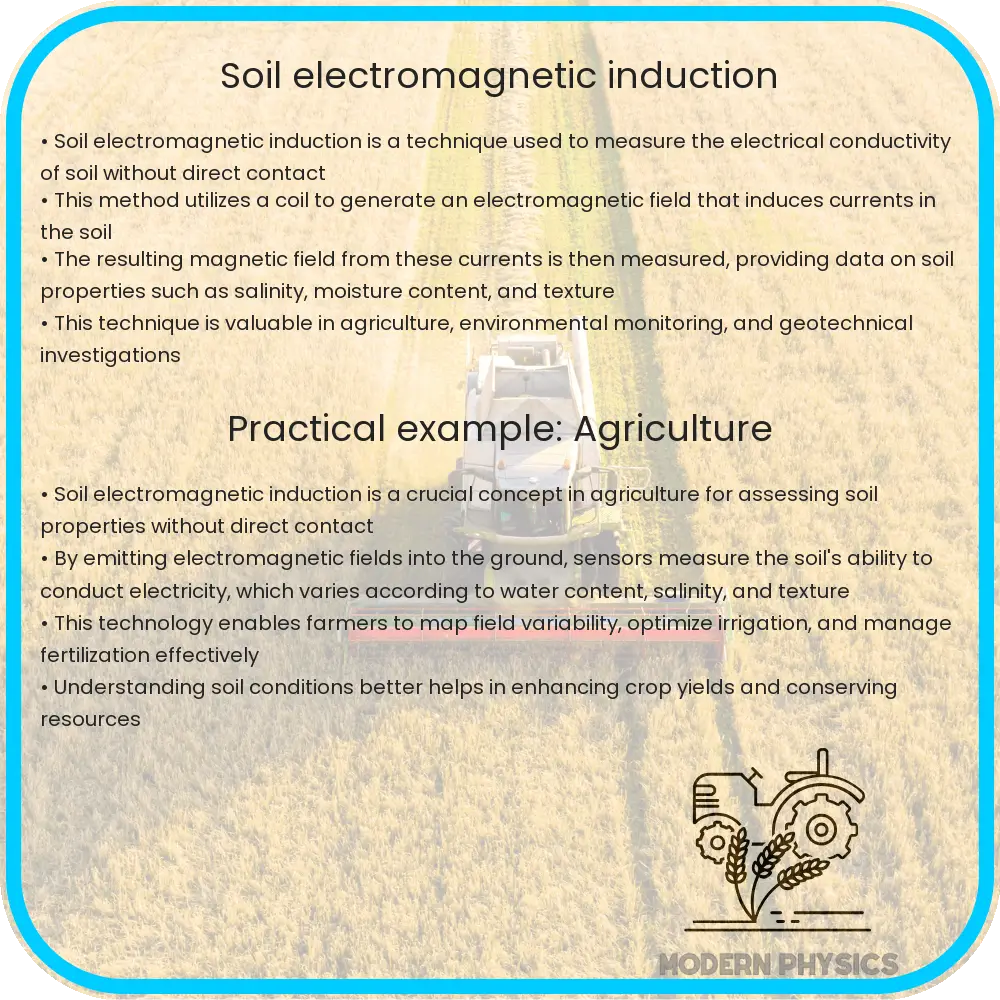
Soil electromagnetic induction is a non-invasive technique used to analyze and enhance soil properties using electromagnetism, essential for sustainable agriculture.
Understanding Soil Electromagnetic Induction
Soil electromagnetic induction is a cutting-edge method that plays a crucial role in modern agriculture, particularly for improving crop yield and maintaining soil health. At its core, this technique leverages the principles of electromagnetism to analyze and modify soil properties. This non-invasive method provides valuable insights into soil composition and moisture without disturbing the soil structure, which is essential for sustainable farming practices.
The Physics Behind Soil Electromagnetic Induction
Electromagnetic induction in soil works on the principle of inducing electric currents to probe underground features. When an alternating current flows through a coil, it generates a time-varying magnetic field around the coil. When this coil is brought close to the soil, the magnetic field induces eddy currents in the soil. The properties of these currents, including their magnitude and phase, depend on the soil’s conductivity and magnetic permeability, which in turn are influenced by soil composition, moisture content, and salinity.
The primary equation that governs electromagnetic induction is Faraday’s Law of Electromagnetic Induction, expressed as:
- Ε = -dΦ/dt
Where Ε represents the electromotive force (EMF) induced in the coil, and Φ is the magnetic flux through the coil. The negative sign indicates that the induced EMF acts in a direction to oppose the change in magnetic flux, a fundamental concept known as Lenz’s Law.
Tools and Technologies Employed
Various tools and technologies are utilized in soil electromagnetic induction, with the most common being the electromagnetic induction meter or sensor. These devices consist of a transmitter coil that generates the magnetic field and a receiver coil that detects the induced currents in the soil. The data collected by these sensors provide readings on soil conductivity and permittivity, which can be used to infer soil texture, water content, and salinity levels.
Advancements in GPS technology and data analysis software have further enhanced the precision and utility of soil electromagnetic induction surveys. By integrating GPS data, farmers and researchers can create detailed maps of soil properties across large areas, leading to more informed decision-making regarding irrigation, fertilization, and crop planning.
Applications in Agriculture
Soil electromagnetic induction has vast applications in agriculture. By providing detailed soil condition data, this technology helps farmers optimize the use of water and fertilizers, thus enhancing crop yield while reducing costs and environmental impact. Specifically, it can assist in:
- Detecting variations in soil textures and types across a field,
- Identifying zones with high salinity levels which could hinder crop growth,
- Mapping soil moisture distributions to optimize irrigation systems,
- Guiding precision farming techniques and variable rate applications (VRA).
In the next part, we will delve into practical examples of how soil electromagnetic induction has been successfully implemented to improve crop yields and maintain soil health, along with some of the challenges and considerations related to this technology.
Limitations and Challenges
Despite its many benefits, soil electromagnetic induction also faces several challenges. One major limitation is the influence of external electromagnetic interference which can distort measurements and lead to inaccuracies. This interference can come from various sources such as power lines, underground utilities, and natural geomagnetic fields. Additionally, the effectiveness of the technique can vary with soil type; for example, highly magnetic soils can affect the induction process and the accuracy of the results.
Moreover, the depth of penetration of the electromagnetic waves is limited. This means that only the properties of the soil at certain depths can be examined, potentially overlooking deeper soil layers that could also impact crop health and yield. The complexity of data interpretation and the need for skilled personnel to operate advanced instruments and analyze the results can also pose challenges, particularly in regions with limited access to training and technology.
Future Prospects
Looking forward, the potential for innovation in soil electromagnetic induction is vast. Researchers are continuously working on improving the accuracy and depth penetration of the technology. Emphasis is also being placed on developing more robust algorithms for data interpretation to minimize the impact of external disturbances and improve usability in diverse soil conditions.
Another promising area is the integration of soil electromagnetic induction data with other types of data, such as satellite imagery and drone-based surveys, to provide a more comprehensive view of soil health and to better inform agricultural practices. This integrated approach can enable more precise and targeted agricultural interventions, further improving productivity and sustainability.
Conclusion
Soil electromagnetic induction represents a powerful tool in modern agriculture, enabling detailed analysis and effective management of soil properties to boost crop yield and ensure sustainable farming practices. By understanding the physical principles behind it and leveraging the latest technologies, this method offers substantial benefits but also presents challenges that require careful consideration and continuous improvement. As technology advances and integrates with other data sources, the future of agricultural practices looks promising, potentially revolutionizing the way we approach farming and food production.