
Explore sheath physics: its role in plasma science, applications in space propulsion, nuclear fusion, and semiconductor manufacturing, plus future research directions.
Introduction to Sheath Physics
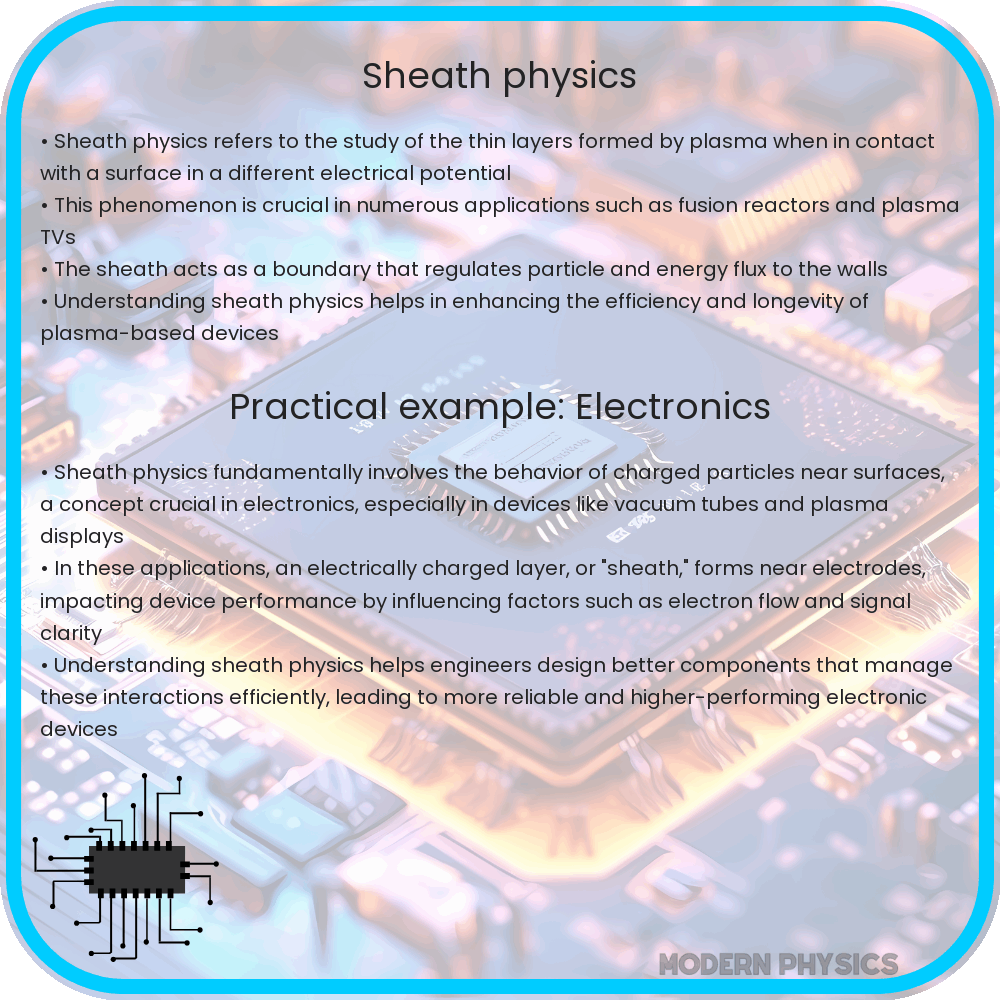
Sheath physics is a fundamental aspect of plasma science, playing a pivotal role in both theoretical studies and practical applications. It deals with the study of the sheath, a thin layer where a significant electric field exists, separating a plasma from a solid or liquid surface. Understanding sheath physics is crucial for advancing technology in various fields, including space propulsion, nuclear fusion, and semiconductor manufacturing.
Theoretical Foundations of Sheath Physics
At its core, sheath physics involves the interaction between charged particles within a plasma and the surfaces in contact with this plasma. The formation of a sheath is an intrinsic property of quasi-neutral plasmas in proximity to material surfaces. Charged particles, electrons, and ions move at different speeds due to their mass difference, creating a charge imbalance at the boundary. This imbalance results in the formation of a potential difference, or sheath potential, which acts to repel electrons and attract ions, maintaining quasi-neutrality in the plasma bulk.
Applications of Sheath Physics
Sheath physics has wide-ranging applications in various industries. In space propulsion, the understanding of sheath dynamics is essential for the development of efficient ion thrusters. In the field of nuclear fusion, controlling the plasma sheath helps in protecting the reactor walls from excessive heat and particle erosion. Semiconductor manufacturing relies on plasma etching processes, where sheath control is critical for achieving precise material removal and surface treatment.
Plasma Analysis in Sheath Physics
Plasma analysis within sheath physics involves several diagnostic techniques to measure sheath properties and dynamics. Langmuir probe diagnostics, for instance, allow for the determination of electron temperature, plasma density, and sheath potential. Optical emission spectroscopy (OES) provides insights into the plasma’s composition and reactions occurring within the sheath. These analyses are crucial for optimizing plasma processes and understanding the underlying physics of sheath formation and behavior.
In summary, sheath physics is a key area of plasma science with significant theoretical and practical implications. Its study not only advances our understanding of plasma behavior but also enables technological advancements in various high-tech industries.
Advancements and Challenges in Sheath Physics
Recent advancements in sheath physics research have led to better simulation models and diagnostic tools, enabling more accurate predictions and control of plasma-sheath interactions. Computational plasma physics has seen significant progress with the development of particle-in-cell (PIC) simulations, which provide detailed insights into the kinetics of plasma and sheath dynamics. These advancements allow for the optimization of industrial processes, such as improving the efficiency of ion thrusters and enhancing the precision of plasma etching in semiconductor fabrication.
Despite these advancements, several challenges remain in the field of sheath physics. One of the primary challenges is the accurate modeling of complex plasma-surface interactions, especially in turbulent or non-equilibrium plasma conditions. Additionally, the development of materials that can withstand the harsh conditions of plasma exposure while minimizing contamination is an ongoing area of research.
Future Directions in Sheath Physics
The future of sheath physics research is poised to address these challenges through interdisciplinary approaches, combining insights from materials science, electrical engineering, and computational physics. The exploration of novel materials and coatings to enhance surface resistance to plasma-induced erosion is one promising area. Furthermore, the integration of machine learning techniques with PIC simulations could lead to breakthroughs in predicting plasma behavior and optimizing plasma-based technologies.
Collaboration between academia and industry is crucial for translating theoretical advancements into practical applications. As the demand for more efficient and precise plasma technologies grows, the role of sheath physics in innovation and technological development will only become more significant.
Conclusion
Sheath physics stands at the intersection of fundamental science and technological innovation, offering profound insights into plasma behavior and its interaction with materials. The study of sheath physics has led to significant advancements in various high-tech industries, from space exploration to semiconductor manufacturing. Despite the challenges that lie ahead, the ongoing research and interdisciplinary efforts promise to unlock new potentials and applications of plasma science. By addressing these challenges and exploring new frontiers, sheath physics will continue to be a cornerstone of progress in science and technology.