
Explore the enigma of Self-Interacting Dark Matter (SIDM), its evidence in the cosmos, and its profound implications on our understanding of the universe’s structure and evolution.
Unraveling the Mystery of Self-Interacting Dark Matter
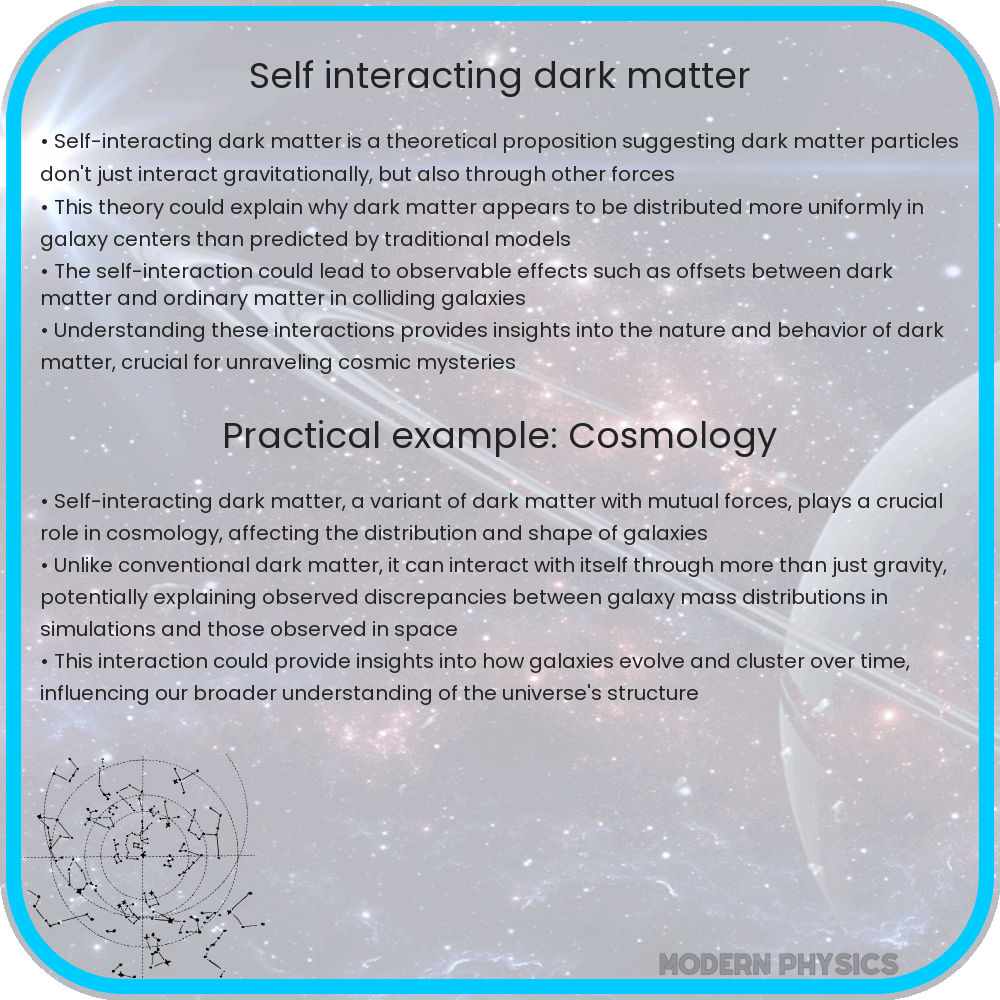
Dark matter, an invisible substance making up approximately 85% of the universe’s mass, has long puzzled scientists. Unlike ordinary matter, dark matter does not emit, absorb, or reflect light, making it extremely difficult to detect. Among the intriguing concepts proposed to explain dark matter’s behavior is the theory of Self-Interacting Dark Matter (SIDM). This concept suggests that dark matter particles can interact with one another through forces other than gravity, a departure from the traditional view of dark matter as entirely non-interactive.
Evidence and Observations
The evidence for SIDM emerges from discrepancies between cosmological simulations based on collisionless dark matter and actual astronomical observations. For instance, conventional dark matter models predict dense, cusp-like centers in galaxies. However, many observed galaxies display flat density profiles, a phenomenon more consistent with SIDM as it allows for particle interactions that could redistribute energy and flatten these cores.
Furthermore, anomalies in the distribution of dark matter within galaxy clusters, such as the observed segregation between dark matter and ordinary matter following cluster collisions, support the SIDM hypothesis. These interactions could explain the apparent offset of dark matter from visible matter, unlike predictions by non-interacting dark matter models.
Implications for Cosmology
The SIDM model has profound implications for our understanding of the universe’s structure and evolution. By allowing for interactions within the dark sector, SIDM provides a framework for explaining the diverse range of galactic shapes and sizes observed across the cosmos. This model can also influence the dynamics of galaxy clusters, potentially solving longstanding puzzles in astrophysics such as the ‘Too Big to Fail’ problem, where simulations predict more large satellite galaxies than are observed around the Milky Way.
Moreover, SIDM can offer insights into the early universe and the nature of dark energy, another mysterious force driving the universe’s accelerated expansion. By adjusting the properties of dark matter interactions, scientists can refine cosmological models to better match observational data, offering a more comprehensive view of the universe’s history and composition.
Challenges and Future Directions
Despite its promising aspects, the SIDM model faces several challenges. One of the primary concerns is the lack of direct evidence for dark matter interactions other than gravitational. Experimental efforts to detect SIDM through particle physics experiments, such as direct and indirect dark matter detection, have yet to yield conclusive results. Furthermore, the exact nature and strength of the interactions within SIDM remain largely speculative, requiring a more profound theoretical framework and computational models to accurately describe them.
Future research in SIDM is poised to bridge these gaps through advancements in both observational astronomy and particle physics. Upcoming telescopes and observatories, equipped with higher resolution and sensitivity, are expected to provide clearer insights into the distribution and behavior of dark matter in the universe. Additionally, improvements in simulation techniques and a deeper understanding of particle physics could lead to more precise predictions of SIDM effects in cosmic structures.
Conclusion
Self-Interacting Dark Matter represents a significant shift from the conventional understanding of dark matter as entirely non-interactive. By proposing that dark matter particles can interact with each other, SIDM offers potential solutions to several astronomical anomalies unexplained by traditional dark matter models. Despite facing challenges such as the lack of direct detection and uncertainties in interaction strength, SIDM remains a compelling avenue for future research. It holds the promise of unraveling some of the most profound mysteries in cosmology and particle physics, bringing us closer to a complete picture of the universe’s composition and evolution. As the quest to understand dark matter continues, SIDM stands out as a testament to the ever-evolving nature of scientific inquiry, encouraging open-mindedness and innovation in the face of the unknown.