
Explore the innovative world of self-healing composites, materials designed to autonomously repair damage and enhance durability in various industries.
Introduction to Self-Healing Composites
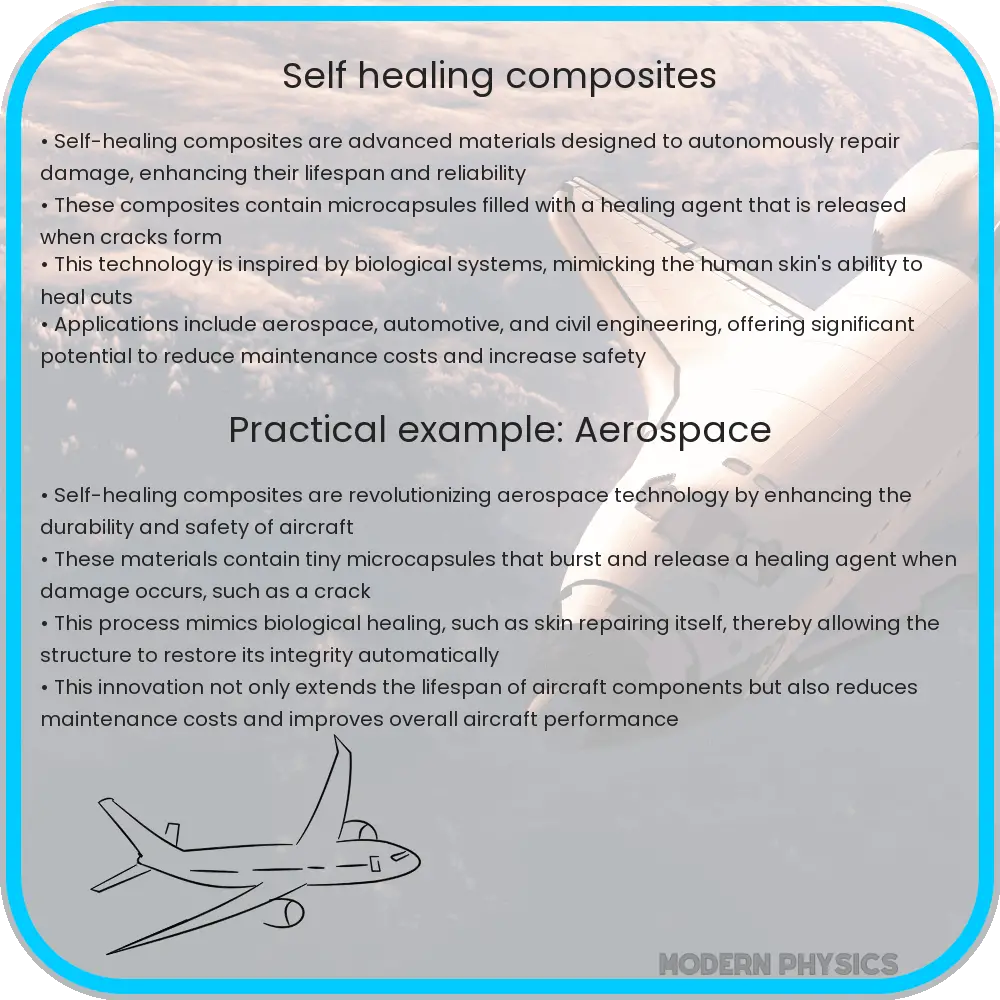
Materials technology is a field that constantly pushes the boundaries of innovation, particularly with the development of self-healing composites. These materials have the remarkable ability to autonomously repair damage, significantly enhancing durability and extending their useful life. This capability not only promises to reduce maintenance costs and improve safety but also opens new avenues for engineering applications across various industries.
Understanding Self-Healing Mechanisms
Self-healing composites employ various mechanisms to repair themselves when damaged. The two primary types of self-healing mechanisms are intrinsic and extrinsic. Intrinsic healing occurs when the material itself has inherent reparative properties. On the other hand, extrinsic healing involves embedded healing agents within the composite, such as microcapsules or vascular networks, which release these agents upon damage.
- Intrinsic Self-Healing: Intrinsic mechanisms often rely on reversible chemical bonds. These bonds can break and reform to heal micro-cracks that develop during the material’s lifecycle.
- Extrinsic Self-Healing: Extrinsic systems might use embedded microcapsules that burst upon impact, releasing a healing agent that polymerizes to repair the damage. Alternatively, vascular networks mimic the human circulatory system by continuously delivering healing agents to the crack site.
Components and Chemistry of Self-Healing Composites
At the heart of self-healing composites are the innovative materials and chemical processes involved. These often include:
- Shape Memory Polymers (SMPs): SMPs can return to their original shape after deformation, aiding the healing process in composites by closing cracks and re-aligning broken fibers.
- Thermally Reversible Polymers: These materials use heat to reverse the damage, primarily through melting and re-solidification at the damaged points.
- Microcapsulated Healing Agents: Typically consisting of a polymerizable resin and a hardener, these components are encapsulated and dispersed within the composite matrix. When a crack propagates, it ruptures the microcapsules, mixing the components to initiate polymerization and heal the material.
The chemical reactions often involve radical polymerization, a process where free radicals are generated to initiate a chain reaction that leads to the curing (hardening) of the polymer. This process is vital for the self-healing mechanism as it restores the mechanical strength of the composite.
Applications and Future Prospects
The practical application of self-healing composites spreads across multiple industries including aerospace, automotive, and civil engineering. In aerospace, these materials can help maintain the integrity of aircraft structures that are susceptible to micro-damage that can lead to catastrophic failures. For the automotive industry, self-healing composites can extend the life of car components, reducing the need for replacements and repairs. In civil engineering, implementing these materials in the construction of bridges, roads, and buildings could lead to structures that require less maintenance and have longer lifespans.
- Aerospace: Enhances safety and reduces maintenance costs by repairing micro-damages in aircraft structures automatically.
- Automotive: Extends the lifespan of automobile parts, making cars more sustainable and economical over time.
- Civil Engineering: Creates more durable infrastructure, potentially reducing repair costs and increasing reliability.
Moreover, the ongoing research promises even broader applications and improvements. Scientists are exploring nano-engineered self-healing systems that could offer even more efficient and rapid healing. Another focus is on developing environmentally friendly self-healing materials, which would further enhance the sustainability of this innovative technology.
Conclusion
Self-healing composites mark a significant evolution in material science, blending chemistry, physics, and engineering to solve real-world problems. These materials not only improve the lifespan and safety of structural elements but also pave the way for more sustainable practices in industries as diverse as aerospace and civil engineering. The ability to recover from damage autonomously reduces the overall environmental footprint by minimizing the need for replacement materials and the associated energy consumption and waste. As research progresses, the potential for these materials to revolutionize our approach to design and maintenance becomes increasingly apparent, promising a future where materials are not only functional but also self-sustaining.