
Explore the essentials of Second Harmonic Generation (SHG), its efficiency enhancements, and diverse applications in technology and medicine.
Understanding Second Harmonic Generation and Its Enhanced Efficiency
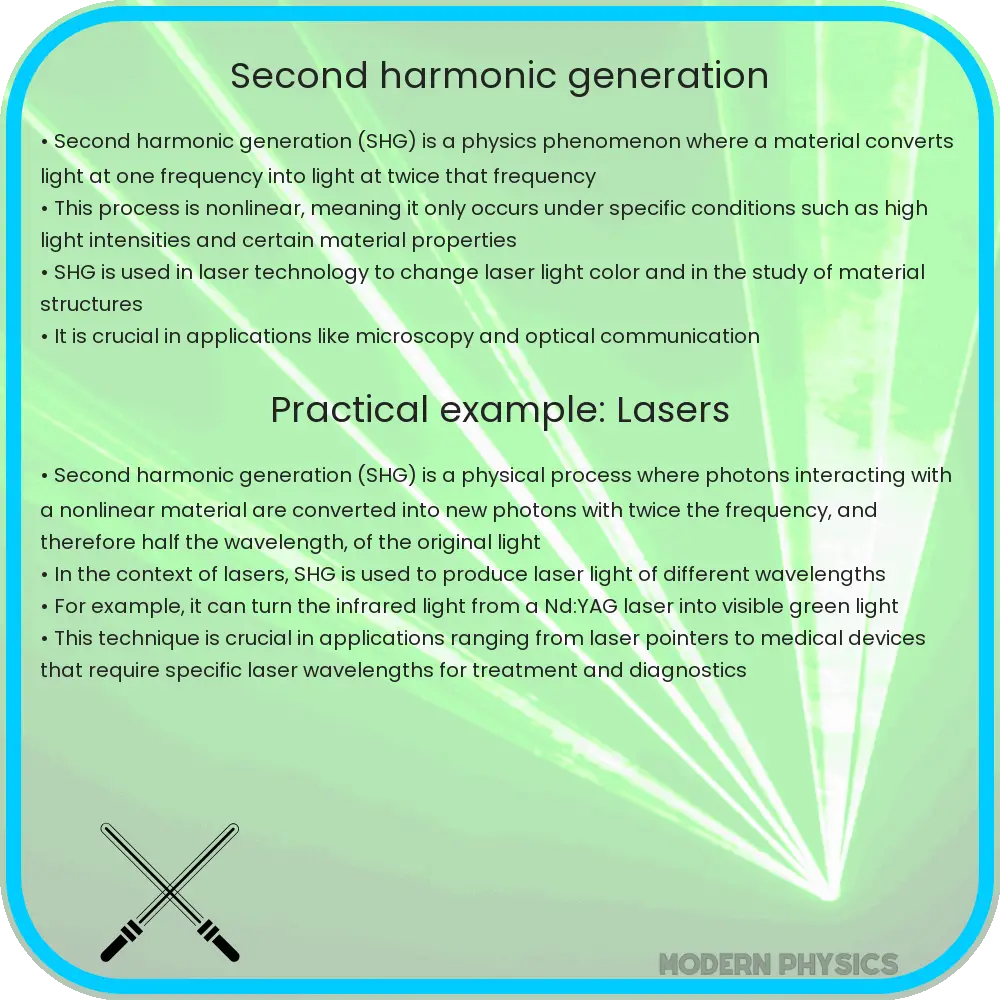
Second Harmonic Generation (SHG) is a nonlinear optical process in which two photons with the same frequency interact within a material to create a new photon with twice the frequency (or half the wavelength) of the initial photons. This phenomenon is pivotal in the field of photonics, serving as a foundation for various applications ranging from laser technology to medical imaging. The efficiency of SHG is crucial, as it determines the extent to which the frequency doubling effect can be utilized in practical applications.
Key Factors Influencing SHG Efficiency
The efficiency of Second Harmonic Generation is influenced by several key factors, including the properties of the nonlinear material used, the phase matching conditions, and the intensity of the input light. Nonlinear optical materials play a central role, with certain crystals like Lithium Niobate (LiNbO3) and Potassium Titanyl Phosphate (KTP) being highly favored for their strong nonlinear optical responses.
- Material Nonlinearity: The inherent nonlinearity of the material dictates its ability to facilitate the conversion of input photons into second harmonic photons efficiently.
- Phase Matching: Achieving phase matching conditions is essential for maximizing the conversion efficiency. This involves aligning the wave vectors of the interacting waves to ensure constructive interference.
- Intensity of Input Light: The intensity of the input light significantly impacts SHG efficiency. Higher light intensities lead to more pronounced nonlinear interactions and thus higher conversion efficiencies.
Applications of Enhanced SHG Efficiency
Enhanced SHG efficiency has opened up a wide array of applications across diverse fields. In the realm of laser technology, SHG is used to generate light at wavelengths that are not directly achievable through laser sources. This capability is particularly beneficial in medical laser applications, where precise and non-invasive treatments are paramount. Furthermore, SHG plays a critical role in optical data storage, telecommunications, and in the development of compact and efficient laser sources for industrial and scientific use.
The quest for materials with higher nonlinear optical coefficients and techniques to optimize phase matching continues to drive research in this area, promising even broader applications and more efficient systems in the future.
Advancements in Second Harmonic Generation
Recent advancements in Second Harmonic Generation technology focus on improving efficiency through innovative materials and configurations. Researchers are exploring novel nonlinear optical materials, including organic compounds and nanostructured materials, which offer unique advantages over traditional crystals. For instance, nanostructures can be engineered to exhibit enhanced nonlinear optical properties and more flexible phase matching conditions. Furthermore, the integration of SHG materials into photonic circuits and fiber optics is a growing area of interest, aiming to miniaturize devices and enhance the efficiency of optical systems.
Challenges and Future Perspectives
Despite its vast potential, SHG technology faces challenges, particularly in terms of material stability and the complexity of achieving optimal phase matching in practical applications. The efficiency of SHG processes is also limited by the fundamental properties of materials and the intensity of available laser sources. However, ongoing research and development efforts are addressing these challenges, with a focus on discovering new materials, refining phase matching techniques, and developing more powerful and tunable laser sources.
- Material Discovery: Identifying and synthesizing new materials with higher nonlinear optical coefficients to improve SHG efficiency.
- Phase Matching Techniques: Developing innovative methods to achieve phase matching more easily and efficiently, including quasi-phase matching and the use of periodic structures.
- Laser Development: Enhancing the power and tunability of laser sources to facilitate stronger and more efficient SHG processes.
Conclusion
Second Harmonic Generation represents a cornerstone of nonlinear optics, with its enhanced efficiency paving the way for revolutionary applications in science, medicine, and technology. The ongoing exploration of new materials, combined with advancements in laser technology and optical engineering, holds the promise of overcoming existing limitations and unlocking new possibilities. From improving medical diagnostics to enabling more efficient communication technologies, the continued development of SHG technology stands to offer significant contributions to a wide array of fields. As researchers address the challenges and leverage the opportunities presented by SHG, the future of this fascinating area of optics looks brighter than ever.