
Explore the speed, efficiency, and electrodynamics of satellite communication, and understand its global impact and future advancements.
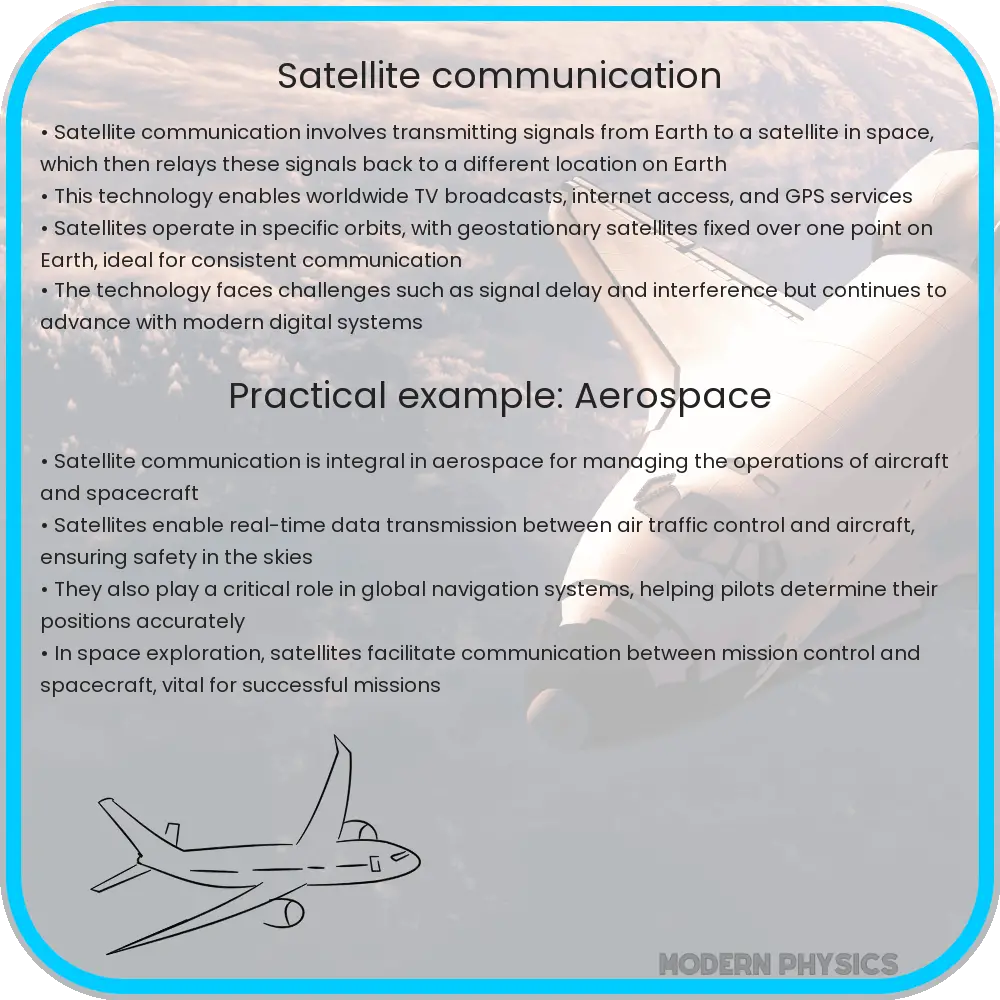
Satellite Communication: Unveiling the Dynamics of Speed and Efficiency
Understanding the intricacies of Satellite Communication is pivotal in grasping how our global communication network operates. Satellite communication plays a critical role in modern connectivity, from television broadcasts to internet access and global navigation. The core of this technology hinges on the principles of speed, efficiency, and the fundamental laws of electrodynamics.
Speed: The Role of Signal Transmission and Reception
The speed of satellite communication is primarily governed by the signal transmission time between the Earth and the satellite. Signals travel at the speed of light (approximately 300,000 km/s), yet the vast distances involved can cause noticeable delays. For instance, a geostationary satellite, orbiting at about 35,786 kilometers above the Earth, will have a signal round-trip time of approximately 239 milliseconds. This aspect is crucial in applications where latency can be a deciding factor, such as high-frequency trading or real-time communications.
Efficiency: Maximizing Bandwidth and Minimizing Interference
Efficiency in satellite communication is twofold – maximizing bandwidth usage and minimizing signal interference. Modern satellites use a range of frequencies, from C-band to Ka-band, each serving different purposes and having varying degrees of susceptibility to atmospheric conditions. Advanced modulation and coding techniques are employed to increase the amount of data transmitted over these bands while maintaining signal integrity. Additionally, techniques like frequency reuse and polarization are utilized to maximize bandwidth efficiency.
Electrodynamics: The Backbone of Satellite Communication
Electrodynamics plays a foundational role in satellite communication. Maxwell’s equations, which describe how electric and magnetic fields are generated and altered by each other and by charges and currents, are fundamental. These principles govern antenna design, wave propagation, and signal polarization – all critical for effective satellite communication. For instance, the antenna design must consider the wave’s frequency and polarization to ensure optimal transmission and reception.
In conclusion, the realms of speed, efficiency, and electrodynamics intertwine to create the sophisticated and intricate world of satellite communication. By diving deeper into these aspects, one can appreciate the complexities and marvels of this technology that connects our world.
Advanced Technologies Enhancing Satellite Communication
Emerging technologies continually push the boundaries of what’s possible in satellite communication. High-throughput satellites (HTS) represent a significant leap, offering substantially more capacity compared to traditional satellites. They achieve this through spot beam technology which allows for a more focused and efficient use of the frequency spectrum. Additionally, advancements in on-board processing enable satellites to perform more complex tasks, reducing the burden on ground stations and improving overall system efficiency.
Global Impact and Future Trends
The global impact of satellite communication is profound. It provides vital connectivity in remote and rural areas where terrestrial networks are unfeasible or too expensive. Satellites also play a critical role in disaster management and emergency response, offering reliable communication links when terrestrial infrastructure is compromised. Looking ahead, the integration of satellite networks with 5G and the potential development of satellite-based Internet of Things (IoT) platforms are areas of significant interest. These advancements promise to further blur the lines between local and global communication networks.
Challenges and Limitations
Despite its advancements, satellite communication is not without challenges. The high cost of launching and maintaining satellites is a significant barrier. There’s also the issue of space debris, which poses a risk to operational satellites. Moreover, signal latency and atmospheric interference (such as rain fade in higher frequency bands) continue to be areas of concern, particularly for applications requiring real-time data transmission.
Conclusion: The Ever-Evolving Realm of Satellite Communication
In conclusion, satellite communication represents a fascinating blend of speed, efficiency, and the principles of electrodynamics. It has evolved from a novel technology to a backbone of global communication, pivotal in bridging geographical divides. As we move forward, the integration of cutting-edge technologies and innovative solutions will continue to expand the capabilities and applications of satellite communication. The future of this field is not just about connecting points on the globe; it’s about creating a seamless, interconnected world where information and communication are boundless and instantaneous.