
Explore the Sagnac Effect in interferometry: its principles, precision applications, and impact on physics and technology.
The Sagnac Effect: An Overview
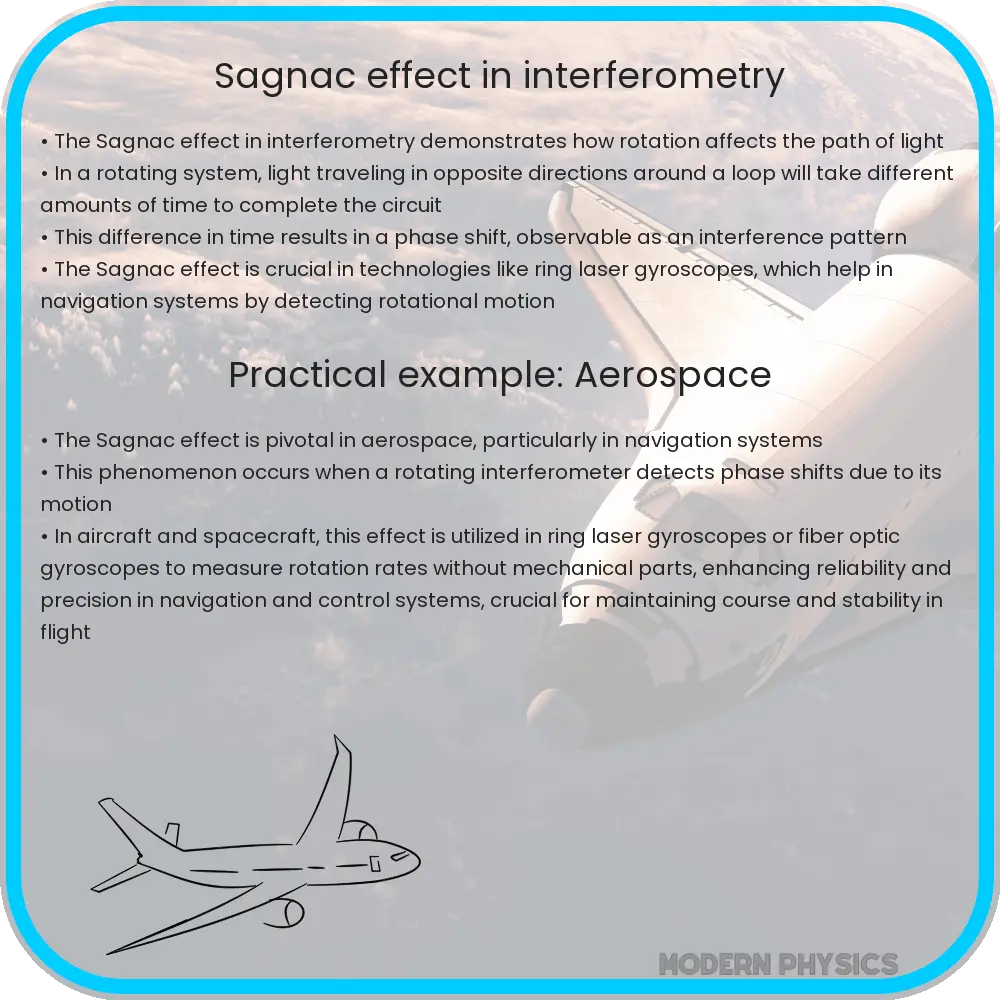
The Sagnac Effect, a phenomenon first observed by French physicist Georges Sagnac in 1913, has become a cornerstone in the field of interferometry, with a wide range of applications in modern science and technology. This effect occurs in a rotating system when beams of light are sent in opposite directions around a closed loop. The key to understanding the Sagnac Effect lies in its reliance on the principles of light’s constant speed and the rotation of the reference frame.
Principles of the Sagnac Effect in Interferometry
Interferometry, the technique of using superimposed waves for measurement and analysis, takes a significant leap forward with the incorporation of the Sagnac Effect. In a typical Sagnac interferometer, light is split into two beams traveling in opposite directions around a rotating loop. When these beams are recombined, an interference pattern is observed. The heart of this phenomenon is the difference in travel time for the light beams due to the rotation of the apparatus. This time difference translates into a phase shift, visible in the interference pattern, which is directly proportional to the angular velocity of the rotation.
High Precision and Sensitivity
The Sagnac interferometer is renowned for its extraordinary sensitivity to rotation, making it an invaluable tool in various scientific and industrial applications. The precision of this instrument is such that it can detect rotational rates as minute as the Earth’s rotation itself. This high sensitivity arises from the linear relationship between the phase shift in the interference pattern and the angular velocity of the system.
Applications of the Sagnac Effect
The practical applications of the Sagnac Effect are diverse, ranging from navigation systems to geophysics. It plays a crucial role in the functioning of ring laser gyroscopes, which are essential components in inertial navigation systems used in aircraft and ships. Additionally, its applications extend to earthquake detection, where it helps in measuring rotational seismic waves, providing valuable data for geophysical research.
In the realm of fundamental physics, the Sagnac Effect has also contributed to the testing of relativity theory, particularly in understanding how rotation affects space-time. Its implications in the study of rotating frames of reference provide deeper insights into the nature of time and motion in the universe.
Theoretical Implications of the Sagnac Effect
The Sagnac Effect is not only significant for its practical applications but also for its theoretical implications in physics. It offers a unique perspective on the nature of light and space-time. The effect is consistent with both special and general relativity, providing a real-world scenario where the interplay between rotation, light, and time can be observed. This has led to a deeper understanding of non-inertial frames of reference, challenging and enriching our comprehension of Einstein’s theories.
Challenges and Future Directions
Despite its widespread application, the Sagnac Effect and Sagnac-based devices face challenges, primarily in terms of sensitivity to environmental factors like temperature fluctuations and mechanical vibrations. Ongoing research focuses on enhancing the stability and accuracy of these systems. Future advancements may include integrating novel materials and quantum technologies to improve performance and open up new avenues for exploration in both applied and theoretical physics.
Conclusion
The Sagnac Effect, a phenomenon discovered over a century ago, continues to be a subject of fascination and utility in the realms of science and technology. Its application in Sagnac interferometers has revolutionized the way we measure and understand rotational motion, providing precision and sensitivity that was previously unattainable. From aiding in navigation to contributing to the fundamental understanding of space-time, the Sagnac Effect has proven to be an indispensable tool in modern science.
As we continue to push the boundaries of physics and technology, the Sagnac Effect stands as a testament to the enduring power of scientific discovery. It reminds us that the pursuit of knowledge often leads to practical applications that can transform our understanding of the world and our place in it. The future of the Sagnac Effect and its applications looks bright, promising further advancements and insights in the fields of physics, engineering, and beyond.