
Explore rollerblade kinematics: Learn how velocity, acceleration, and motion principles enhance rollerblading techniques and equipment design.
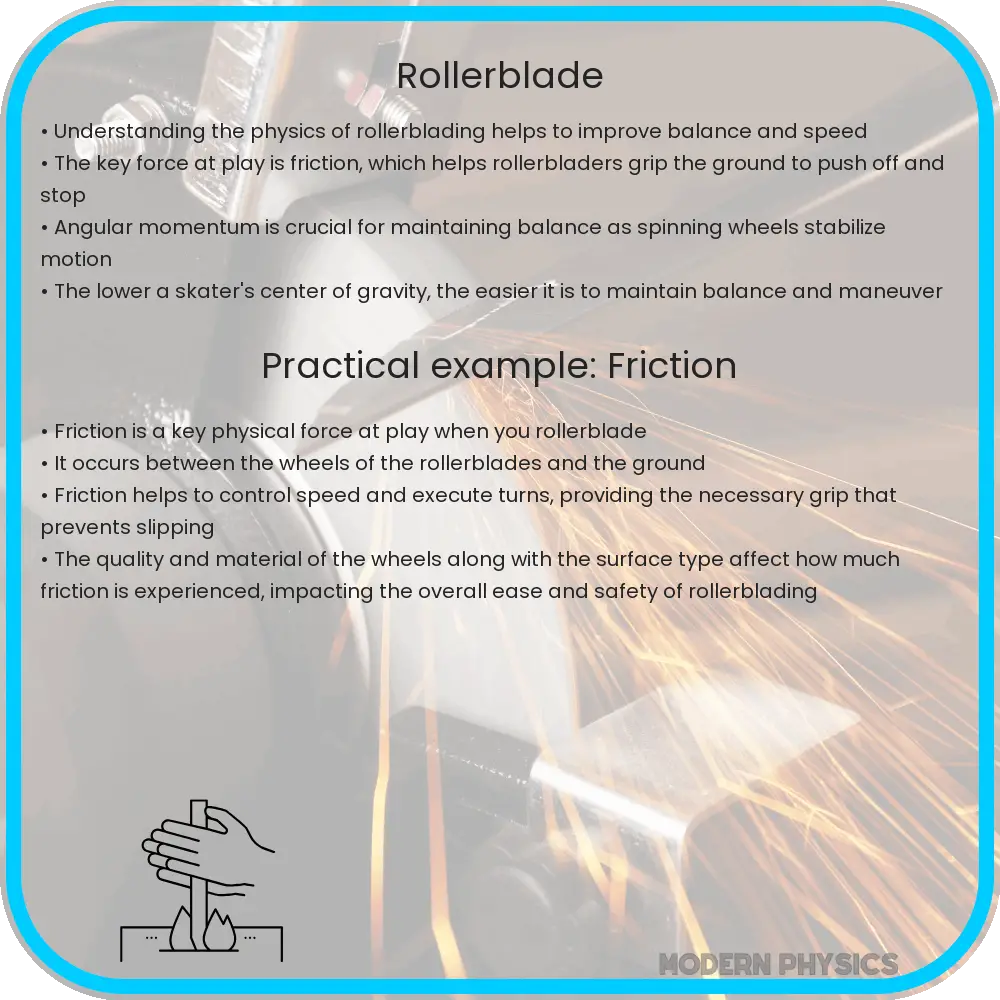
An Introduction to Rollerblade Kinematics: Understanding Velocity, Acceleration, and Motion
Rollerblading, a popular form of recreational and competitive sport, offers an excellent real-world example to explore the principles of kinematics – the branch of physics that deals with motion. By examining the velocity, acceleration, and overall motion of a rollerblader, we can gain a deeper understanding of these fundamental concepts.
Velocity in Rollerblading
Velocity, a vector quantity, represents the rate of change of a rollerblader’s position in a specific direction. It’s not just about speed (which is scalar) but also the direction of movement. The formula for velocity (\(v\)) is given by:
\[v = \frac{\Delta x}{\Delta t}\]
Where \(\Delta x\) is the change in position and \(\Delta t\) is the change in time. For instance, if a rollerblader moves 10 meters north in 2 seconds, their velocity would be 5 meters per second north.
Acceleration in Rollerblading
Acceleration is another vector quantity crucial in understanding rollerblade kinematics. It refers to the rate of change of velocity. When a rollerblader speeds up, slows down, or changes direction, they are accelerating. The formula for acceleration (\(a\)) is:
\[a = \frac{\Delta v}{\Delta t}\]
Where \(\Delta v\) is the change in velocity and \(\Delta t\) is the time over which this change occurs. For example, if a rollerblader increases their velocity from 0 to 10 m/s in 2 seconds, their acceleration is 5 m/s2.
Motion Analysis in Rollerblading
Understanding rollerblading motion involves analyzing how the velocity and acceleration of the rollerblader change over time. This analysis often involves graphical representations of these quantities. A velocity-time graph, for instance, can illustrate how the rollerblader’s speed and direction change over a given period, while an acceleration-time graph can show variations in the rate of these changes.
These principles of kinematics not only apply to rollerblading but also to a wide range of movements in sports and everyday life. By studying these concepts in the context of rollerblading, we can appreciate the intricate interplay of forces and motion that govern our physical world.
In the next section, we will delve deeper into the practical implications of these concepts, exploring how they influence the performance and techniques of rollerblading, as well as their relevance in designing rollerblading equipment and safety measures.
Practical Implications of Kinematics in Rollerblading
Understanding the kinematics of rollerblading is not just an academic exercise; it has practical implications for both the rollerbladers and the design of rollerblading equipment. For instance, by comprehending acceleration and velocity, a rollerblader can improve their techniques, such as how to achieve greater speed or control their movement more efficiently during turns and stops. This knowledge also aids in executing complex maneuvers and tricks, especially in competitive rollerblading.
Designing Rollerblading Equipment
From an equipment design perspective, kinematics plays a crucial role. Manufacturers can use these principles to create rollerblades that enhance performance and safety. For example, understanding the forces involved in acceleration and deceleration can lead to the development of better braking systems and wheel materials that offer optimal friction and durability. Similarly, the analysis of motion patterns can inform the design of more ergonomic and comfortable rollerblades that reduce the risk of injuries.
Rollerblading Safety and Training
Safety is a crucial aspect of rollerblading, where kinematics again plays a vital role. Knowledge of motion principles is essential for developing effective training programs that teach rollerbladers how to control their speed and navigate turns safely, thereby minimizing the risk of accidents. Additionally, understanding the forces involved in different movements helps in the design of protective gear, such as helmets and pads, that effectively absorb impact and reduce injury risk.
Conclusion
The study of kinematics in the context of rollerblading offers more than just a theoretical understanding of motion. It has significant practical applications that enhance performance, equipment design, and safety. By applying these principles, rollerbladers can refine their techniques for better control and efficiency, while manufacturers can develop equipment that maximizes performance and safety. Furthermore, a comprehensive understanding of these concepts is crucial for creating effective training and safety protocols. Ultimately, the intersection of physics and rollerblading not only enriches our understanding of motion but also contributes to the evolution and enjoyment of this dynamic sport.