
Explore roller support in engineering: its role in stability, load distribution, and how advancements in technology enhance structural integrity.
Understanding Roller Support in Engineering: Key Concepts
Roller support plays a crucial role in the field of structural engineering, particularly in the design and analysis of beams and bridges. It is a type of support that allows for linear movement along the axis of the beam, offering stability while accommodating structural expansions or contractions. This article delves into the fundamentals of roller support, its importance in load distribution, and how it is analyzed in structural engineering.
Key Characteristics of Roller Support
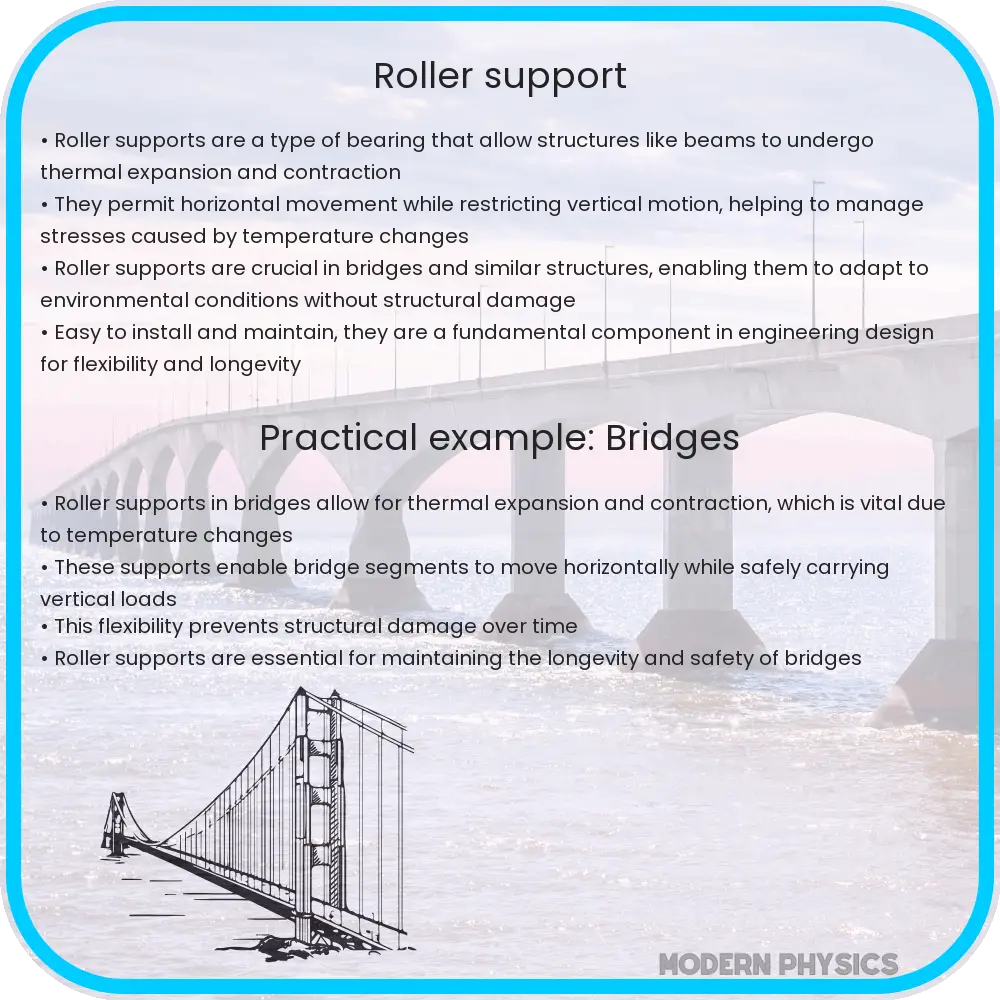
Roller supports are primarily used in structures where linear movement due to temperature changes or other factors is expected. They are characterized by their ability to resist vertical forces while allowing horizontal movements. This flexibility is essential in preventing stress accumulation in the structure.
Stability and Load Distribution
The stability provided by roller supports is critical in maintaining the structural integrity of bridges and beams. By allowing horizontal movement, these supports prevent the build-up of internal stresses that could lead to structural failure. Furthermore, roller supports effectively distribute loads across the structure. This distribution is vital in ensuring that no single part of the structure bears excessive stress, which could compromise its stability.
Analyzing Roller Support in Structural Engineering
The analysis of roller support involves several key considerations. Engineers must account for the maximum load the support can handle, the potential movements due to external factors, and the overall impact on the structure’s stability. This analysis typically involves sophisticated computational methods and the application of fundamental engineering principles.
For instance, when analyzing a beam on roller support, engineers use equations of equilibrium to determine the reactions at the supports. These reactions are crucial for designing a safe and efficient structure. The use of mathematical models and software tools has significantly enhanced the accuracy and efficiency of these analyses.
Moreover, the material and design of the roller support itself are also important factors. The selection of materials must consider factors such as durability, strength, and resistance to environmental conditions. The design must ensure that the support can accommodate the expected movements without compromising the structure’s stability.
In summary, roller support is an essential component in structural engineering, offering flexibility and stability to structures. Its analysis requires a comprehensive understanding of mechanical principles and the application of advanced computational tools. The next section will delve deeper into the applications of roller support in various structures and the latest advancements in this field.
Applications and Advancements in Roller Support Technology
Roller supports find their application in a wide range of engineering structures, most notably in bridge construction and large building frameworks. They are particularly advantageous in structures spanning large distances, where thermal expansion or contraction is a significant concern. The design of roller supports in bridges, for example, allows for temperature-induced expansions without causing stress or damage to the structure.
Advancements in materials science and engineering have led to the development of more sophisticated roller support systems. Modern roller supports are designed with high-strength materials and advanced manufacturing techniques, increasing their load-bearing capacity and durability. Innovations in design also include self-adjusting roller supports that can adapt to varying loads and environmental conditions, ensuring consistent performance and longevity.
Challenges in the Implementation of Roller Supports
Despite their advantages, implementing roller supports presents certain challenges. One of the primary concerns is ensuring precise installation, as incorrect placement can lead to uneven load distribution and potential structural issues. Additionally, maintenance is crucial, as the rollers and their bearings are subject to wear and tear over time. Regular inspections and maintenance are necessary to ensure the continued efficacy and safety of these supports.
Conclusion
In conclusion, roller supports are an integral component in the realm of structural engineering, playing a vital role in ensuring the stability and integrity of various structures. Their ability to accommodate linear movements and distribute loads effectively makes them indispensable in the design of bridges, buildings, and other large-scale structures. Ongoing advancements in materials and design continue to enhance the functionality and reliability of roller supports, addressing the evolving needs of modern engineering projects. However, it is imperative to acknowledge the challenges associated with their implementation, particularly in terms of installation accuracy and maintenance. As the field of structural engineering continues to evolve, the role of roller supports remains pivotal, underlining the importance of continuous research and development in this area.