
Explore the fundamentals of Resistive Wall Mode (RWM), its impact on plasma stability in fusion reactors, and the latest in control techniques and materials research.
Understanding Resistive Wall Mode: Fundamentals of Stability, Control, and Plasma Analysis
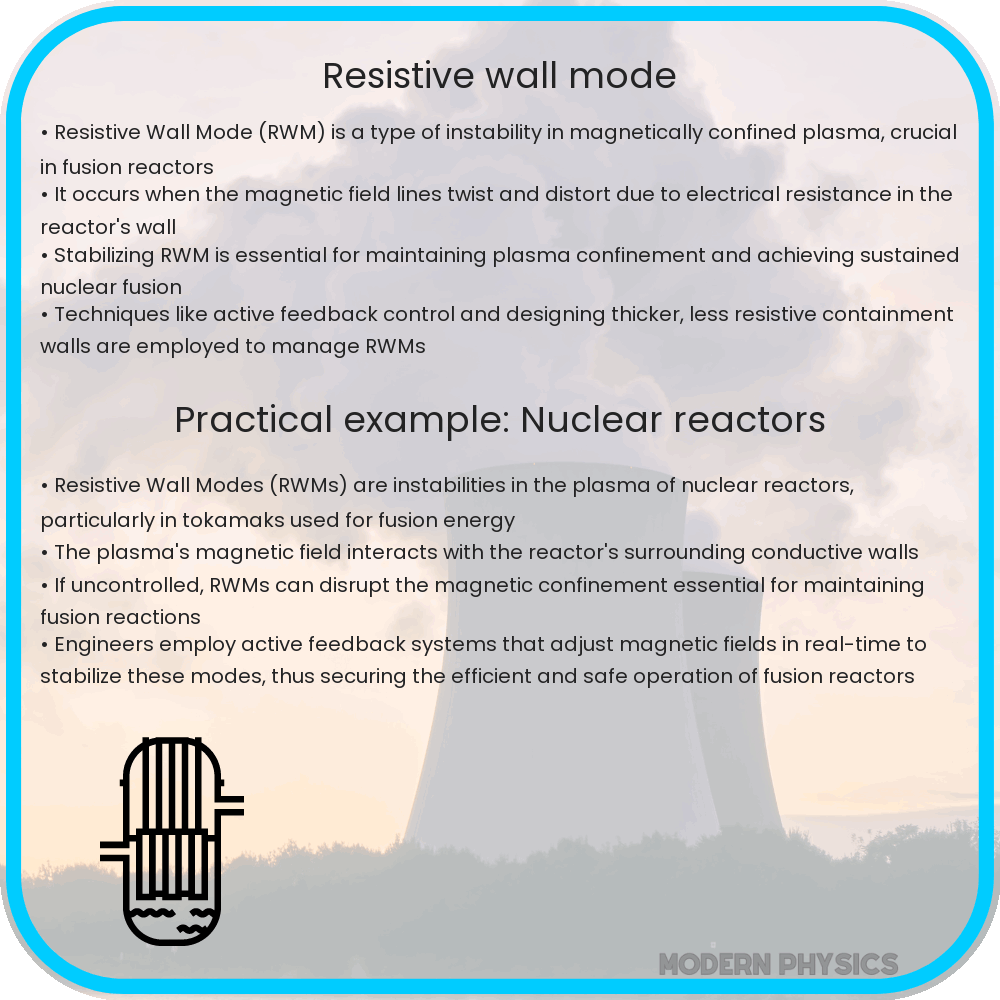
The concept of Resistive Wall Mode (RWM) plays a pivotal role in the field of plasma physics, particularly within the context of controlled nuclear fusion. This phenomenon is crucial for enhancing the stability of plasma within fusion devices like tokamaks and stellarators. RWM is characterized by the interaction between plasma and the surrounding conductive walls, which can either stabilize or destabilize the plasma under certain conditions.
The Essence of RWM Stability
Stability in plasma is essential for sustaining nuclear fusion reactions over extended periods. RWM stability refers to the ability of the system to contain plasma without it becoming unstable due to the resistive walls of the confinement device. The resistive walls, although not perfectly conductive, can delay the growth of instabilities, thus providing a window for corrective action through external control systems.
Advanced Control Techniques for RWM
Control of RWM involves sophisticated techniques that predict and counteract instabilities before they can escalate. One of the primary methods is the use of active feedback systems. These systems employ sensors to detect the onset of RWM and initiate countermeasures through magnetic coils surrounding the plasma. By adjusting the magnetic field, these coils can effectively suppress instabilities, maintaining the plasma’s stability.
Plasma Analysis in the Presence of RWM
Understanding and analyzing plasma behavior in the presence of RWM is vital for the design and operation of fusion reactors. Advanced diagnostic tools are used to monitor plasma parameters and detect any signs of RWM. This analysis is fundamental for the ongoing development of more effective control strategies and for improving the overall performance of fusion devices.
Comprehensive analysis of RWM involves both experimental and theoretical approaches, including the use of sophisticated simulations. These simulations help in understanding the complex interactions between plasma and the resistive wall, enabling researchers to predict the behavior under various conditions and devise more effective strategies for controlling RWM.
Challenges and Future Directions in RWM Research
The study and management of Resistive Wall Modes present a set of challenges that are at the forefront of current research in plasma physics. One of the primary difficulties lies in the precise prediction and control of RWM in high-performance plasmas. As the plasma approaches operational limits, the effectiveness of traditional control methods can diminish, necessitating the development of more sophisticated techniques.
Another significant challenge is the design of materials and structures for the resistive walls themselves. The material properties, such as electrical conductivity and magnetic permeability, play a crucial role in the effectiveness of RWM suppression. Research is ongoing to find materials that strike an optimal balance between conductivity, durability, and other physical constraints.
Furthermore, the integration of RWM control systems into future fusion reactors poses engineering and technological hurdles. These systems must not only be effective in suppressing instabilities but also robust enough to withstand the extreme conditions inside a fusion reactor.
Innovations in RWM Suppression and Plasma Confinement
Innovation in the field of RWM suppression is vital for advancing fusion energy research. Recent developments include the exploration of passive control methods, such as designing wall structures that naturally dampen instabilities without the need for active intervention. Additionally, the use of advanced algorithms and machine learning techniques in the control systems offers promising improvements in the real-time prediction and suppression of RWM.
Collaborative international projects, such as the ITER (International Thermonuclear Experimental Reactor), are critical in driving forward the research on RWM and plasma stability. These large-scale experiments provide invaluable data and insights, facilitating a deeper understanding of plasma behavior in conditions closely resembling those in commercial fusion reactors.
Conclusion
Resistive Wall Mode and its implications for plasma stability represent a critical area of research in the quest for sustainable fusion energy. The challenges posed by RWM are matched by the innovative strategies developed for its analysis, control, and suppression. As the scientific community advances in its understanding and technological capabilities, the prospects for overcoming these obstacles grow increasingly promising. The ongoing research and development efforts are paving the way towards reliable, efficient fusion power, promising a future with a clean and abundant source of energy. Through collaborative efforts and continued innovation, the goal of harnessing fusion energy for the benefit of humanity appears more attainable than ever.