
Explore how relativistic reflection and refraction adjust classic physics laws at speeds near light, incorporating special relativity effects.
Understanding Relativistic Reflection and Refraction
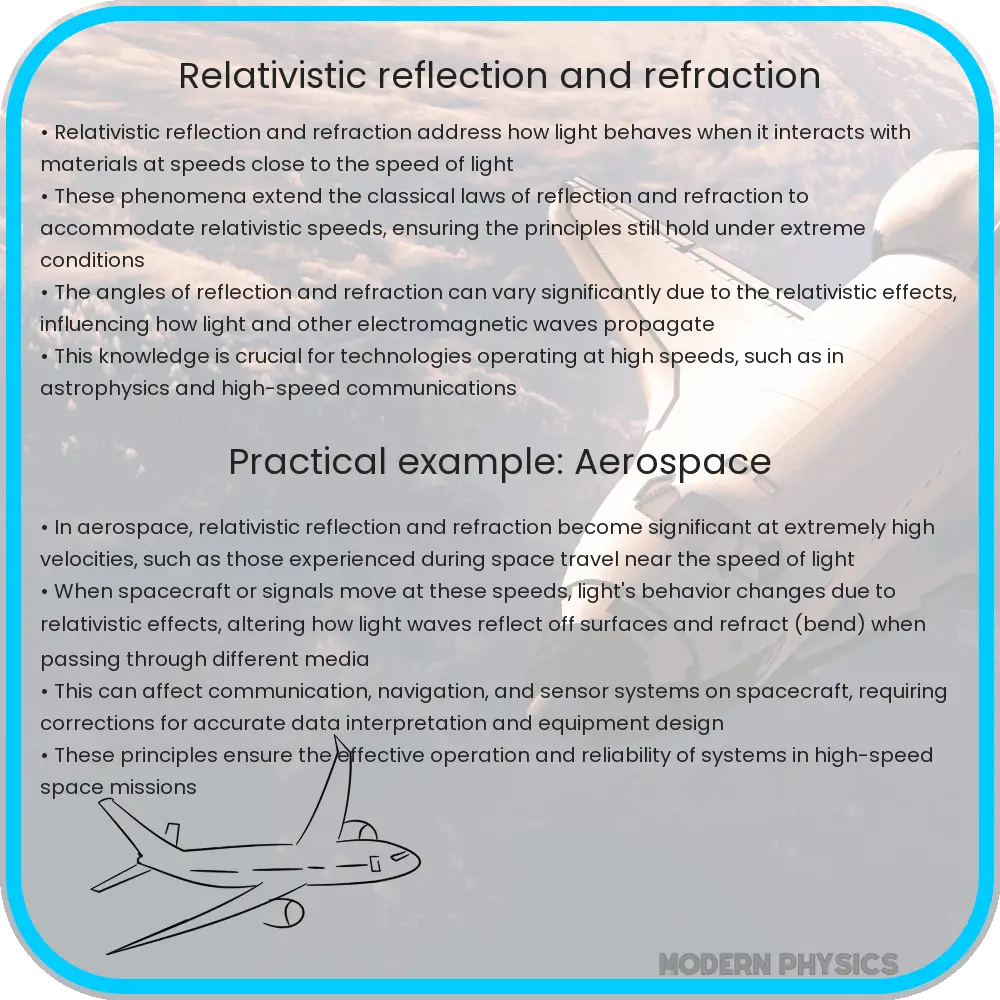
Relativistic reflection and refraction are fascinating concepts in physics that extend the classic laws of reflection and refraction into the realm of high speeds, close to the speed of light. This adjustment is necessary due to the effects of special relativity, formulated by Albert Einstein. In this article, we will delve into how angles and speeds are affected under these relativistic conditions.
Foundational Theories
The principles of relativistic reflection and refraction are based on the Lorentz transformation, which describes how, according to observers in different inertial frames, the measurements of space and time can vary significantly. These transformations deeply affect the angles and speed at which light and other electromagnetic waves propagate, especially as they approach the speed of light.
Relativistic Reflection
In classical physics, the law of reflection states that the angle of incidence (the angle at which the wave strikes a surface) is equal to the angle of reflection (the angle at which it bounces off the surface). However, under relativistic speeds, these angles can appear altered when observed from different reference frames due to time dilation and length contraction.
- Angle of Incidence: This is traditionally denoted as \( \theta_i \) and is the angle between the incident ray and the normal (perpendicular) to the reflecting surface.
- Angle of Reflection: Noted as \( \theta_r \), this angle aligns with the angle of incidence in classical physics: \( \theta_i = \theta_r \). In relativistic physics, however, this relationship holds true only if the observer and the reflecting surface are at rest relative to each other.
Relativistic Refraction
Refraction also undergoes modifications under relativistic effects. Snell’s Law, which links the angles of incidence and refraction with the indices of refraction of the two media, must be adjusted in high-speed scenarios.
- Classical Snell’s Law: \( n_1 \sin(\theta_1) = n_2 \sin(\theta_2) \), where \( n_1 \) and \( n_2 \) are the refractive indices of the first and second medium, respectively.
- Relativistic Snell’s Law: Under relativistic conditions, the indices of refraction themselves could alter due to relativistic effects like Doppler shift, depending on the relative motion of the source and the medium.
For instance, if light travels from a slower medium to a faster one, and if the source is moving relative to these media, the effective refractive indices are changed by the relativistic Doppler effect, thus modifying the traditional Snell’s law. This effect is crucial for understanding phenomena such as the apparent bending of starlight near the Sun, predicted by General Relativity and confirmed by historical astronomical observations.
Relativistic Effects on Light Speed
The speed of light in a vacuum is constant and denoted by \( c \). However, when light travels through a medium, its speed changes according to the medium’s refractive index: \( v = \frac{c}{n} \). Under relativistic conditions, not only can the speed of light appear to vary to an observer in a different inertial frame, but the refractive index may also differ.
This complexity arises from how velocities are added in Einstein’s theory. If a medium is moving relative to an observer, the resultant speed of light in that medium is influenced by both the speed of the medium and the light’s speed in the medium’s reference frame, calculated using the relativistic velocity addition formula:
\[ v’ = \frac{v + u}{1 + \frac{v \cdot u}{c^2}} \]
where \( v \) is the light’s speed in a stationary medium and \( u \) is the speed of the medium relative to the observer.
Applications in Modern Technology
The principles of relativistic reflection and refraction are not just theoretical exercises but have practical applications in modern technology. One of the most significant applications is in the field of GPS (Global Positioning System) technology. GPS satellites orbit the Earth at high velocities and altitudes, conditions under which relativistic effects become noticeable and must be accounted for in the calculations that determine precise locations on Earth’s surface.
Another application is in the realm of high-speed communications and astrophysics, where understanding how light behaves under extreme conditions can lead to improvements in data transmission across space and provide more accurate readings of cosmic phenomena.
Conclusion
Relativistic reflection and refraction extend classical physics into the high-speed realm of special relativity, showing us that the laws governing light and other electromagnetic waves are influenced by the relative motion between the observer and the source. From altering the angles of incidence and reflection to modifying Snell’s Law under high-speed conditions, these effects play a crucial role in areas ranging from global positioning systems to astronomical observations. This fascinating intersection of physics not only deepens our understanding of the universe but also enhances various technologies critical to modern society. As we continue to explore and push the boundaries of high-speed travel and communication, the principles of relativistic reflection and refraction will become increasingly important in designing future technologies and experiments.
In conclusion, the study of relativistic effects on reflection and refraction provides a remarkable example of how fundamental scientific principles can lead to practical technological advancements, further illustrating the incredible interconnectedness of theoretical physics and real-world applications.