
Explore the complexities of relativistic phase space in physics, linking dynamics, momentum, and energy to Einstein’s theory of relativity.
Understanding Relativistic Phase Space in Physics
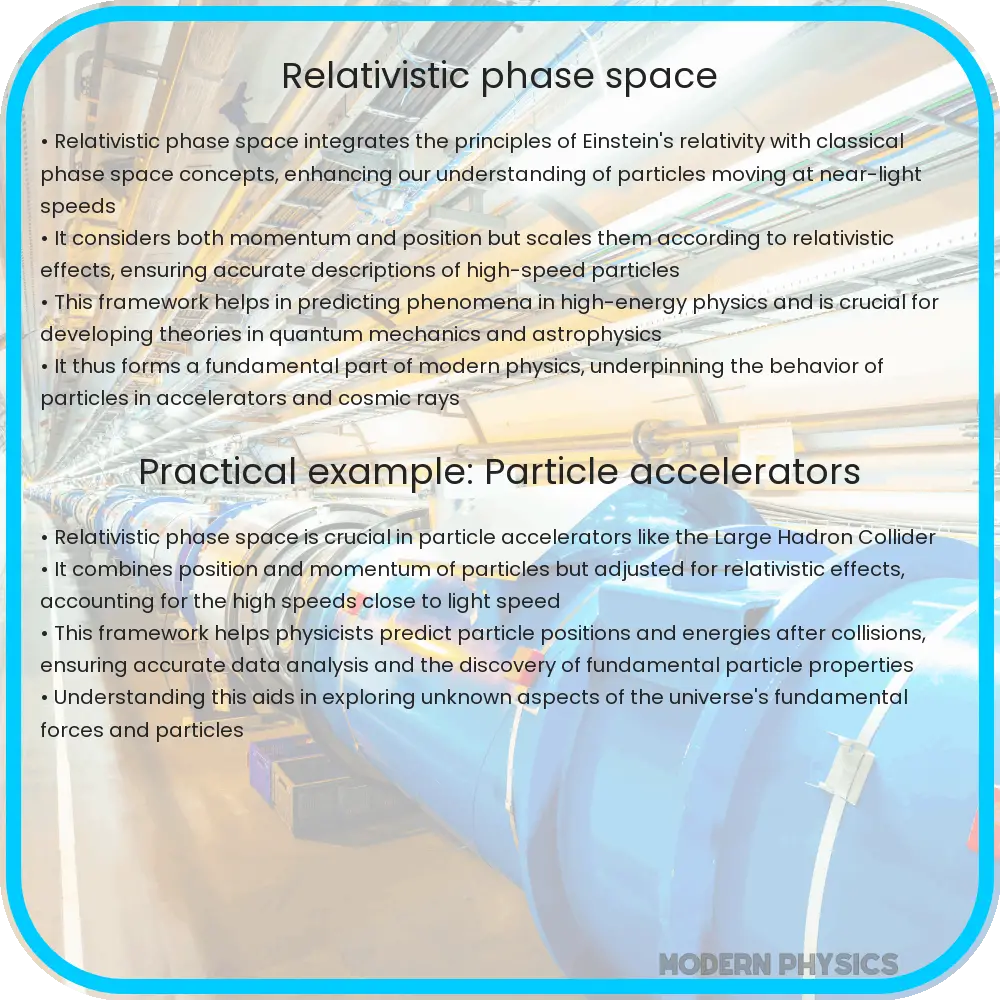
Relativistic phase space is a fundamental concept in physics, particularly in the realms of dynamics, momentum, and energy when considering systems moving at speeds comparable to the speed of light. This concept extends the classical phase space, which is used to describe the state of a physical system, into the domain of special relativity.
The Basics of Phase Space
Traditionally, phase space is a mathematical construct used in physics to represent the states of a dynamical system. Each point in this space corresponds to a possible state of the system, defined by its position and momentum. In classical mechanics, the phase space of a particle in three-dimensional space is six-dimensional, with three dimensions each for position (x, y, z) and momentum (px, py, pz).
Extension to Relativistic Regimes
However, when velocities approach that of light, classical mechanics fails to accurately describe the behavior of objects. Here, Einstein’s theory of special relativity comes into play, modifying the classical notions of space and time. Consequently, the concept of phase space is extended to incorporate relativistic effects.
Relativistic Dynamics, Momentum, and Energy
In relativistic dynamics, the momentum of an object is no longer linearly proportional to its velocity. Instead, it follows the relativistic momentum formula: p = γmv, where m is the rest mass of the object, v is its velocity, and γ (gamma) is the Lorentz factor, given by γ = 1 / √(1 – v2/c2), with c being the speed of light. This equation reflects how momentum increases dramatically as an object’s speed approaches the speed of light.
Similarly, the concept of energy is modified in relativity. The total energy (E) of a particle is given by E = γmc2, combining its rest energy (mc2) and kinetic energy. This equation shows the inherent relationship between mass and energy, a cornerstone of relativistic physics.
Relativistic phase space, therefore, incorporates these modified dynamics, providing a more comprehensive framework for understanding high-speed phenomena in the universe. It is crucial for accurately describing processes in high-energy physics, astrophysics, and other fields where velocities are a significant fraction of the speed of light.
Implications of Relativistic Phase Space
The exploration of relativistic phase space has profound implications in modern physics. It is essential for predicting the behavior of particles in accelerators, where speeds near that of light are common. In astrophysics, it aids in understanding the dynamics of celestial bodies moving at high velocities and in extreme gravitational fields, like those near black holes.
Quantum Mechanics and Relativistic Phase Space
Furthermore, relativistic phase space forms a bridge to quantum mechanics. Quantum field theory, which combines quantum mechanics with relativity, relies on this concept to describe particle interactions at high energies. The famous Dirac equation, which provides a relativistic description of the electron, is a prime example of the application of these principles in quantum mechanics.
Challenges and Future Directions
Despite its successes, the application of relativistic phase space poses significant mathematical and conceptual challenges. The non-linear nature of relativistic equations complicates analyses, demanding advanced mathematical techniques. Additionally, integrating gravity into this framework, a goal of theories like quantum gravity, remains an elusive but active area of research.
Conclusion
Relativistic phase space is a pivotal concept in physics, extending the classical understanding of dynamics, momentum, and energy to account for the effects of special relativity. Its development has not only deepened our comprehension of high-speed phenomena but has also catalyzed advancements in fields like particle physics and astrophysics. The integration of relativistic principles into the phase space paradigm exemplifies the continual evolution of scientific thought in the quest to understand the universe. As research progresses, especially in areas like quantum gravity, the exploration of relativistic phase space will undoubtedly yield further insights into the fabric of reality.