
Explore the intriguing world of relativistic optics, understanding light’s behavior at near-light speeds, its impact on technology and astrophysics.
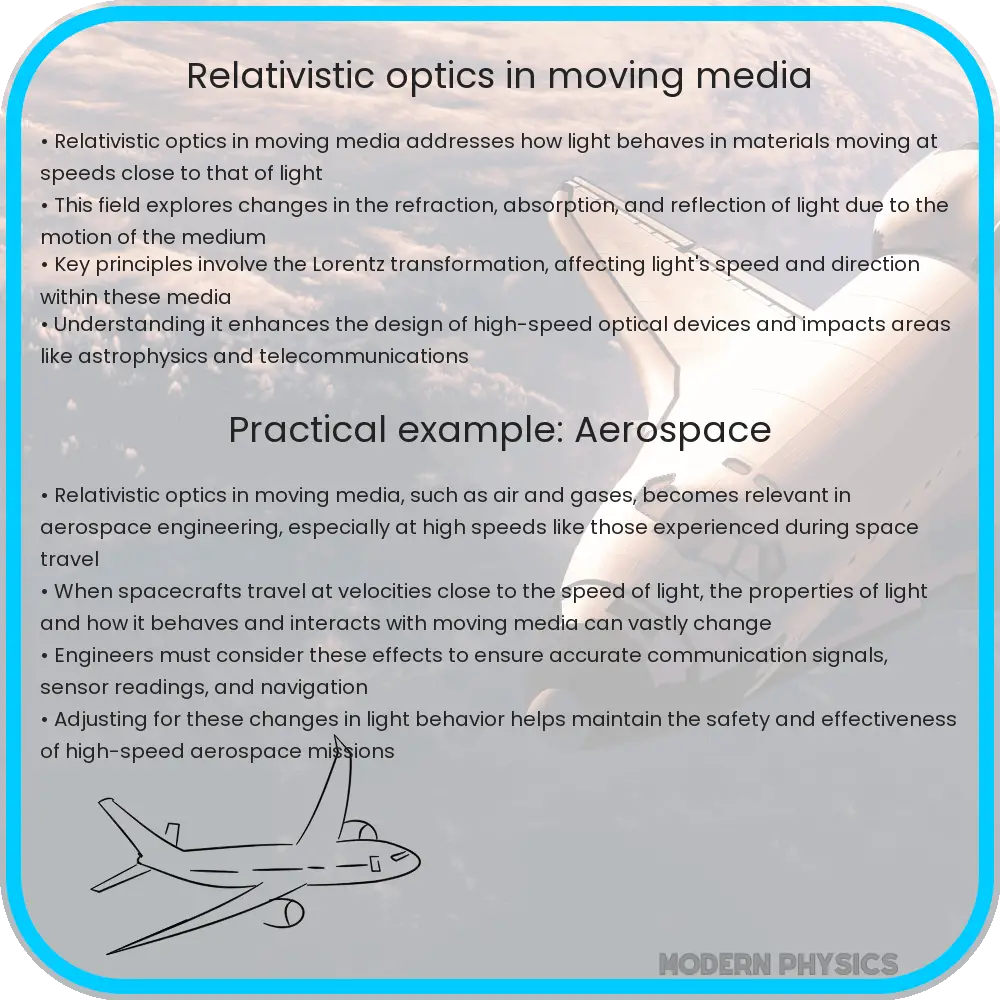
Exploring the Fascinating World of Relativistic Optics
Relativistic optics, a branch of physics that melds the principles of optics with Einstein’s theory of relativity, offers profound insights into how light behaves at speeds approaching that of light. This intriguing field investigates the dynamics of light in various media under the influence of relativistic speeds, shedding light on phenomena such as light shifts and time dilation.
Understanding the Speed of Light in Different Media
The speed of light, denoted as ‘c’ in vacuum, is a fundamental constant in physics. However, when light travels through different media, its speed changes due to the refractive index of the medium. The refractive index, ‘n’, is a dimensionless number that describes how light propagates through that medium. It is defined as the ratio of the speed of light in a vacuum to the speed of light in the medium: \( n = \frac{c}{v} \), where ‘v’ is the speed of light in the medium. In relativistic optics, the refractive index becomes significant as it influences how light and matter interact at high speeds.
Media Dynamics and Light Propagation
In relativistic optics, understanding the dynamics of the medium through which light travels is crucial. For instance, in a moving medium, the Doppler effect and relativistic aberration come into play. These effects cause shifts in the frequency and direction of light, respectively, which are crucial in understanding astrophysical phenomena and in applications like GPS technology. The Doppler effect, observable when there is relative motion between the source of light and the observer, results in a shift in frequency – a redshift for moving away and a blueshift for moving towards.
Relativistic Shifts in Light Frequency
One of the most intriguing aspects of relativistic optics is the shift in light frequency due to relativistic speeds. This shift, often referred to as the relativistic Doppler effect, goes beyond the classical Doppler effect by accounting for time dilation. In this scenario, the frequency of light perceived by an observer is affected not only by the relative velocity between the source and the observer but also by the time dilation effect of special relativity. This results in complex and fascinating phenomena that challenge our traditional understanding of light and motion.
Gravitational Lensing: A Relativistic Phenomenon
Another compelling aspect of relativistic optics is gravitational lensing. This phenomenon occurs when light from a distant star or galaxy passes near a massive object, causing the light to bend due to gravity. According to Einstein’s theory of general relativity, massive objects cause a curvature in space-time, and light follows this curvature. Gravitational lensing has become a vital tool in astrophysics, allowing us to observe and study distant galaxies, detect dark matter, and even search for exoplanets.
Applications of Relativistic Optics in Modern Technology
The principles of relativistic optics are not just theoretical curiosities; they have practical applications in modern technology. For example, the Global Positioning System (GPS) relies on an understanding of relativistic effects. GPS satellites orbit the Earth at high speeds and are subject to different gravitational forces compared to receivers on Earth. Without corrections for both special and general relativistic effects, GPS would be significantly less accurate. This real-world application underscores the importance of relativistic optics in daily life.
The Future of Relativistic Optics Research
Research in relativistic optics is ongoing, with scientists continuously exploring its implications in various fields. The integration of quantum mechanics with relativistic optics is an area of particular interest, potentially leading to breakthroughs in quantum computing and communications. Moreover, advanced telescopes and observational techniques are enhancing our understanding of cosmic phenomena through the lens of relativistic optics.
Conclusion
Relativistic optics, blending the principles of Einstein’s relativity with classical optics, offers a deeper understanding of light’s behavior in extreme conditions. From altering the speed of light in various media to explaining cosmic phenomena like gravitational lensing, it reveals the intricate interplay between light, space, and time. Its applications in technology, such as in GPS systems, demonstrate its relevance in everyday life. As research continues, relativistic optics promises to uncover more mysteries of the universe, bridging gaps in our knowledge and paving the way for future technological advancements.