
Explore the mysteries of relativistic jets, their origins around supermassive black holes, impacts on galaxies, and future observational prospects.
Understanding Relativistic Jets: Speed, Origins, and Impact on Galaxies
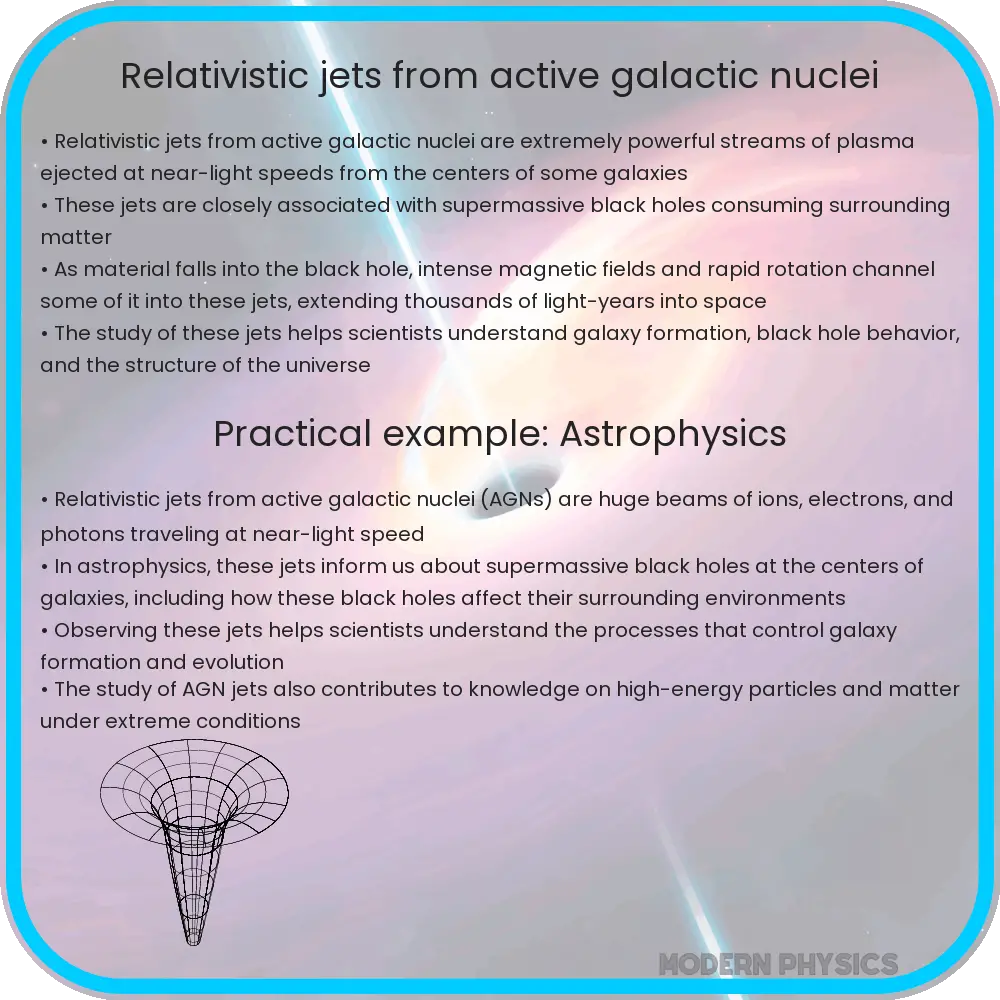
Relativistic jets are among the most spectacular and enigmatic phenomena in the cosmos. These jets, consisting of matter moving at speeds close to the speed of light, emerge from the centers of certain types of galaxies, particularly those harboring supermassive black holes. They play a crucial role in the dynamics of their host galaxies and the intergalactic environment.
Speed: Approaching the Speed of Light
The term ‘relativistic’ in relativistic jets refers to the speeds these jets achieve, which are significant fractions of the speed of light (denoted as ‘c’). Observations indicate that the particles in these jets can travel at velocities up to 99.9% of c. At these extreme velocities, the effects of Einstein’s theory of relativity become pronounced, leading to phenomena such as time dilation and length contraction.
Origins: Supermassive Black Holes and Accretion Disks
Relativistic jets are believed to originate from the regions around supermassive black holes, which lie at the centers of most large galaxies. These black holes, with masses ranging from millions to billions of solar masses (M☉), exert immense gravitational forces. Surrounding these black holes are accretion disks – swirling masses of gas and dust spiraling inward towards the event horizon. It’s within these high-energy environments that the conditions for the formation of relativistic jets are set.
Impact on Galaxies: Influencing Galactic Evolution
The impact of relativistic jets on their host galaxies and beyond is profound. They can transport energy and matter over vast distances, influencing star formation rates and distributing heavy elements across intergalactic space. Additionally, the jets interact with the interstellar medium, heating it and potentially quenching star formation in certain regions. This feedback mechanism is a crucial aspect in understanding galaxy formation and evolution.
In summary, relativistic jets are not only fascinating for their extreme velocities but also for their significant role in shaping the cosmos. Their study offers insights into the complex interplay between supermassive black holes and their host galaxies, a vital chapter in the story of our universe.
Galactic Feedback and Intergalactic Influence
Relativistic jets extend their influence beyond their host galaxies, impacting the larger intergalactic medium (IGM). They inject vast amounts of kinetic energy into the IGM, which can disrupt the cooling processes necessary for star formation in neighboring galaxies. This galactic feedback mechanism is a key factor in shaping the large-scale structure of the universe. Furthermore, these jets contribute to the reionization and chemical enrichment of the IGM, playing a role in its evolution over cosmic timescales.
Observational Challenges and Future Prospects
Studying relativistic jets poses significant observational challenges due to their immense distances and the complexities of astrophysical phenomena involved. Advanced telescopes across multiple wavelengths – from radio to gamma rays – are employed to unravel their mysteries. Upcoming missions and telescopes, like the James Webb Space Telescope and the Event Horizon Telescope, promise to provide deeper insights into the physics of relativistic jets and the environments around black holes.
Conclusion
Relativistic jets, as one of the universe’s most energetic and dynamic phenomena, offer a unique window into high-energy astrophysics and the workings of supermassive black holes. Their study not only enhances our understanding of the physics governing these extreme environments but also sheds light on the broader aspects of galaxy formation, evolution, and the interplay between galaxies and the intergalactic medium. The continued exploration of relativistic jets stands as a testament to human curiosity and our quest to understand the universe in its most extreme forms.