
Explore the world of high-speed physics with user-friendly relativistic energy and momentum calculators, perfect for professionals and students.
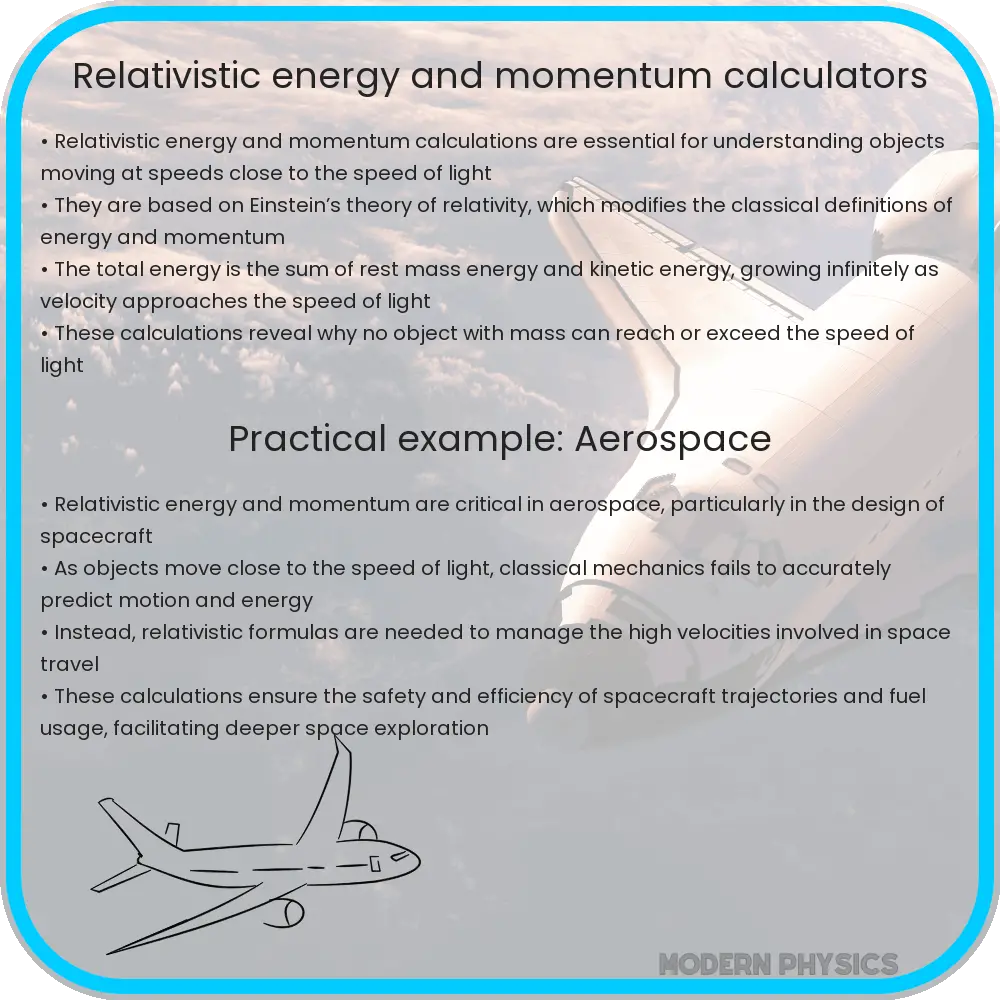
Understanding Relativistic Energy and Momentum
In the realm of physics, especially when dealing with high-speed objects approaching the speed of light, classical mechanics fall short, making way for the principles of Special Relativity. This groundbreaking theory, introduced by Albert Einstein in 1905, revolutionized our understanding of energy and momentum. It’s crucial for scientists and engineers working in fields such as particle physics, astrophysics, and space travel to have tools that accurately calculate relativistic energy and momentum. This article introduces sophisticated yet user-friendly calculators specifically designed for these complex computations.
The Significance of Relativistic Calculations
At velocities close to the speed of light, objects exhibit behaviors that defy the predictions of Newtonian mechanics. For instance, their mass appears to increase, time seems to dilate, and lengths contract. These phenomena have profound implications, from the design of particle accelerators to understanding the universe’s fabric. Here lies the importance of accurate relativistic energy and momentum calculators: they enable professionals and enthusiasts to explore and understand these high-velocity scenarios without delving into the complex mathematics of Special Relativity.
Key Features of Relativistic Energy and Momentum Calculators
- Accuracy: These calculators use precise algorithms to ensure results are accurate, even at speeds fractionally less than the speed of light.
- Speed: Designed for efficiency, they can quickly process calculations, an essential feature for real-time applications and simulations.
- User-friendly Interface: Despite the complexity of the underlying physics, these tools are accessible, with intuitive interfaces that make them easy to use.
Relativistic Energy: E=mc2 and Beyond
The most famous equation of Special Relativity, E=mc2, where E is energy, m is mass, and c is the speed of light, explains that energy and mass are interchangeable. However, this equation only scratches the surface. For moving objects, the total energy (E) is a combination of its rest mass energy (mc2) and its kinetic energy. The calculators take into account the entire energy equation, which is more complex and accounts for the velocity of the object.
Relativistic Momentum: Not Just mv
In classical mechanics, momentum (p) is simply the product of mass (m) and velocity (v). However, in relativistic terms, this definition evolves. The momentum of an object moving at relativistic speeds increases exponentially, not linearly, as its velocity approaches the speed of light. This is because the effective mass of the object increases with speed. The calculators provide precise measurements of this relativistic momentum, essential for accurate modeling in high-speed scenarios.
Practical Applications of Relativistic Calculators
Relativistic energy and momentum calculators have a wide range of practical applications. In particle physics, they are indispensable for calculating the energies and momenta of particles in accelerators like the Large Hadron Collider. In astrophysics, they help in understanding phenomena such as pulsars, black holes, and gravitational lensing. These tools also play a crucial role in space travel and research, especially for missions involving high velocities where relativistic effects become significant.
Enhancing Educational Understanding
Beyond their professional use, these calculators serve an educational purpose. They provide students and science enthusiasts with a tangible way to explore and understand the abstract concepts of Special Relativity. By simplifying complex calculations, they make learning more accessible and engaging, allowing users to experiment with various scenarios and see the principles of relativity in action.
Customization and Adaptability
An important aspect of these calculators is their customization capability. Users can tailor calculations to specific scenarios, varying parameters like velocity, mass, and energy. This flexibility is vital for researchers and educators who might deal with a wide range of conditions and hypotheses in their work.
Conclusion
Relativistic energy and momentum calculators represent a significant advancement in the field of computational physics. By combining accuracy, speed, and user-friendly interfaces, they bridge the gap between complex theoretical concepts and practical application. Whether it’s for cutting-edge scientific research, space exploration, or educational purposes, these tools are invaluable for anyone delving into the world of high-velocity physics. As our technological capabilities continue to grow, and as we venture further into the cosmos, the importance and relevance of understanding relativistic physics will only increase. These calculators not only facilitate this understanding but also inspire a deeper appreciation for the intricate and fascinating nature of our universe.
Is this conversation helpful so far?