
Explore the fascinating world of relativistic effects on speed, energy, and wavelength, and their profound implications in physics and technology.
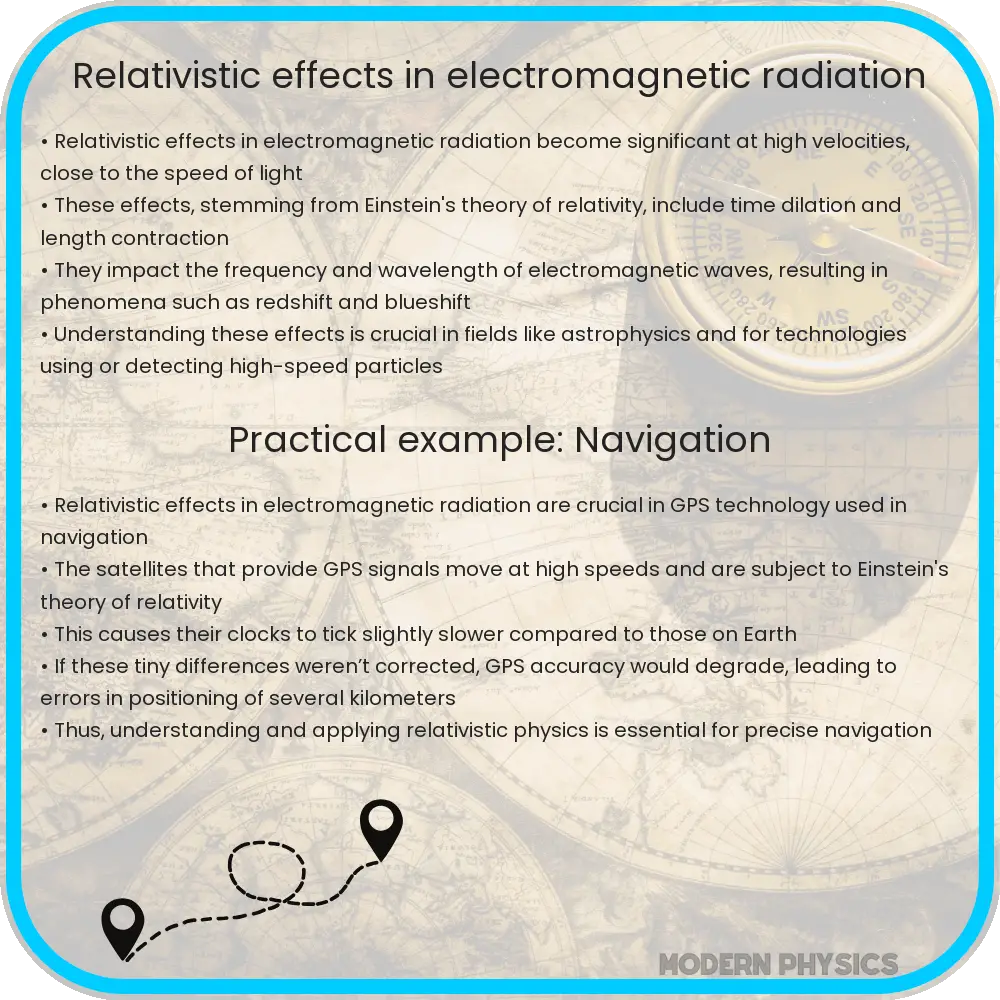
Understanding Relativistic Effects in Physics
Relativistic effects become significant when dealing with objects moving at speeds close to the speed of light, denoted as c. These effects, predicted by Einstein’s theory of relativity, have profound implications in various fields of physics, particularly in high-energy phenomena and astrophysics. This article delves into the core aspects of relativistic effects, focusing on their impact on speed, energy, and wavelength.
Impact on Speed: Time Dilation and Length Contraction
One of the most intriguing consequences of relativity is time dilation, where time appears to pass slower for an object moving at relativistic speeds compared to a stationary observer. This effect is described by the formula \( t’ = \frac{t}{\sqrt{1 – \frac{v^2}{c^2}}} \), where \( t’ \) is the time experienced by the moving object, \( t \) is the time observed by the stationary observer, and \( v \) is the velocity of the moving object. Additionally, length contraction occurs, where the length of an object in the direction of motion appears shorter to an outside observer. This phenomenon is quantified by \( L’ = L \sqrt{1 – \frac{v^2}{c^2}} \), with \( L’ \) being the contracted length and \( L \) the original length.
Energy Transformations at High Speeds
In the realm of relativistic speeds, the classical equation of kinetic energy, \( KE = \frac{1}{2}mv^2 \), becomes inadequate. Instead, the relativistic kinetic energy is given by \( KE = (\gamma – 1)mc^2 \), where \( \gamma = \frac{1}{\sqrt{1 – \frac{v^2}{c^2}}} \) is the Lorentz factor, and \( m \) is the mass of the object. This equation reveals that as the velocity of an object approaches the speed of light, its kinetic energy tends toward infinity, implying that no object with mass can reach or exceed the speed of light.
Wavelength Alterations Due to Relativistic Speeds
Relativistic speeds also significantly affect electromagnetic radiation, notably in the phenomenon of relativistic Doppler effect. This effect causes a shift in the wavelength of light emitted from a source moving relative to an observer. For a source moving away, the light is redshifted (increase in wavelength), while for a source approaching, the light is blueshifted (decrease in wavelength). The formula for this shift is \( \lambda’ = \lambda \sqrt{\frac{1 + \frac{v}{c}}{1 – \frac{v}{c}}} \), where \( \lambda’ \) is the observed wavelength, \( \lambda \) is the emitted wavelength, and \( v \) is the relative velocity between the source and the observer.
Is this conversation helpful so far?
Gravitational Effects in Relativity
Relativity also profoundly impacts our understanding of gravity. In Einstein’s general theory of relativity, gravity is not a force but a curvature of spacetime caused by mass. This curvature affects the path of objects, leading to what we perceive as gravitational attraction. The famous equation \( E = mc^2 \), where \( E \) is energy, \( m \) is mass, and \( c \) is the speed of light, implies that mass and energy are interchangeable. This principle is crucial in understanding the energy release in nuclear reactions and the behavior of massive celestial bodies like black holes.
Practical Applications of Relativistic Principles
Relativistic effects, though seemingly abstract, have practical applications. For instance, the Global Positioning System (GPS) must account for time dilation due to both the high speeds of satellites and the weaker gravitational field at their altitude compared to Earth’s surface. Without corrections based on relativity, GPS accuracy would deteriorate, leading to significant navigational errors within minutes. Similarly, particle accelerators like the Large Hadron Collider (LHC) must consider relativistic effects to accurately predict the behavior of particles moving at near-light speeds.
Challenges and Future Perspectives
While relativity has been immensely successful in explaining a wide range of phenomena, challenges remain. Integrating the theory of relativity with quantum mechanics, the physics of the very small, is one of the major unresolved issues in physics. This integration is necessary for a complete understanding of the fundamental forces of nature, especially at the incredibly high energies found in the early universe or inside black holes.
Conclusion
In conclusion, relativistic effects are not just theoretical curiosities but are essential for understanding the universe at both cosmological and subatomic scales. From altering our perception of time and space to enabling the precise operation of technology like GPS, the implications of relativity permeate through various scientific and practical domains. As we continue to explore the universe and delve deeper into the realms of high-energy physics, the principles of relativity will undoubtedly play a critical role in shaping our understanding of the cosmos and the fundamental laws that govern it.